HOUSEHOLD PLANNING · EMERGENCY SUPPLIES
How do I plan food supplies for a pet emergency kit?
Use an existing daily feeding amount and a locally appropriate planning period to check supplies, package information and the next replacement date.
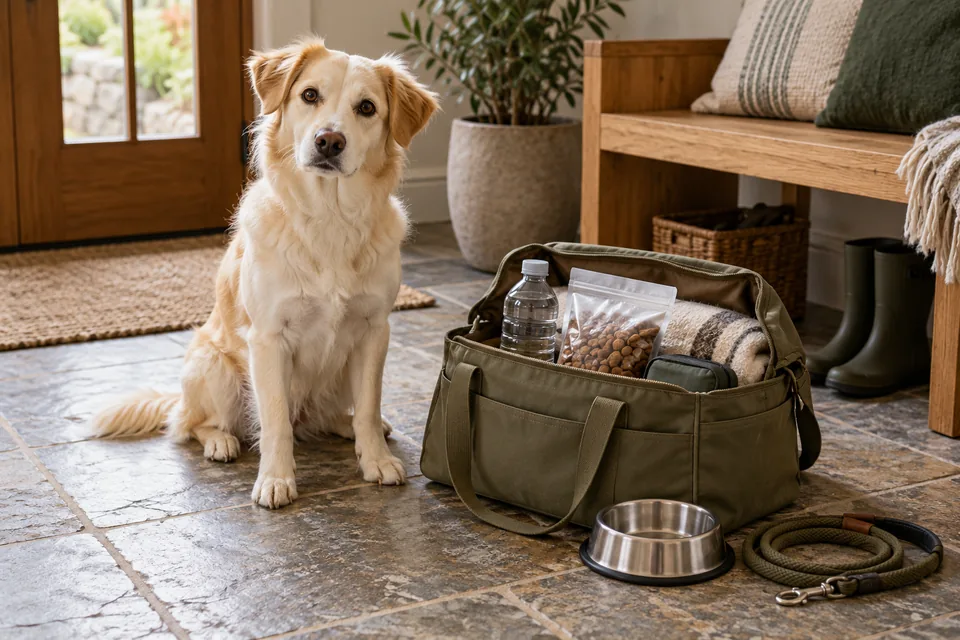
THE DIRECT ANSWER
Choose a preparation period using your local emergency guidance, then multiply each pet’s existing daily use of each food by that period. Keep foods identifiable, include the equipment and instructions needed to serve them, and plan when to check and replace supplies. Food quantity is only one part of a pet emergency kit; this calculation does not determine a ration, water requirement or complete evacuation plan.
Sources: North Carolina Emergency Management: Pets and Service Animals · Los Angeles County: Pet Disaster Supply Kits
Choose the planning period before doing the multiplication
Public preparedness instructions vary with place and context. On October 19, 2026, North Carolina Emergency Management’s page listed 3–7 days of food and water in its kit checklist and separately advised at least a week on hand. Los Angeles County’s pet-kit page listed 7–10 days. These are source-specific examples, not a universal duration chosen by PetCheck.
Use your current local authority’s advice and your household’s access and evacuation circumstances. The seven-day calculation below is an arithmetic example, not a claim that seven days will cover every disruption.
Decide where the reserve will be kept and how you could carry it. A heavy bag in a cupboard and a portable evacuation supply serve different practical needs. Count only food that will actually be available in the situation you are planning for.
Sources: North Carolina Emergency Management: Pets and Service Animals · Los Angeles County: Pet Disaster Supply Kits
Keep each pet and each recipe on its own line
Use the daily quantity from the plan already established for that pet. If it is in cups, first confirm the exact food’s grams per cup and cup definition. Do not substitute bowl capacity or body weight for daily food use.
For multiple foods, keep separate lines rather than adding grams of different recipes and treating them as interchangeable. The purpose is to pack enough of each existing food, not to create a new combined diet.
| Input | Record | Check |
|---|---|---|
| Pet and exact food | One pet/recipe combination per line | This is the food currently used in the plan |
| Existing daily use | Grams, cans or pouches per day with unit | Whole-day quantity, including all meals from that food |
| Planning period | Number of days and local guidance consulted | Do not silently change days between rows |
| Required quantity | Daily use × days | Convert units consistently before comparing packages |
| Usable supply packed | Quantity actually in the kit | Ordinary cupboard stock is not automatically part of it |
A fictional seven-day kit for two different foods
Imagine a dog whose established dry-food use is 180 g per day and a cat whose established plan uses two unopened 85 g pouches per day. These fictional amounts are not recommended portions. The household chooses seven days for this example.
The dog’s line is 180 × 7 = 1,260 g, or 1.26 kg. The cat’s line is 2 × 7 = 14 pouches, containing 1,190 g in total. The combined food mass is 2,450 g, but that combined figure cannot tell you whether the correct food for either pet is present.
If the kit currently contains 1,000 g of the dog’s food and ten of the cat’s pouches, the shortfalls are 260 g and four pouches. A spare 500 g bag of the dog’s food does not resolve the missing cat-food line. Check the planned quantity and the actual package choice separately.
| Food line | Seven-day requirement | Example shortfall |
|---|---|---|
| Dog’s dry recipe | 180 g × 7 = 1,260 g | 1,260 − 1,000 = 260 g |
| Cat’s 85 g pouches | 2 × 7 = 14 pouches | 14 − 10 = 4 pouches |
| Combined food mass | 1,260 + (14 × 85) = 2,450 g | Useful for carrying weight, not recipe substitution |
A packed quantity must also be usable
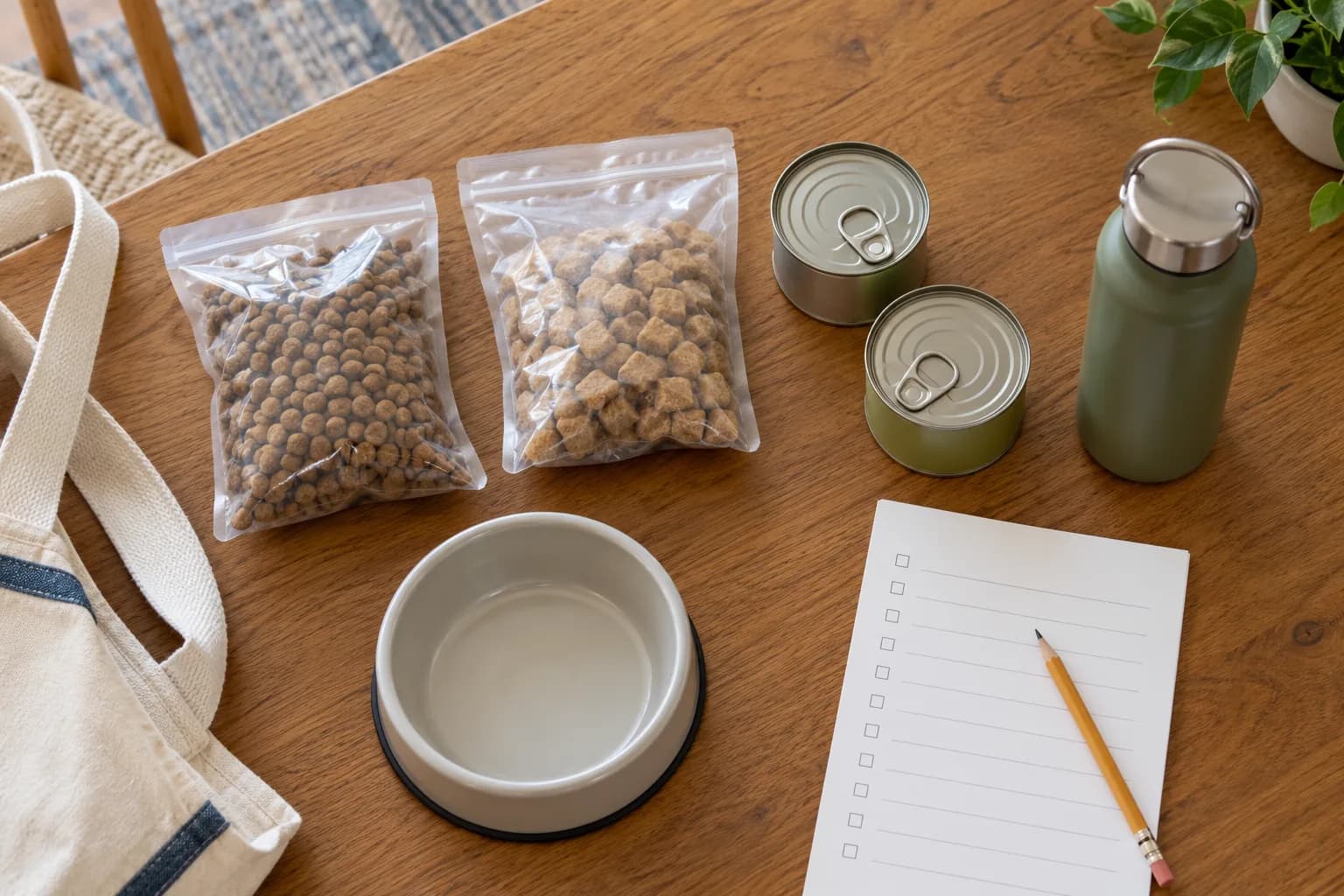
Include feeding dishes and any opener required by the actual cans, as the local kit guidance describes. Keep a written feeding schedule and veterinary contact information with the kit. Water, transport, identification and medical needs require their own planning; a correct food calculation cannot stand in for them.
Preserve original product, lot and date information. FDA recommends keeping dry food in its original package and storing dry food and unopened cans in a cool, dry place. A car that becomes hot is not automatically a suitable permanent storage place.
Consider what happens after a package is opened. If the usual food depends on refrigeration, ask the manufacturer and clinic how to plan for loss of refrigeration before an emergency. Do not assume a sealed bag, ice pack or large opened can will meet the food’s handling requirements.
Sources: Los Angeles County: Pet Disaster Supply Kits · FDA: storing pet food and treats
Give the reserve a replacement routine
Choose a review date that lets you act before relevant package limits. At that check, inspect the actual packages, confirm the recipe still matches the feeding plan and recount the quantity. A new diet, a second pet or food taken out of the kit can make an unchanged packing list inaccurate.
PetCheck’s editorial approach is to rotate usable supplies into the ordinary feeding routine while they remain appropriate, then replace the reserve. Do not replace the label date when you move a package or treat a scheduled check as proof of freshness. Follow product handling directions throughout.
The existing bag calculator can check how many days a dry-food amount covers at your established daily use. The food-supply review lets you choose your own recheck date. Neither tool inspects the kit, monitors food condition or replaces local emergency alerts.
- Every food line has a pet, recipe, daily amount and planning period.
- Usable quantities, package identities and dates are checked in the actual kit.
- Bowls, opening equipment, feeding instructions and contacts are accessible.
- Water, transport and medical planning have been addressed separately.
THE NEXT QUESTIONS
What else might you be wondering?
Should I feed less so the emergency supply lasts longer?
This planning calculation uses the existing feeding amount; it does not authorize ration reduction. If supplies are insufficient or the usual diet is unavailable, seek local assistance and veterinary advice about the individual pet’s needs.
Can I count the same bag as both household stock and a packed reserve?
Only count what will actually be available for the intended situation. If daily meals are being taken from it, update the remaining quantity; a full-bag number becomes stale as the bag is used.
Does this tell me how much water or medicine to pack?
No. Use current local preparedness guidance and your veterinarian’s instructions for those separate needs. The food example must not be converted into a medicine dose or a water prescription.
Sources: North Carolina Emergency Management: Pets and Service Animals · Los Angeles County: Pet Disaster Supply Kits
LOOK CLOSER AT THE EVIDENCE
Sources & what they establish
Official guidance, research findings and PetCheck’s practical interpretations have different roles. These notes explain how the sources were used.
Public preparedness guidance
Local authorities specify different supply periods
North Carolina and Los Angeles County include food, water and supporting pet-care supplies in their guidance.
Limit: Their listed periods are not a guarantee of disruption length and may not match your location.
Sources: North Carolina Emergency Management: Pets and Service Animals · Los Angeles County: Pet Disaster Supply Kits
Official food storage guidance
FDA: packaging and storage still matter
Supports retaining identifiers and following storage requirements.
Limit: No kit shelf life or emergency substitute diet is established here.
Sources: FDA: storing pet food and treats
Editorial arithmetic
Separate food lines prevent false totals
The fictional seven-day example shows requirements and shortfalls for two foods.
Limit: It is not an assessment of any animal or a complete disaster plan.
Sources checked 2026-10-19. Examples are fictional and illustrate reasoning, not patient outcomes. This is an editorial source review, not independent veterinary review. How we prepare these guides →
FOR ANOTHER VISIT
Keep this guide close.
Save it to read again, or copy a link to share.
ONE QUESTION CAN LEAD TO ANOTHER
A useful next read.
Choose the question that fits what you want to understand next.
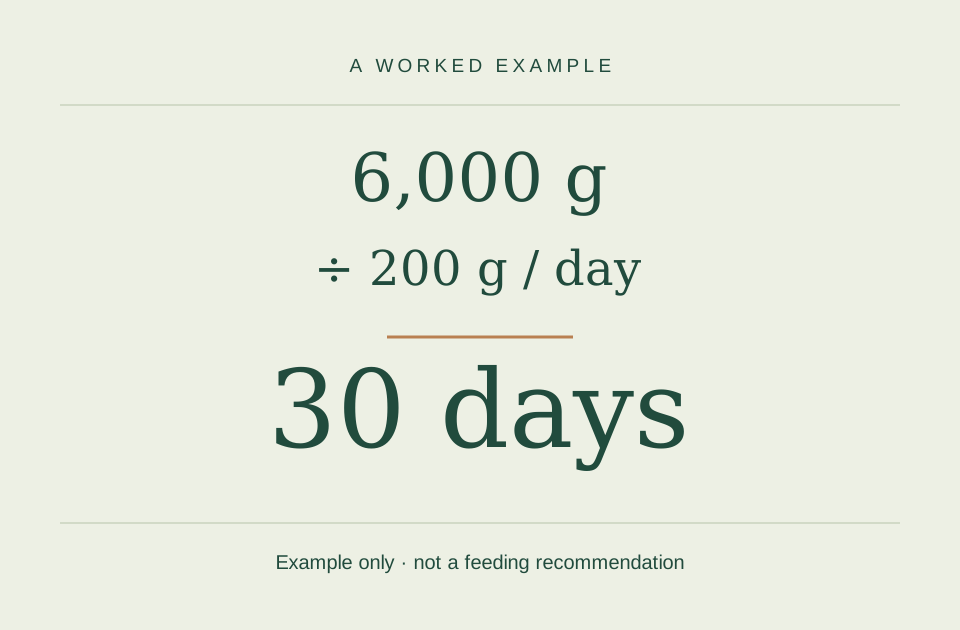 Worked arithmetic example
How long does a bag of dog food last?
Convert an established daily food amount into days of supply.
Read the guide AI-generated editorial scene
What feeding instructions should I leave a pet sitter?
Pack clear feeding instructions in case another person needs to provide the meals.
Read the guide