EVERYDAY CARE · THE HANDOFF
What feeding instructions should I leave a pet sitter?
Turn an existing feeding plan into a clear handoff: the right pet, exact food, daily total, each meal and a record of what actually happened.
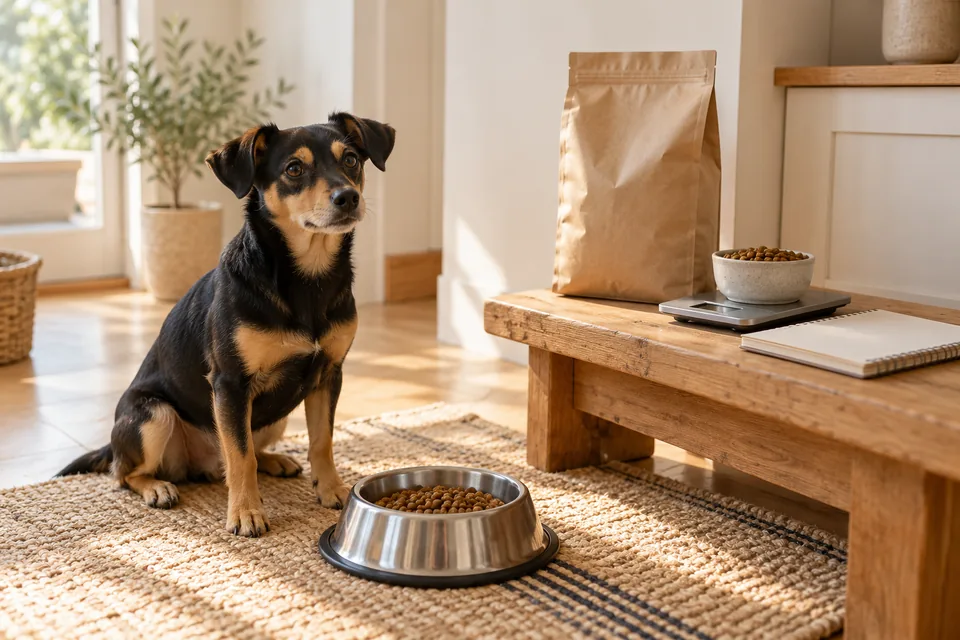
THE DIRECT ANSWER
Leave one written instruction for each pet: the exact food, the already agreed daily total, each meal’s amount and unit, meal times, and who to contact if something is unclear. Add a separate place to record meals actually offered. Before leaving, have the sitter explain one meal back to you using the real food and measuring equipment. This handoff communicates an existing plan; it does not choose a new ration or medicine dose.
Sources: AAHA: Preparing for the Unexpected—Essential Pet Sitter Instructions (2025)
A good handoff removes the need to guess
‘Give the usual scoop’ depends on knowledge that may leave the house with you. Which scoop, which food, and does ‘twice’ describe the daily amount or two full servings? The useful test is whether another person can perform the task without interpreting your habits.
AAHA’s sitter guidance recommends recording meal times and amounts, dietary restrictions, feeding locations and useful contacts. The worksheet below is PetCheck’s practical way to organize that information. It is a household communication aid, not a clinically validated form.
Use one current copy with a revision date. If you change an instruction by message, update the copy the sitter will actually read. An accurate new message does little good if an older note remains beside the food.
Sources: AAHA: Preparing for the Unexpected—Essential Pet Sitter Instructions (2025)
Write the plan with its units still attached
Fill these fields from the plan you already follow. Keep separate rows for different pets or different foods. A shared bag does not imply that every animal receives the same amount.
| Field | Write this | Check before leaving |
|---|---|---|
| Pet | Name and an identifying description or photo | The sitter can distinguish every animal. |
| Exact food | Brand, recipe, format and where it is kept | The actual package matches; similar-looking bags are separate. |
| Daily total | Existing whole-day quantity, with g or the defined cup unit | This is a daily total, not an amount at every meal. |
| Each meal | Time, quantity and unit for each serving | The servings add up to the stated daily total. |
| Method | Which measure to use; for grams, the agreed tare setup | The dish’s mass is not counted as food. |
| Extras and restrictions | Existing treat instructions and foods to avoid | Do not let ‘a little extra’ become an unwritten second plan. |
| Contacts | Owner, backup contact, usual clinic and emergency clinic | Numbers and locations are current and accessible offline. |
Sources: AAHA: Preparing for the Unexpected—Essential Pet Sitter Instructions (2025)
Fix the ambiguity before calculating supplies
The following quantities and food name are invented. They illustrate how to rewrite instructions, not how much any dog should eat. Imagine an existing plan for Milo using 180 g of ‘Example Recipe A dry food’ per day, split equally between two meals.
The weak note says ‘90 twice, food in cupboard.’ The revised note says ‘Milo only; Example Recipe A from the labelled bag; 180 g per day total: 90 g at 07:30 and 90 g at 18:30. Use grams and tare the empty bowl.’ The second note preserves the same plan while making the daily-versus-meal distinction visible.
For four complete days, 180 × 4 = 720 g from that bag. If the owner has already given the first morning meal, the sitter is responsible for seven remaining 90 g meals: 630 g. Count the handoff boundary rather than automatically multiplying every date on the calendar by a full day.
| Period | Responsibility | Food for this example |
|---|---|---|
| Day 1 breakfast | Owner already fed; record it as done | 90 g, outside the sitter’s remaining supply |
| Day 1 dinner through Day 4 dinner | Sitter: seven scheduled meals | 7 × 90 g = 630 g |
| After returning | Explicitly confirm the next meal’s owner | Do not feed again because the handoff is unclear |
Keep the instruction separate from the meal record
A schedule says what should happen. A completion record says what did happen. A tick next to ‘breakfast’ is only useful if everyone knows which pet and date it refers to. Record promptly after the event, not in advance.
Offering a meal is also different from watching it all being eaten. Write what you observed: ‘offered’, ‘some left’, or ‘not observed’. Do not turn an empty shared bowl into a precise intake measurement for one pet. If the pet will not eat or seems unwell, use the agreed clinic instructions and seek veterinary advice rather than improvising an extra portion or medication change.
| Date, pet and time | Action and person | Observation or follow-up |
|---|---|---|
| Day 2, Milo, 07:30 | 90 g offered; sitter initials | Some food left; owner informed according to the plan |
| Day 2, Milo, 18:30 | Fill in only after the meal | Do not pre-mark a planned meal as completed |
Rehearse one ordinary meal together
Walk through finding the bag, identifying the pet, measuring, serving and recording. Ask the sitter where a used bowl goes and where a clean one waits. If two pets eat separately, show the arrangement rather than relying on ‘they usually know their bowls’.
Medicines need their own veterinarian-provided directions, with the current label and a separate completion record. This food worksheet must not be used to calculate doses, replace a prescription or decide what to do after a missed dose. Clarify those questions with the clinic before the trip.
For the separate shopping task, the bag calculator uses an existing daily amount to estimate days of supply. It does not know which meals the owner already gave and does not monitor the sitter. Keep the trip’s actual meal count in your handoff note.
- The sitter can explain the daily total and each meal without prompting.
- Food identity, measuring method and last completed meal are clear.
- There is a reachable backup contact and a plan for uncertainty.
THE NEXT QUESTIONS
What else might you be wondering?
Can I just leave a photo of the scoop?
A photo can identify equipment but does not define its volume, how full it should be or the recipe’s grams per cup. Keep the written unit and amount, then demonstrate the agreed method.
Should I split the daily total evenly between meals?
Only if that is already the feeding plan. Copy the actual split rather than changing it for convenience. Ask the clinic about any unclear or prescribed schedule.
Sources: AAHA: individualized nutritional recommendations (2021)
What if two people might have fed the same meal?
Check the dated completion record and contact the people involved. If uncertainty remains, state it and ask the owner or clinic for instructions. A new tick cannot reconstruct an unobserved event.
LOOK CLOSER AT THE EVIDENCE
Sources & what they establish
Official guidance, research findings and PetCheck’s practical interpretations have different roles. These notes explain how the sources were used.
Veterinary organization guidance
AAHA: information a sitter needs
Supports communicating routines, meal details, restrictions and emergency contacts.
Limit: Does not approve a feeding amount for your pet or validate this worksheet.
Sources: AAHA: Preparing for the Unexpected—Essential Pet Sitter Instructions (2025) · AAHA: individualized nutritional recommendations (2021)
PetCheck editorial method
Plan, completion and observation are different records
The handoff table, read-back and seven-meal example make an existing instruction repeatable.
Limit: The household and quantities are fictional; no sitter or pet trial was conducted.
Sources checked 2026-10-19. Examples are fictional and illustrate reasoning, not patient outcomes. This is an editorial source review, not independent veterinary review. How we prepare these guides →
FOR ANOTHER VISIT
Keep this guide close.
Save it to read again, or copy a link to share.
ONE QUESTION CAN LEAD TO ANOTHER
A useful next read.
Choose the question that fits what you want to understand next.
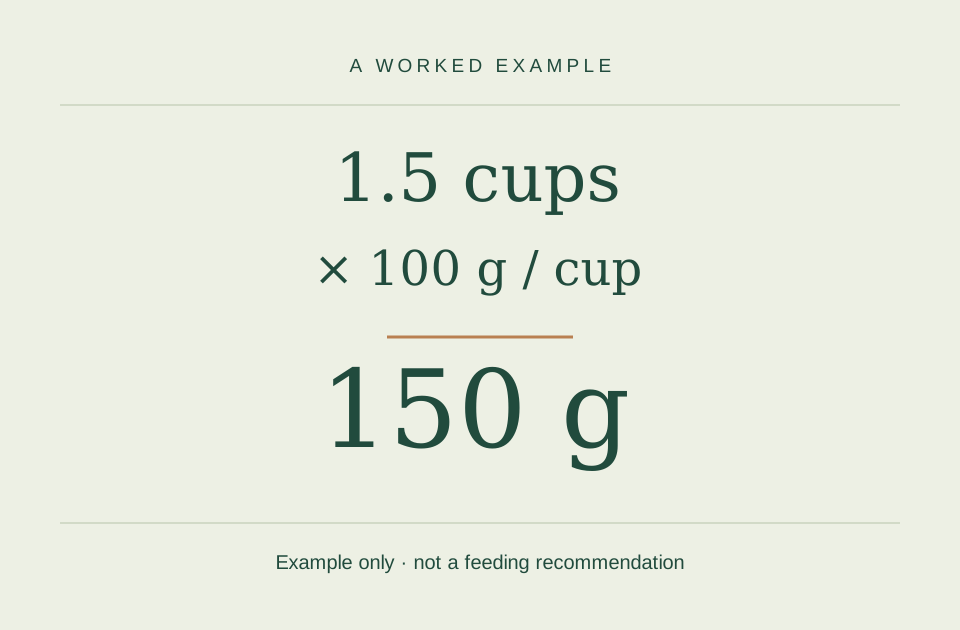 Worked arithmetic example
Should you measure dog food in cups or grams?
Make the food and measuring unit unambiguous before handing over the next meal.
Read the guide AI-generated editorial scene
How should I store opened wet cat food?
If wet food is part of the plan, distinguish the refrigerated remainder from food already served.
Read the guide