Food & measuring
Should you measure dog food in cups or grams?
Understand grams per cup, daily totals and the difference between measuring food and choosing a portion. Includes worked examples and a saved bag calculator.
THE DIRECT ANSWER
Use the units in your pet’s feeding plan and clarify any uncertainty with the clinic or manufacturer. Grams measure mass; cups measure volume. If the plan is in grams, a suitable scale measures that amount directly. Converting cups to grams requires the grams-per-cup value for the exact food—not a universal conversion.
Sources: AAHA: 2014 Weight Management Guidelines, measuring food (p. 4) · AAHA: individualized nutritional recommendations (2021)
A SMALL TOOL FOR YOUR NEXT REFILL
How long will this bag last?
Use the daily amount you already feed.
This calculates supply, not how much your pet should eat. Ask your veterinarian if the feeding amount is uncertain.
A CLEARER REFILL PLAN
Two amounts.
One useful estimate.
Enter the bag weight and current daily use, then calculate. If you use cups, add this food’s grams per cup.
Saved estimate
Checking for a saved estimate…
A REASON TO COME BACK
Choose a day to check your food supply.
Pick a day to look at the food you have left and revisit your estimate. You choose the date; the calculator does not predict when to reorder.
Open the .ics file in your calendar and set any alerts there. PetCheck sends no email or push notification. Changing or removing this date does not update an imported event. Save keeps one date on this browser; clearing browser data removes it.
My saved check-in →Loading your check-in…
“How much?” and “How do I measure it?” are different questions
A feeding plan identifies the amount appropriate to the individual pet. A measuring method helps you offer that amount consistently. Switching from a cup to a scale changes the measuring method; it does not by itself tell you to increase or reduce the portion.
AAHA describes nutritional recommendations as individualized and based on assessment. Its weight-management guidance also notes that cup measures can be imprecise, particularly for small amounts. These are reasons to clarify the plan and measurement, not to copy a quantity from another animal.
PetCheck’s practical starting point is a short written instruction: the exact food, the total daily amount, the unit and how that total is split. If two people feed the pet, both should be able to interpret the same instruction.
Sources: AAHA: individualized nutritional recommendations (2021) · AAHA: 2014 Weight Management Guidelines, measuring food (p. 4)
Check what the number actually describes
A label can place several kinds of numbers close together. A food’s grams per cup, a bowl’s fluid-ounce capacity, calories per cup and a recommended feeding amount answer different questions. Keep the unit attached when you copy a number.
For cup-based arithmetic, the cup definition must match the manufacturer’s conversion. A household mug or a scoop of unknown volume is not automatically the same measure. If the correct conversion is unavailable, ask the manufacturer or use the gram amount in the feeding plan rather than guessing.
| Quantity | What it describes | What it does not establish |
|---|---|---|
| Grams per cup | Mass of this food in the stated cup measure | A universal value for all kibble |
| Cups per day | Volume used across the whole day | The amount at each meal unless specified |
| Grams per day | Total mass used across the whole day | Calories without the food’s energy information |
| Bowl capacity | How much the bowl can hold | How much your pet should eat |
Follow one conversion from cup to daily total
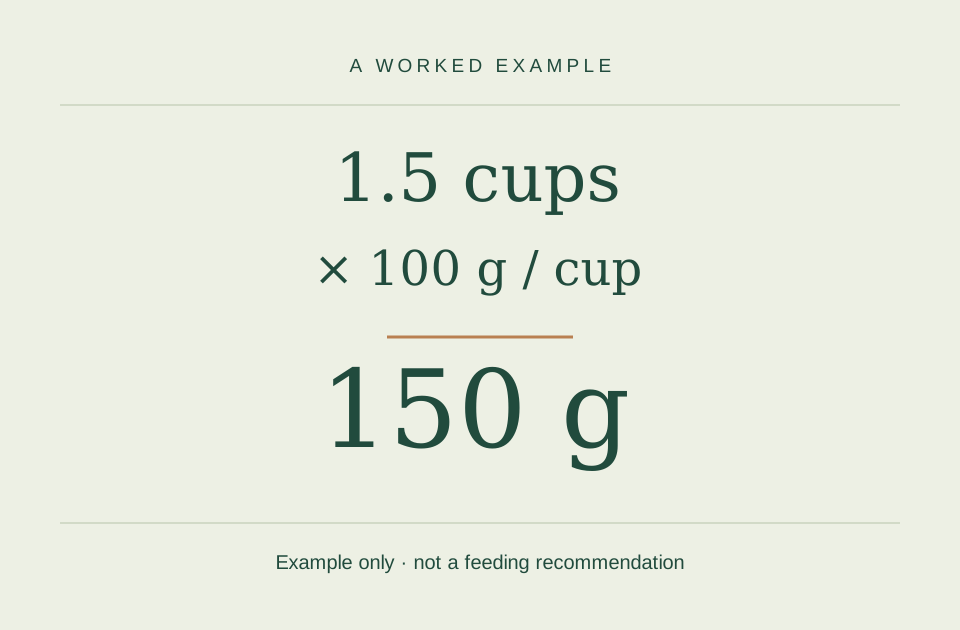
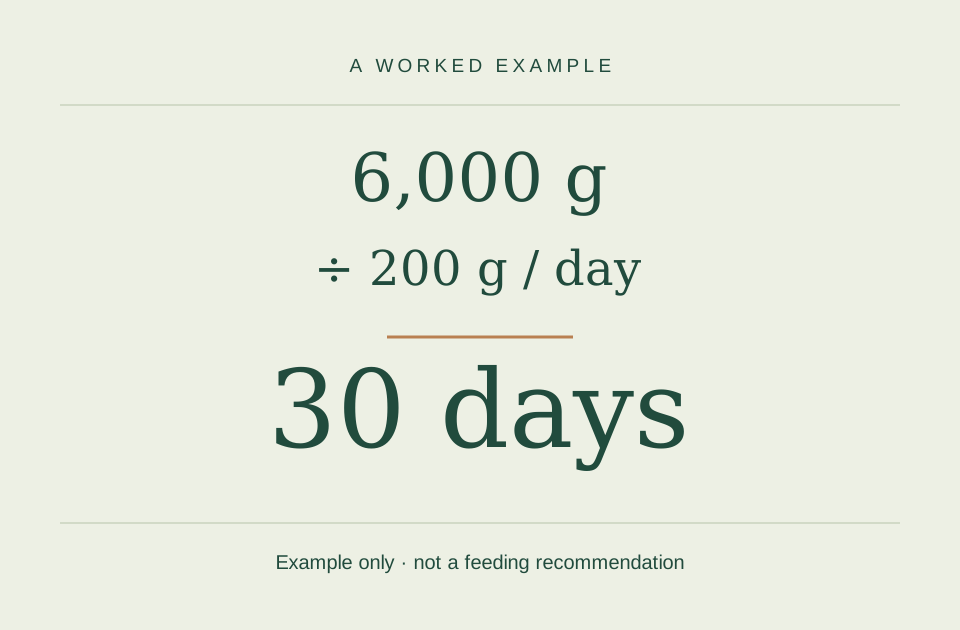
Suppose a fictional recipe is listed as 100 g per cup and an existing plan uses 1.5 cups over the whole day. Multiplying 1.5 by 100 gives 150 g per day. Dividing a fictional 3,000 g bag by 150 gives 20 days of supply. Neither the recipe value nor the portion is a recommendation.
If “1.5 cups” meant each of two meals instead, the daily total would be three cups. The same bag would then cover half as many days. That difference comes from the meaning of “per meal” and “per day,” not from the calculator.
Change the recipe and you must check the conversion again. Carrying a saved grams-per-cup value into a different food silently changes the calculation. Our saved estimate stays editable so you can replace the old value before using it for another bag.
Make the instruction easy to repeat at home
For a gram-based amount, follow the scale’s instructions: place it on the specified surface, choose grams, put the empty food dish on it and use tare to exclude the dish’s weight before adding food. Check that its capacity and displayed increments are suitable for the task. These are practical measuring steps, not a recommendation for a particular scale.
If you already own a suitable scale, try that setup before buying another one. A larger or more expensive bowl does not make a portion more accurate. A bowl’s capacity should never become the feeding instruction.
At the next food change, keep the amount and units explicit. Our bag calculator can help with the separate shopping question of how long the supply lasts. It does not calculate calories, a weight-loss plan or a new daily ration.
- The food and recipe match the conversion I am using.
- I distinguished a whole-day amount from an amount per meal.
- I excluded the dish’s weight when using a scale.
- Other people feeding the pet can follow the same written instruction.
THE NEXT QUESTIONS
What else might you be wondering?
Is one cup of dog food always the same number of grams?
No. A volume-to-mass conversion depends on the food and the defined cup measure. Use the exact recipe’s information rather than copying a number from another product.
Can I enter ½ cup in the calculator?
Enter 0.5 with a decimal point, not a decimal comma. Add all meals from the same bag to get the daily total, and supply the recipe’s grams per cup.
Will a scale tell me the right feeding amount?
A scale measures mass. It cannot assess the pet or choose an appropriate diet or portion. Clarify the amount with your veterinarian if it is uncertain.
Sources: AAHA: individualized nutritional recommendations (2021)
LOOK CLOSER AT THE EVIDENCE
Sources & what they establish
Official guidance, research findings and PetCheck’s practical interpretations have different roles. These notes explain how the sources were used.
VETERINARY GUIDANCE
Measurement and nutritional assessment have different roles
AAHA’s 2014 weight-management guidance supports weighing dry food where possible. Its 2021 nutrition guidance emphasizes individualized recommendations. The examples here explain units and arithmetic.
Limit: The examples are not meal plans. PetCheck has not measured the precision of your cup or scale and has not assessed your pet.
Sources: AAHA: 2014 Weight Management Guidelines, measuring food (p. 4) · AAHA: individualized nutritional recommendations (2021)
Sources checked 2026-10-01. Examples are fictional and illustrate reasoning, not patient outcomes. This is an editorial source review, not independent veterinary review. How we prepare these guides →
PUT THIS GUIDE TO USE
Turn daily cups into a supply estimate.
Bring the bag weight, the grams-per-cup value for your exact food and the daily cups already chosen for your pet. Calculate days of supply without choosing a new feeding amount.
Calculate supply from cupsKeep the guide for another visit, too.
ONE QUESTION CAN LEAD TO ANOTHER
A useful next read.
Choose the question that fits what you want to understand next.
 Worked arithmetic example
How long does a bag of dog food last?
Use the daily amount for the separate question of how long your bag lasts.
Read the guide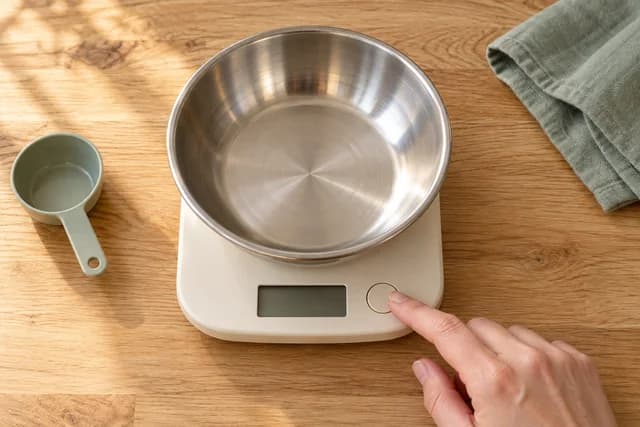 AI-generated editorial scene
Kitchen scales for pet food: compare display & controls
Check the display, tare controls and bowl space before choosing a food scale.
Explore the buying guide