CAT FOOD · AFTER OPENING
How should I store opened wet cat food?
Separate food kept for later from food already served. Check product-specific storage instructions, keep a useful opening note and make the next bowl easy to prepare.
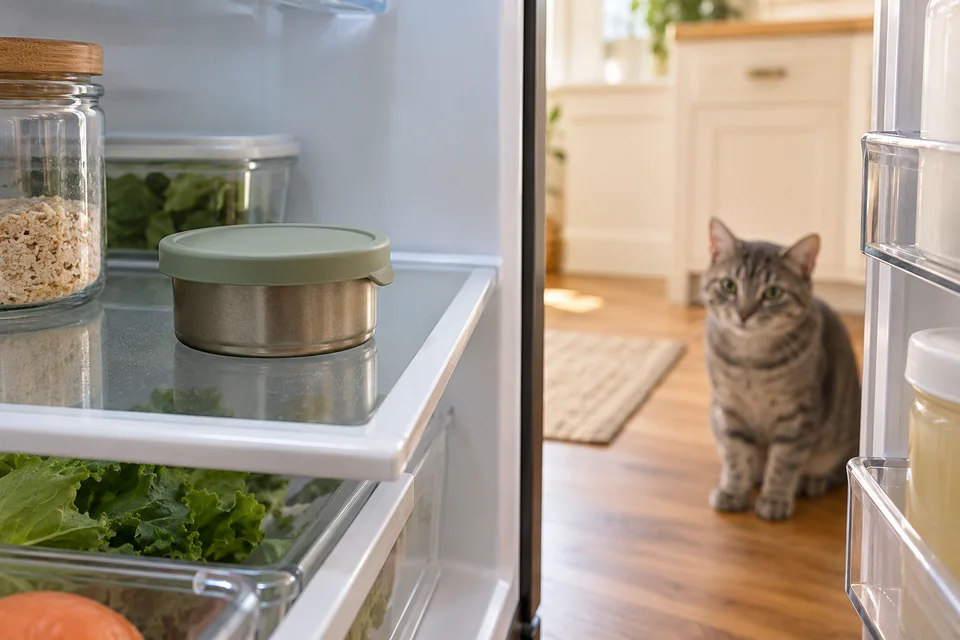
THE DIRECT ANSWER
Cover and promptly refrigerate the part of an opened can or pouch you are keeping for later, following the exact product’s instructions. FDA guidance sets the refrigerator at 40°F or below (about 4°C). Food already served in a bowl has a different handling history. Record when the package was opened and when food was served; there is no single refrigerated shelf life that applies to every wet cat food.
Sources: FDA: storing pet food and treats · Purina US: cat food storage · Hill’s US: pet food storage tips
Start with which food you mean
‘There is half a can left’ leaves out the most useful detail: where has that food been? A covered remainder put away at opening is not the same record as food collected from a feeding bowl later. Before looking for a number of days, identify the situation.
This guide concerns commercially prepared, shelf-stable canned or pouched cat food. Fresh refrigerated, raw, frozen and reconstituted products need their own instructions. A shelf-stable package also stops being an unopened pantry item once its seal is broken.
| Situation | What matters | Practical next step |
|---|---|---|
| Unopened shelf-stable package | Intact packaging, label date and storage directions | Keep it in its specified cool, dry storage. A distant best-by date does not compensate for damaged packaging. |
| Opened, but this part has not been served | Opening time, prompt refrigeration and the exact food’s after-opening instructions | Cover and refrigerate the reserved portion. Keep the original product and batch details with it. |
| Food already offered in a bowl | When it was served and the conditions while it was out | Use the product’s served-food guidance. Do not treat this as an untouched refrigerated remainder. |
| Opening or storage history unknown | A missing time, an unlabelled container or uncertainty about refrigeration | Do not invent a new opening time. Our conservative household approach is to discard it rather than guess. |
Sources: FDA: storing pet food and treats · Purina US: cat food storage
Why three days and seven days are not interchangeable answers
Manufacturer advice must stay attached to the manufacturer and product it describes. The examples below were checked on October 18, 2026. They show why choosing the longest number from a search result is a poor way to manage a different food.
For example, Purina’s US storage page gives a three-day refrigerated window and says to discard wet food left in the bowl for more than an hour. Hill’s US page discusses a maximum of five to seven days for opened cans of its foods. These are published instructions, not results of PetCheck testing.
| Source | What it says about opened food | How to use it |
|---|---|---|
| FDA general guidance | Prompt refrigeration or disposal; refrigerator at 40°F or below | Use the general handling baseline, then check the exact food’s after-opening directions. |
| Purina US storage guide | Sealed and refrigerated wet food: within three days | Do not transfer this number automatically to another brand or a food with different label instructions. |
| Hill’s US storage guide | Opened cans: maximum five to seven days; its page lists 40–45°F | This concerns Hill’s foods. Keep the FDA’s 40°F-or-below baseline; 40°F is the overlap, not a reason to turn a fridge up to 45°F. |
- Read the package for your exact recipe, format and country of purchase.
- If the package and a general brand webpage differ, ask the manufacturer which instruction applies; do not extend storage by selecting the longer window.
- If directions are missing, ask about both the refrigerated remainder and food already served. Those are two different questions.
Sources: FDA: storing pet food and treats · Purina US: cat food storage · Hill’s US: pet food storage tips
Leave a note that another person can use
A note should answer the question without requiring someone to remember yesterday’s breakfast. Keep the information on the package or beside the covered portion. If you move the food into another suitable container, retain the original packaging details so the new container is still identifiable.
Opening time and a product-specific use-by instruction are separate fields. ‘Opened Sunday morning’ is an observation. ‘Use within the manufacturer’s stated window’ is an instruction. Recording both prevents a fresh container or a fresh handwritten date from making old food appear newly opened.
| Field | What to record | What to avoid |
|---|---|---|
| Food identity | Brand, exact recipe and package size; retain lot and label details | ‘The cat food’ when two foods are in the fridge |
| Opened | Actual date and time the seal was broken | Replacing the opening date after each meal |
| Put away | When the reserved portion went into the refrigerator | Assuming ‘cold now’ explains where it was earlier |
| Product instruction | The after-opening limit from the label or manufacturer | Borrowing a longer limit from an unrelated product |
| Served separately | Meal time and the bowl’s outcome, if another person needs to know | Adding bowl leftovers back into the reserved-food total |
Sources: FDA: storing pet food and treats
A fictional morning: 55 g in the fridge is not 63 g
Consider an invented household using an 85 g can. Its existing feeding plan calls for a 30 g serving at this meal. These numbers demonstrate record-keeping only; they are not a recommended portion, daily intake or diet for a cat.
At 07:30, the owner opens the can, puts 30 g into a clean bowl and promptly covers and refrigerates the remaining 55 g. At 07:50, they collect the bowl and observe 8 g left. In this example they choose to discard that served remainder. The amount reserved in the refrigerator remains 55 g, not 63 g.
The distinction is useful even when nobody weighs every leftover. Write ‘reserved can in fridge’ and ‘served bowl discarded’ as separate events. The twenty-minute collection in this example is a household choice, not a new food-safety threshold.
| Event | Quantity record | What the next person knows |
|---|---|---|
| Can opened and meal served | 85 g − 30 g = 55 g reserved | The opening and refrigeration note belongs to this remainder. |
| Bowl collected | 8 g of the served food discarded | It is not added back to the reserved portion. |
| Later 30 g serving, if storage checks still pass | 55 g − 30 g = 25 g reserved | The original opening time still applies to the 25 g. |
Finish the meal by preparing the next clean bowl
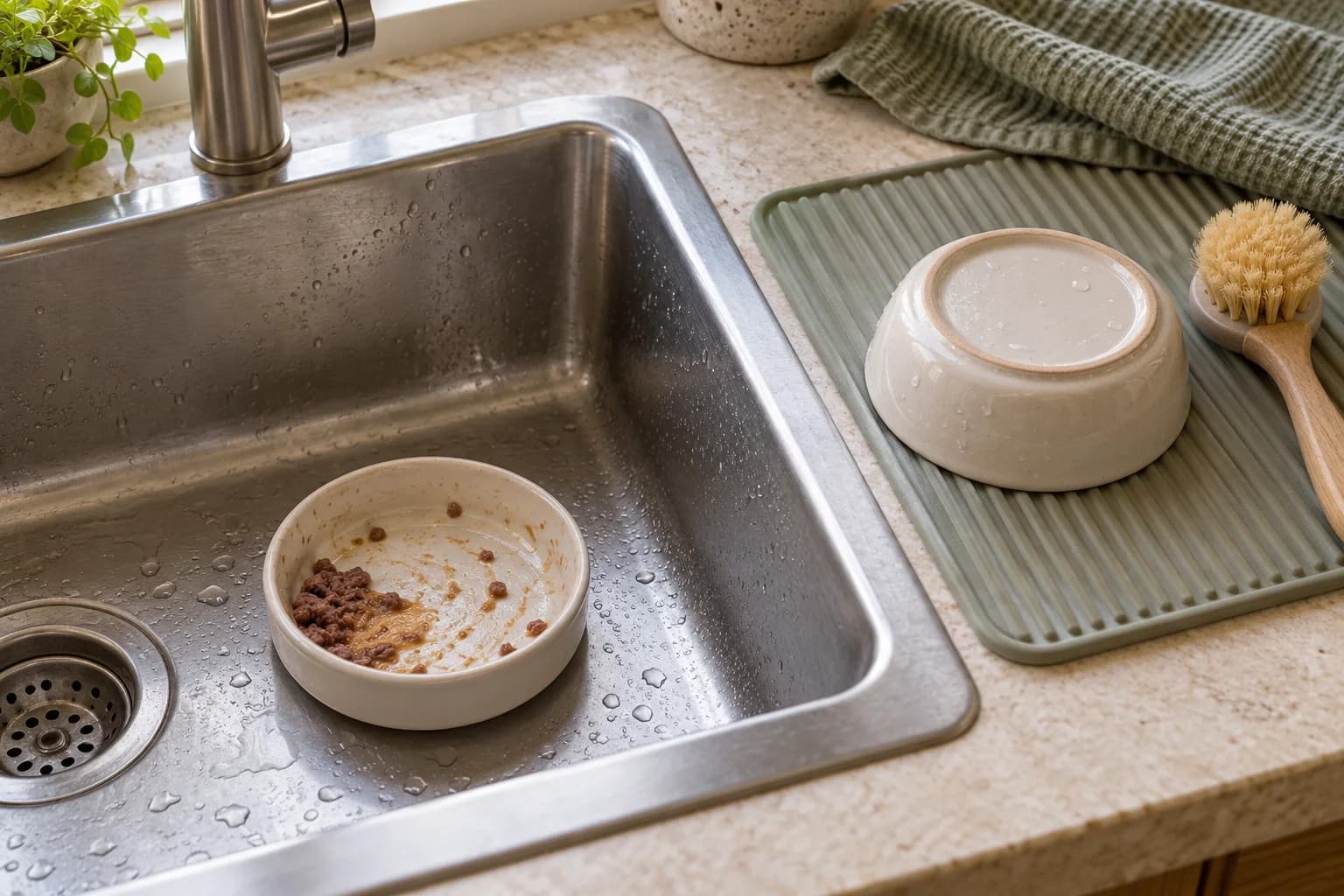
CDC recommends cleaning wet-food bowls after every use. Wash with soap or detergent and warm water, scrub, rinse and dry; follow the bowl’s care instructions. Keep the washing area clean. When using a disinfectant, follow its label and keep pets away until the area is safe for use. Cleaning a bowl and keeping food correctly are separate jobs.
A practical arrangement is to decide where the used bowl goes and where a clean, dry one waits. A spare bowl can make that handoff easier, but you do not need to buy a new set to start. Avoid leaving the next meal dependent on someone remembering which bowl was washed.
The existing bowl-care guide lets you build and save a washing routine on this browser. It does not store a can’s opening time, monitor fridge temperature or send a food-expiry alert. Keep those food-specific notes with the package.
Ask a precise question when the label does not settle it
A useful manufacturer enquiry identifies the food and the uncertainty: ‘I have this recipe in this pouch size, purchased in this country. What is its refrigerated limit after opening, and what do you advise for food already served?’ This is easier to answer than ‘How long does cat food last?’
Include what you actually know about opening, refrigeration and time out of the fridge. Do not fill a gap with an estimate presented as fact. If leftovers are a recurring problem, compare available package sizes against the feeding plan you already follow; do not increase meals simply to finish a can.
- Can everyone identify the opened food and find its original opening note?
- Is the refrigerated reserve clearly separate from food already served?
- Is the next bowl clean, dry and ready before food is taken out?
THE NEXT QUESTIONS
What else might you be wondering?
Does a lid make an opened can safe on the counter?
A cover is not refrigeration. Follow the prompt-storage step and the product’s instructions; do not substitute a tightly closed lid for putting the reserved food away.
Sources: FDA: storing pet food and treats
Does the printed best-by date still tell me when to finish an opened can?
Purina distinguishes its unopened-package date from the shorter after-opening instructions. Keep your opening note alongside the original label; the printed date does not record when your household broke the seal.
Sources: Purina US: cat food storage
What if the food looks normal but I cannot remember when it was opened?
Appearance cannot reconstruct a missing opening or refrigeration record. Our conservative editorial recommendation is to discard an untraceable remainder rather than assign it a fresh starting date. A new note helps with the next package, not the unknown history of this one.
Can I freeze leftovers or warm the whole can for each meal?
Ask about your exact food before adding freezing or warming to the routine. Hill’s cautions that freezing its canned foods can change texture and taste. This guide does not establish a freezing life, microwave time or safe repeated warming cycle; a refrigerator window is not evidence for any of those practices.
Sources: Hill’s US: pet food storage tips
LOOK CLOSER AT THE EVIDENCE
Sources & what they establish
Official guidance, research findings and PetCheck’s practical interpretations have different roles. These notes explain how the sources were used.
Official handling guidance
FDA: storage and identification
Supports refrigeration and preserving package information.
Limit: Does not supply one after-opening day limit for all wet foods or validate an individual leftover.
Sources: FDA: storing pet food and treats
Manufacturer guidance
Purina US and Hill’s US: different published windows
Their pages distinguish refrigerated opened food from other storage situations. The comparison keeps each instruction attached to its source.
Limit: Brand-level pages are not interchangeable product labels. Different markets or products may carry different instructions. No comparative shelf-life experiment was conducted.
Sources: Purina US: cat food storage · Hill’s US: pet food storage tips
Public-health guidance
CDC: the used bowl and washing area
Supports the wet-food bowl-cleaning schedule and cleaning method described above.
Limit: Does not determine how long a particular opened food can be kept.
PetCheck editorial reasoning
Separate records for reserved and served food
The four-situation table, handoff fields and fictional 85 g example organize the household decision. Discarding an unknown-history remainder is our conservative approach.
Limit: These are editorial aids, not observed household results, a storage trial or an individualized nutrition plan.
Sources checked 2026-10-18. Examples are fictional and illustrate reasoning, not patient outcomes. This is an editorial source review, not independent veterinary review. How we prepare these guides →
FOR ANOTHER VISIT
Keep this guide close.
Save it to read again, or copy a link to share.
ONE QUESTION CAN LEAD TO ANOTHER
A useful next read.
Choose the question that fits what you want to understand next.
 AI-generated editorial scene
How often should you clean pet bowls?
Put the used wet-food bowl into a washing routine you can save and repeat.
Read the guide AI-generated editorial scene
How should you store dry pet food?
If you also serve dry food, keep its bag and storage routine separate from opened wet food.
Read the guide