Food & refill planning
How long does a bag of dog food last?
Calculate a dry-food bag’s coverage from its weight and your current daily use. Save the estimate, then check storage before your next refill.
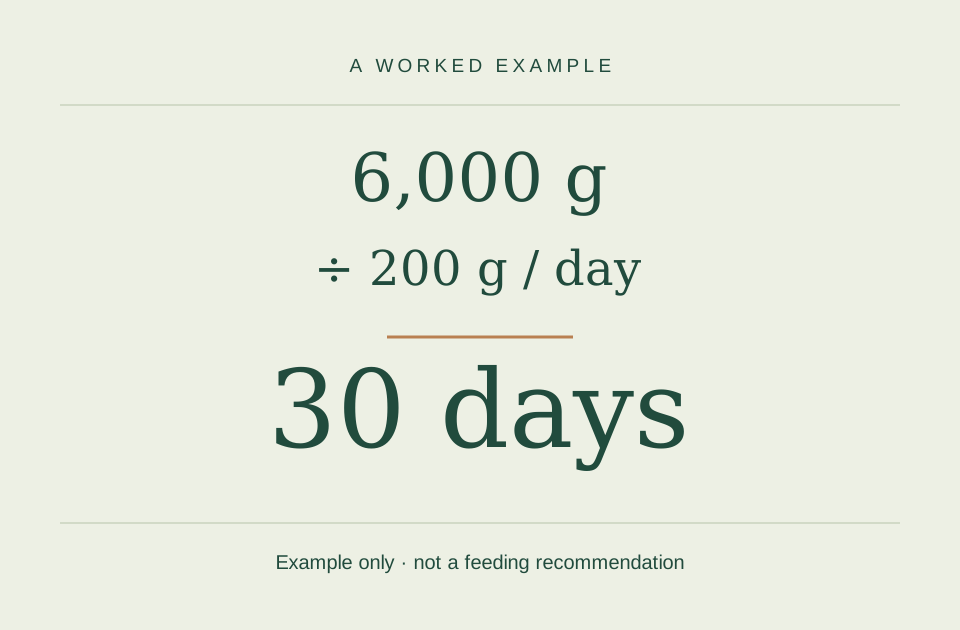
THE DIRECT ANSWER
Divide the food’s weight in grams by the grams used each day. A 6 kg bag contains 6,000 g; at an illustrative 200 g per day, it covers 30 days. Your result depends on your actual daily use. This estimates supply, not a recommended portion, an expiry date or how long an opened bag stays fresh.
A SMALL TOOL FOR YOUR NEXT REFILL
How long will this bag last?
Use the daily amount you already feed.
This calculates supply, not how much your pet should eat. Ask your veterinarian if the feeding amount is uncertain.
A CLEARER REFILL PLAN
Two amounts.
One useful estimate.
Enter the bag weight and current daily use, then calculate. If you use cups, add this food’s grams per cup.
Saved estimate
Checking for a saved estimate…
A REASON TO COME BACK
Choose a day to check your food supply.
Pick a day to look at the food you have left and revisit your estimate. You choose the date; the calculator does not predict when to reorder.
Open the .ics file in your calendar and set any alerts there. PetCheck sends no email or push notification. Changing or removing this date does not update an imported event. Save keeps one date on this browser; clearing browser data removes it.
My saved check-in →Loading your check-in…
Put both amounts in the same units
A bag label tells you how much food was packed. Your feeding routine tells you how much of that food leaves the bag each day. To compare them, convert the bag weight to grams and divide by the combined daily grams. One kilogram is 1,000 grams; one pound is 453.59237 grams.
If you feed twice a day, add both meals before dividing. If two pets use the same bag, add the amounts taken from that bag for both. Food taken from a different bag does not belong in this inventory calculation. This arithmetic does not decide whether any individual feeding amount is appropriate.
| Food in bag | Daily use entered | Estimated coverage |
|---|---|---|
| 3 kg = 3,000 g | 150 g/day | 20 days |
| 6 kg = 6,000 g | 200 g/day | 30 days |
| 12 lb ≈ 5,443 g | 180 g/day | About 30.2 days |
Using cups? Bring the food’s own conversion
A cup measures volume; a gram measures mass. You cannot convert between them without information about the food being measured. Check the exact recipe’s grams-per-cup information with the manufacturer. Do not use the weight of a cup of water or a conversion copied from another kibble.
For an arithmetic example, 1.5 cups per day multiplied by 100 g per cup equals 150 g per day. The 100 g figure here is invented to show the calculation. Our calculator leaves that field empty until you supply the value for your own food.
Knowing a conversion does not make an uneven scoop precise. When the portion is specified in grams, AAHA’s weight-management guidance notes the limitations of cups and recommends weighing dry food when possible. Ask the clinic to clarify an uncertain amount instead of adjusting it to fit a desired shopping schedule.
Sources: AAHA: 2014 Weight Management Guidelines, measuring food (p. 4)
Why the next bag may last a different number of days
The estimate assumes daily use stays constant and all the entered food is available. A spilled scoop, an additional animal eating from the bag, food used for training, or a change in routine can alter the actual finish date. The result cannot see these events.
Saving an estimate keeps the numbers you entered. It does not subtract food automatically or claim to know what remains today. Reopen it when the bag size, recipe or daily use changes. For an opened bag, weigh the remaining food separately if you want a new estimate for the remaining quantity.
Use the number to ask a better buying question
A larger bag may cover more days, but that does not establish that it is the right purchase. Compare the manufacturer’s storage and post-opening instructions with your actual use. A long calculated supply is not a shelf-life guarantee, and a bigger container does not extend a food’s stated life.
FDA recommends preserving the original bag and batch information and, when using another container, placing the whole bag inside it when possible. Keep dry food in appropriate cool, dry storage and wash and dry the container between bags.
PetCheck’s practical comparison: check the bag’s width and height against the container’s opening and internal space, then check the room needed to open its lid at home. Weight capacity alone cannot answer these fit questions. Use the linked storage guide when there is a specific problem to solve; keep a suitable existing setup.
Choosing a larger bag? Compare cost, supply and storage together →
- I used the current daily amount from this bag, including all its uses.
- I checked this recipe’s grams-per-cup value if using cups.
- I will recheck storage instructions separately from the supply estimate.
- I know the original bag and batch label will stay identifiable.
Sources: FDA: storing pet food and treats
THE NEXT QUESTIONS
What else might you be wondering?
Can I use this for dry cat food?
Yes. The division works for a dry-food quantity and a known daily amount regardless of whether it is dog or cat food. It does not choose the cat’s portion or assess a diet.
Does “30 days” mean the food is fresh for 30 days?
No. It means the entered quantity divided by the entered daily use equals 30. Follow the food manufacturer’s storage and post-opening instructions; the calculator does not assess freshness.
Should I reduce a portion to make the bag last longer?
A supply estimate is not a reason to reduce food. Nutritional needs require an individual assessment; ask your veterinarian about the feeding plan if cost or supply is a concern.
Sources: AAHA: individualized nutritional recommendations (2021)
LOOK CLOSER AT THE EVIDENCE
Sources & what they establish
Official guidance, research findings and PetCheck’s practical interpretations have different roles. These notes explain how the sources were used.
ARITHMETIC & PUBLIC GUIDANCE
A transparent calculation, with separate storage checks
The estimate uses weight divided by daily use. FDA informs the storage discussion; AAHA informs the distinction between measuring an amount and choosing a feeding plan.
Limit: No product was tested. The calculator cannot assess nutrition, contamination, freshness or actual remaining stock.
Sources: FDA: storing pet food and treats · AAHA: individualized nutritional recommendations (2021) · AAHA: 2014 Weight Management Guidelines, measuring food (p. 4)
Sources checked 2026-10-01. Examples are fictional and illustrate reasoning, not patient outcomes. This is an editorial source review, not independent veterinary review. How we prepare these guides →
PUT THIS GUIDE TO USE
Put your own bag into the calculation.
Use the bag weight and the daily amount you already feed. Calculate the days of supply, then save the estimate if you want to return to it.
Use the bag calculatorKeep the guide for another visit, too.
ONE QUESTION CAN LEAD TO ANOTHER
A useful next read.
Choose the question that fits what you want to understand next.
 AI-generated editorial scene
How often should I schedule dog food delivery?
Connect your remaining supply to the next order, estimated arrival and ongoing delivery interval.
Read the guide AI-generated editorial scene
Is a bigger bag of dog food better value?
Put the days of supply beside the unit price, total amount to pay and storage fit before choosing a bag size.
Read the guide