FOOD LABELS · UNDERSTAND THE UNITS
What do kcal/kg and kcal/cup mean on pet food labels?
Read energy density without confusing it with a feeding recommendation. Follow a fictional label through grams, cups and an existing daily amount.
THE DIRECT ANSWER
kcal/kg describes the food’s energy per kilogram; kcal/cup describes energy in the stated cup measure of that exact food. Neither number is a daily feeding recommendation. To connect them, you need that recipe’s grams per cup: kcal/kg ÷ 1,000 × grams per cup = kcal/cup. Use the label’s values and clarify missing or inconsistent information with the manufacturer.
Sources: AAFCO: Understanding Pet Food—Calories · AAFCO: Calorie Content and unit conversions
Read the denominator as carefully as the number
A food calorie on a nutrition label is a kilocalorie, abbreviated kcal. AAFCO explains calorie statements using both a food-mass basis and a familiar unit such as a cup or can. ‘Per’ tells you what amount of food the energy number describes.
Keep energy density, the weight of a cup and the pet’s daily amount on separate lines. Confusing those lines can turn an otherwise correct multiplication into the wrong answer. A scale can supply a mass measurement; it cannot tell you the pet’s energy requirement.
| Quantity | Meaning | Not the same as |
|---|---|---|
| kcal/kg | Energy in 1,000 g of this food | The pet’s daily calorie target |
| g/cup | Mass in the specified cup measure of this recipe | A universal weight for every kibble |
| kcal/cup | Energy in that cup of this recipe | Calories in any household mug |
| g/day or cups/day | Amount in an existing daily feeding plan | The food’s energy density |
Sources: AAFCO: Understanding Pet Food—Calories · AAFCO: Calorie Content and unit conversions
Work through one invented label in both directions
Assume a fictional dry recipe lists 3,600 kcal/kg and 100 g per defined cup. Dividing 3,600 by 1,000 gives 3.6 kcal/g. Multiplying 3.6 by 100 gives 360 kcal/cup. These are invented label values for arithmetic, not the analysis of a named product.
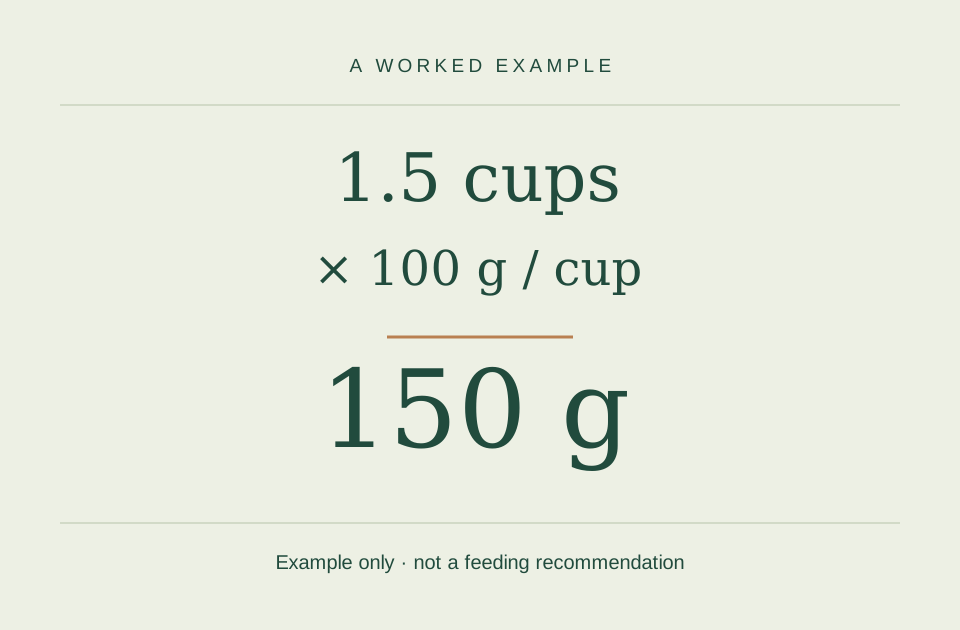
Now suppose an existing plan uses 150 g of that food over the whole day. Its energy contribution is 150 × 3.6 = 540 kcal. In the same fictional food, 150 g equals 1.5 defined cups; 1.5 × 360 gives the same 540 kcal. The second route is a cross-check, not a second feeding recommendation.
If the food is only one part of the day, 540 kcal describes only that part. It does not automatically include treats, another recipe or food used with medication. Keep separate known contributions separate instead of presenting one food’s subtotal as the complete daily intake.
| Question | Calculation | Answer |
|---|---|---|
| Energy per gram | 3,600 kcal/kg ÷ 1,000 | 3.6 kcal/g |
| Energy per defined cup | 3.6 kcal/g × 100 g/cup | 360 kcal/cup |
| Energy from an existing 150 g/day | 150 g/day × 3.6 kcal/g | 540 kcal/day from this food |
| Check through cups | (150 ÷ 100) cups/day × 360 kcal/cup | 540 kcal/day—the same subtotal |
The same cup can tell a different story after a recipe change
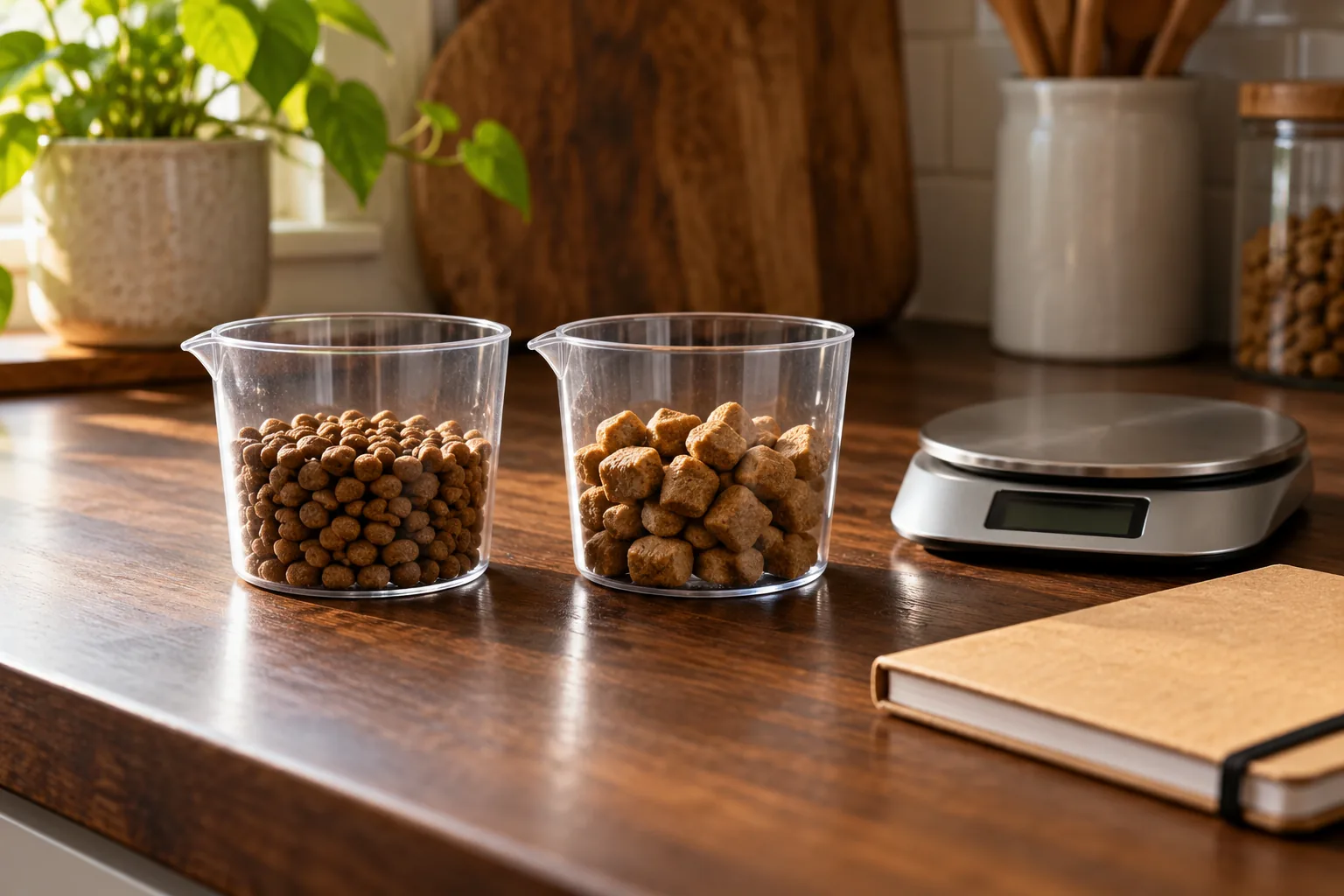
Consider a second fictional recipe with 3,800 kcal/kg and 85 g per cup. It contains 3.8 kcal/g, so a defined cup contains 323 kcal. It has more energy per gram than the first recipe but fewer calories per cup, because the cup holds less food mass.
At 150 g, Recipe A contributes 540 kcal while Recipe B contributes 570 kcal. At one cup, the figures are 360 and 323 kcal. Both comparisons are mathematically consistent: their denominators differ. Neither comparison establishes which food is suitable for a particular pet.
Do not carry a grams-per-cup value into a new recipe just because the scoop is unchanged. Before changing a feeding amount, review the individual plan with the veterinarian. This guide explains why the numbers can differ; it does not prescribe the adjustment.
| Basis | Recipe A | Recipe B |
|---|---|---|
| kcal/kg | 3,600 | 3,800 |
| g per defined cup | 100 | 85 |
| kcal per cup | 360 | 323 |
| kcal in 150 g | 540 | 570 |
If the label and your calculation disagree, ask a precise question
Check that the numbers come from the same recipe, format and current package. Keep ‘per cup’, ‘per can’ and ‘per pouch’ attached to their values. A multipack’s total weight is not the weight of one serving unit.
Small differences can arise when displayed values are rounded. A large discrepancy should prompt a source check, not an invented correction. Send the manufacturer the exact product details and the two values that appear inconsistent; ask for the intended cup definition and grams per cup.
AAFCO’s explanation uses food ‘as fed’. Moisture affects comparisons between dry and canned foods, so a lower kcal/kg figure in a wet food is not by itself a quality ranking. Its calorie-content resource also distinguishes an average calorie value from nutrient minimum or maximum guarantees. Do not try to reconstruct an exact energy analysis by treating every guaranteed-analysis number as an actual measured average.
- All values belong to the same current recipe and format.
- The cup or package unit is explicitly defined.
- Daily totals are distinct from meal quantities.
- Missing information stays marked unknown until clarified.
Sources: AAFCO: Understanding Pet Food—Calories · AAFCO: Calorie Content and unit conversions
Use each calculation for the question it can answer
The existing cups-and-grams guide handles the measuring step. The bag calculator uses bag mass and established daily use to estimate supply. It does not determine a calorie target or select a weight-loss plan.
The price comparison tool compares package prices for the same recipe. It does not compare diets by nutrition or calculate cost per calorie. Even when two foods happen to show the same kcal/kg, that number alone does not make them nutritionally interchangeable.
A useful next step is to keep a short label note: exact food, kcal/kg, kcal per stated unit and the current feeding instruction. Bring it to a nutrition discussion rather than choosing a new daily amount from a generic worked example.
Sources: AAHA: individualized nutritional recommendations (2021)
THE NEXT QUESTIONS
What else might you be wondering?
Does 3,600 kcal/kg mean my pet should eat 3,600 kcal a day?
No. It describes energy in a kilogram of the food. A daily requirement is a separate, individualized question.
Sources: AAHA: individualized nutritional recommendations (2021)
Can I divide kcal/cup by kcal/g to find grams per cup?
Yes, as an arithmetic consistency check: in Recipe A, 360 ÷ 3.6 = 100 g/cup. Rounded or mismatched label figures may not recover an exact mass. Confirm the manufacturer’s stated value rather than treating the quotient as a measurement of your scoop.
Is a lower calorie number always better?
No. Suitability depends on the individual animal and the whole diet. Energy density is information to discuss, not a standalone health score.
Sources: AAHA: individualized nutritional recommendations (2021)
LOOK CLOSER AT THE EVIDENCE
Sources & what they establish
Official guidance, research findings and PetCheck’s practical interpretations have different roles. These notes explain how the sources were used.
Label education
AAFCO: energy statements and units
Supports reading energy per mass and per familiar unit, and converting through grams.
Limit: This explains units, not a personalized intake target or a comparison of product quality.
Sources: AAFCO: Understanding Pet Food—Calories · AAFCO: Calorie Content and unit conversions
Individual nutrition guidance
AAHA: an individual plan is a separate decision
Nutritional recommendations follow assessment of the animal and diet.
Limit: PetCheck has not assessed the reader’s pet or independently measured a food’s energy content.
Sources: AAHA: individualized nutritional recommendations (2021)
Editorial arithmetic
Two consistent routes through fictional labels
The examples distinguish equal mass from equal volume and verify daily subtotals.
Limit: All example values are invented; they must not be copied as a feeding plan.
Sources checked 2026-10-19. Examples are fictional and illustrate reasoning, not patient outcomes. This is an editorial source review, not independent veterinary review. How we prepare these guides →
FOR ANOTHER VISIT
Keep this guide close.
Save it to read again, or copy a link to share.
ONE QUESTION CAN LEAD TO ANOTHER
A useful next read.
Choose the question that fits what you want to understand next.
 Worked arithmetic example
Should you measure dog food in cups or grams?
Keep the exact recipe’s cup weight separate from the daily amount you already use.
Read the guide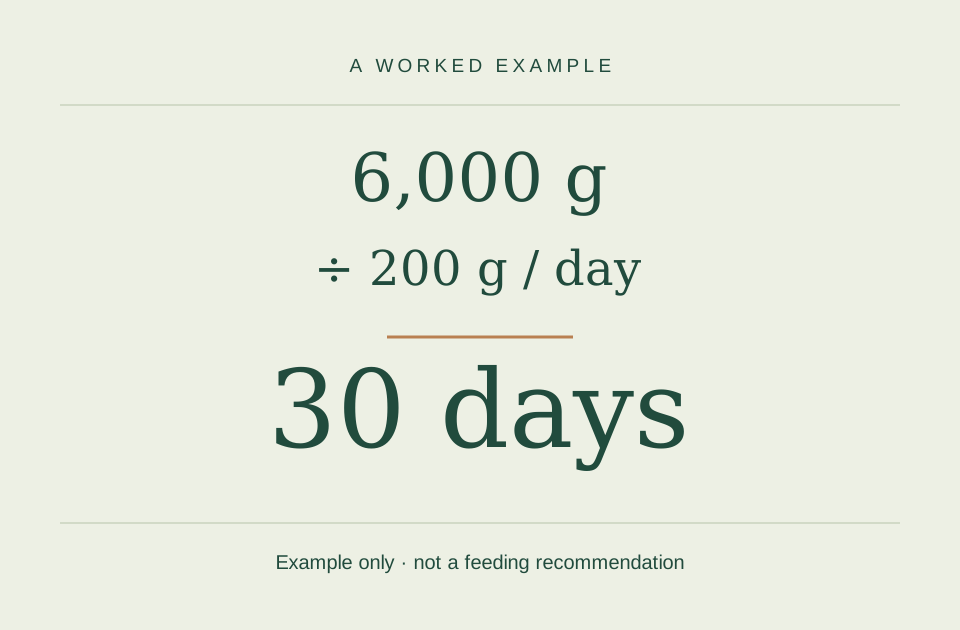 Worked arithmetic example
How long does a bag of dog food last?
Use grams per day for the separate task of estimating food inventory.
Read the guide