FOOD & MEASURING · THE DEVICE
What does one portion on an automatic pet feeder mean?
Separate the manual’s unit, your selected setting, the food actually dispensed and the amount your pet eats. Includes a fictional measurement log.
THE DIRECT ANSWER
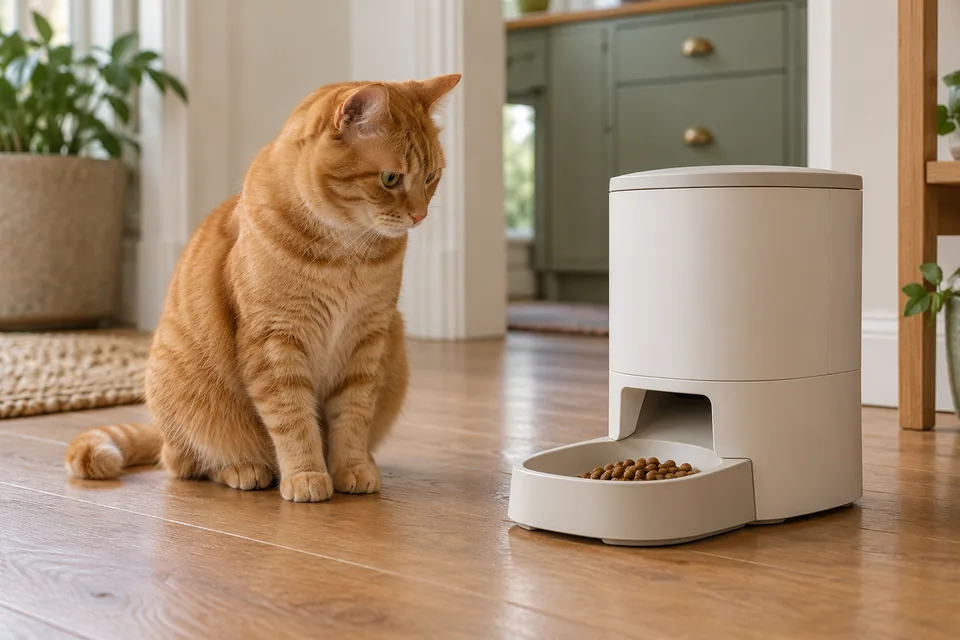
A ‘portion’ is defined by the feeder’s own instructions; it is not a universal number of grams or your pet’s recommended meal. Find the exact model and manual, identify the setting’s unit, and check its instructions for your food. Keep the programmed setting, measured output and food actually eaten as separate records. PetCheck has not tested these feeders or their dispensing accuracy.
Sources: PetSafe: FlexFeed manual feeding instructions · PetSafe: Smart Feed setup, first and second generation
Start with the model—not the word portion
Two screens can both show ‘3’ while controlling different amounts. One device may count dispensing units; another may let you choose a volume. A tray feeder may simply expose food you placed in a compartment. Copying a setting from a video or a different model skips the most important definition.
The manufacturer examples below were opened on October 19, 2026. They illustrate different interfaces, not a ranking or a recommendation. Check your model, generation and current instructions before applying either example.
| Device instructions | Published unit | What remains to check |
|---|---|---|
| PetSafe FlexFeed manual-feed instructions | One manual portion is approximately 1/15 cup | Approximate volume is not an exact gram amount for every food. |
| PetSafe Smart Feed, first and second generation setup | Programmable portions from 1/8 cup to 4 cups | The selected cup amount must still match the existing feeding plan. |
| A different model | Read that model’s manual | Do not import either conversion above. |
Sources: PetSafe: FlexFeed manual feeding instructions · PetSafe: Smart Feed setup, first and second generation
Four numbers answer four different questions
Treat a setting as an instruction to a machine. It is not a measurement of what left the machine and it is not proof of which animal ate it. These distinctions matter when a bowl remains partly full or more than one pet can reach it.
Keep your exact recipe beside the device information. A previous household note about another kibble is not a fresh check of the current setup. Follow the manufacturer’s food compatibility, setup and cleaning directions; this guide does not certify a food’s suitability for a feeder.
| Record | Example field | Does not establish |
|---|---|---|
| Manual definition | Model, generation, unit and instructions | An individualized meal size |
| Programmed setting | Meal time and number or volume selected | Actual output on that occasion |
| Dispensed output | Food-only mass measured in a tared dish | How much a particular pet ate |
| Observed intake | What you actually watched; note leftovers or uncertainty | A diagnosis or a new diet prescription |
Make a small output log before relying on a number
PetCheck’s practical approach is to follow the manual’s permitted setup procedure, collect output in a suitable dish and use a suitable scale to record food-only mass. Record the selected setting and recipe beside each observation. Keep setup-test food separate from scheduled meals so testing does not quietly add extra feedings.
Do not put a scale, loose container or other object under a moving mechanism unless the manufacturer permits that arrangement. Use its specified bowl and transfer the collected food for weighing if needed. An awkward improvised setup can change the very output you are trying to understand.
If repeated output is inconsistent, the device jams, or the available increments cannot reproduce the existing plan, ask the manufacturer and, for feeding-plan questions, the veterinarian. Do not simply increase a setting to compensate for an unexplained problem.
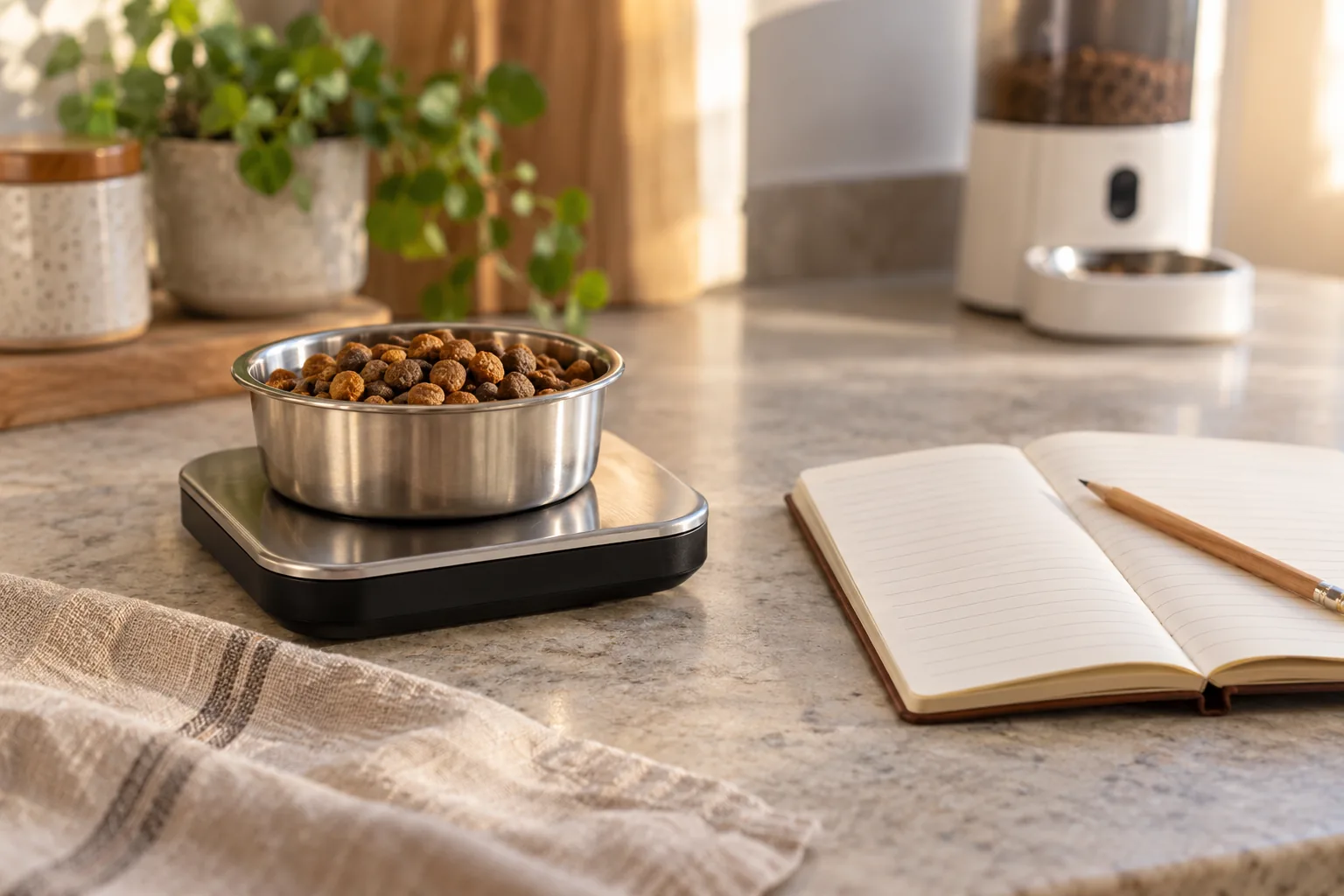
- Exact feeder model and exact food are recorded together.
- The dish’s weight is excluded, and the unit is grams.
- Each observation keeps its own setting and measured output.
- Setup checks are not automatically added to the pet’s meals.
A fictional log: an average is not a guarantee
Imagine a fictional feeder at setting 4 with one fictional dry recipe. Three separate checks yield 19 g, 21 g and 20 g. Their total is 60 g and the arithmetic mean is 20 g. This example is invented; it is not data from either named device.
The mean does not promise that the next output will be exactly 20 g. Nor does dividing by four establish that every single dispensing unit always weighs 5 g. That would assume uniform behavior at another setting without checking it.
Suppose the household’s existing plan calls for 40 g at a meal. The log alone does not prove that setting 8 will deliver 40 g, that two runs will be identical, or that the plan should change. Ask how to reproduce the required meal using the device’s supported settings and a suitable checking method.
| Check | Same fictional setting and recipe | Food-only output |
|---|---|---|
| 1 | Setting 4, Recipe A | 19 g |
| 2 | Setting 4, Recipe A | 21 g |
| 3 | Setting 4, Recipe A | 20 g |
| Arithmetic summary | (19 + 21 + 20) ÷ 3 | 20 g mean; 19–21 g observed range |
The feeder still needs a household handoff
Name who checks the bowl and device, who refills it and who handles an interruption. A schedule in an app does not eliminate those jobs. Check the manual for power-loss behavior, clock changes, manual feeds and backup operation rather than assuming every feeder behaves alike.
For shopping, use the bag calculator with the daily food use you already know. It does not connect to a feeder or read its hopper. If intake or output is uncertain, resolve that uncertainty before treating a stock estimate as accurate.
THE NEXT QUESTIONS
What else might you be wondering?
Is one portion always 10 g?
No universal gram value applies. Use your model’s definition and the exact recipe; a number copied from another feeder is not evidence for yours.
Sources: PetSafe: FlexFeed manual feeding instructions · PetSafe: Smart Feed setup, first and second generation
Does a successful dispense notification mean my pet ate?
It does not establish intake by a particular animal. Keep the device event separate from what you observed at the bowl, including other pets’ access and leftovers.
Can the feeder decide how much my pet needs?
This guide only explains settings and observations. An appropriate feeding plan requires individual assessment; clarify an uncertain amount with your veterinarian.
Sources: AAHA: individualized nutritional recommendations (2021)
LOOK CLOSER AT THE EVIDENCE
Sources & what they establish
Official guidance, research findings and PetCheck’s practical interpretations have different roles. These notes explain how the sources were used.
Manufacturer instructions
Two examples of unit definitions
The PetSafe pages document their respective portion interfaces and setup context.
Limit: They are model-specific instructions, not independent measurements. PetCheck has not tested either feeder.
Sources: PetSafe: FlexFeed manual feeding instructions · PetSafe: Smart Feed setup, first and second generation
Editorial measurement workflow
Keep settings and observations distinct
The log and fictional mean explain what can be inferred from recorded outputs.
Limit: Three invented values establish no device accuracy, acceptable tolerance or nutritional adequacy.
Sources: AAHA: individualized nutritional recommendations (2021)
Sources checked 2026-10-19. Examples are fictional and illustrate reasoning, not patient outcomes. This is an editorial source review, not independent veterinary review. How we prepare these guides →
FOR ANOTHER VISIT
Keep this guide close.
Save it to read again, or copy a link to share.
ONE QUESTION CAN LEAD TO ANOTHER
A useful next read.
Choose the question that fits what you want to understand next.
 AI-generated editorial scene
Kitchen scales for pet food: compare display & controls
Check tare, display and bowl space when measuring a feeder’s actual output.
Explore the buying guide AI-generated editorial scene
What feeding instructions should I leave a pet sitter?
Explain the feeder and backup feeding plan to the person caring for your pet.
Read the guide