Food & everyday planning
How often should I schedule dog food delivery?
Turn the food you have left into a useful delivery plan. Separate your next order date, arrival estimate and repeat interval.
THE DIRECT ANSWER
Start with the food you have left and the amount your household already uses each day. Divide the remaining food weight by that daily amount to estimate days of supply. Then compare those days with the expected arrival of your next order—not just its order date. Set the repeat interval separately, using the quantity delivered each time. There is no single monthly schedule that fits every bag or household.
Count what is left, not what the bag held when it arrived
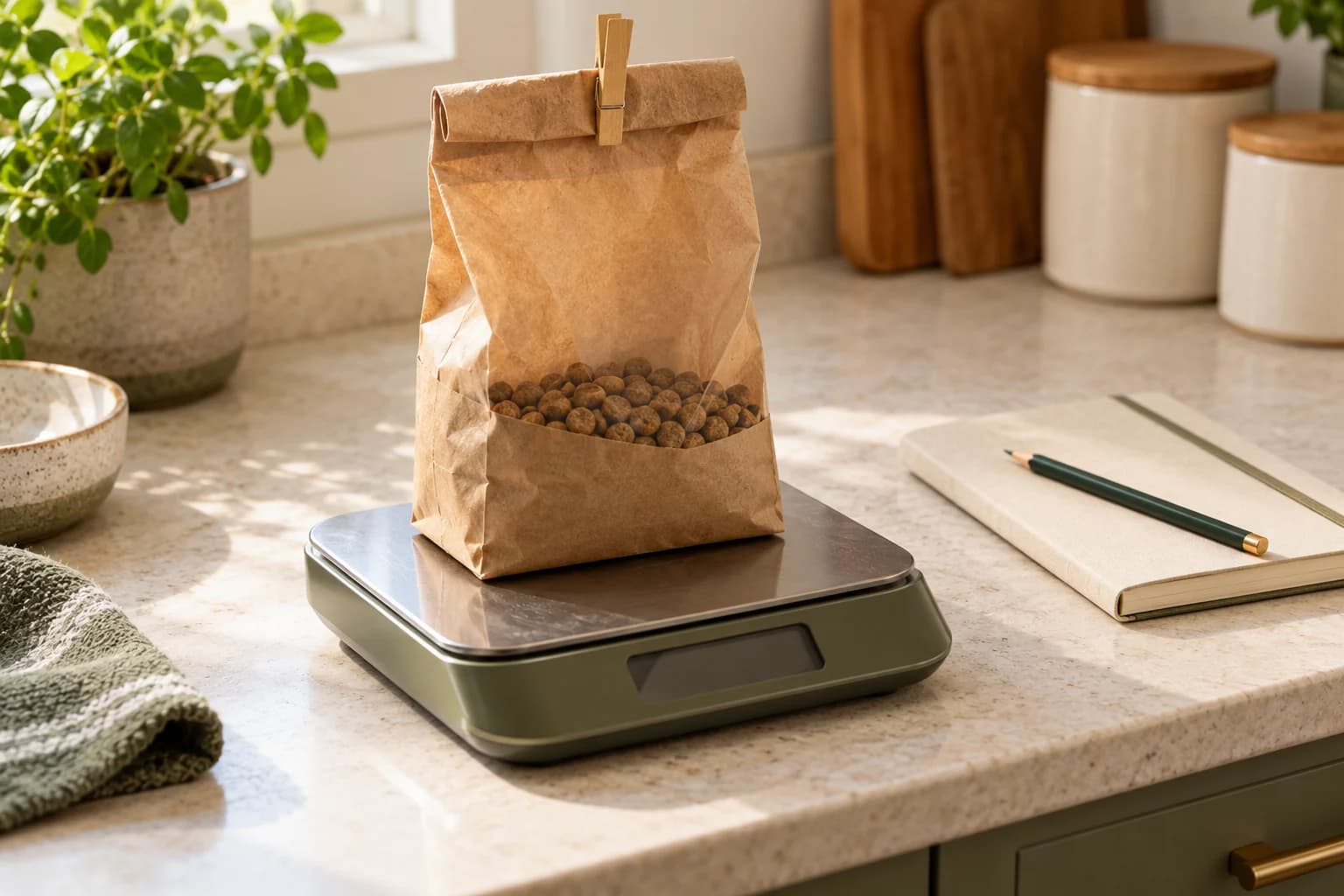
A 7 kg label describes a full bag. It does not tell you whether the half-used bag in your cupboard can cover the next delivery. Work with one exact recipe at a time, using grams for both the remaining quantity and daily use. Include usable unopened stock of that same recipe separately; do not count a different food as interchangeable supply.
Daily use means the food leaving this supply. Add the existing amounts for every pet sharing it, including any kibble taken from this bag for training. Do not count a wet-food meal as dry-food grams. Spilled or discarded food also reduces stock, so an estimate based only on portions can be optimistic. This is an inventory calculation, not a way to choose a feeding amount.
Exclude the weight of the bag, container or bowl from a food measurement. If you cannot establish the empty packaging weight, mark the result as approximate rather than treating a gross scale reading as food weight. A second stock check is more useful than adding decimal places to an uncertain starting number.
| Detail | What to write down | Why it changes the plan |
|---|---|---|
| Remaining food | Estimated food-only grams in the opened bag, plus usable unopened stock of the same recipe | The original bag size can overstate what is available now. |
| Daily use | The current total grams taken from this supply for all pets and uses | A per-meal or one-pet amount can make the supply look longer than it is. |
| Next order | The upcoming order date shown in the retailer account | An order being placed is not the same as food arriving. |
| Expected arrival | The retailer’s current estimate, including processing and delivery | A later arrival must still fit inside the remaining supply. |
| Change deadline | The last point at which the upcoming order can be edited | A personal review date is useful only if there is still time to act. |
The next order and the repeat interval are two different settings
A repeat interval answers ‘how often after this?’ The next-order setting answers ‘when is the upcoming order placed?’ The arrival estimate answers a third question: ‘when might the food reach me?’ Write all three down before editing anything.
For example, Chewy’s US Autoship guidance says a frequency change takes effect after the next order and does not move that next order. Changing the next-order date does not change the frequency. Its public page currently gives a 48-hour window before the scheduled order for date changes. Check the current account instructions and retailer support if the order is already processing.
That is one retailer’s setup, not a rule for every subscription. With any service, confirm the saved next-order date and estimated arrival after making a change. Do not assume that clicking a shorter interval has solved an imminent shortage.
Sources: Chewy: Autoship frequency, next-order date and change window (US)
A worked plan: 28 days of food, but an arrival in 29 days
The following quantities are fictional and demonstrate scheduling arithmetic. They are not a feeding recommendation or a promise of delivery speed. Suppose a household has 7,000 g of usable food left and already takes 250 g from that supply each day. Its estimated supply is 7,000 ÷ 250 = 28 days.
Now suppose its next order is due in 25 days, with an estimated four days from ordering to arrival. That gives an arrival in 29 days: one day beyond the estimated supply. The order date looks early enough when considered alone, but the arrival does not.
| Step | Calculation | Meaning |
|---|---|---|
| Supply remaining | 7,000 g ÷ 250 g/day = 28 days | At this unchanged daily use, the current food covers about 28 days. |
| Current arrival estimate | 25 days until order + 4 days to arrive = 29 days | Arrival is about one day beyond the estimated supply. |
| Chosen planning margin | 2 days, selected for this example | A personal allowance for uncertainty, not a universal safety guarantee. |
| Revised order target | 28 − 4 − 2 = 22 days from the check | An estimated arrival in 26 days leaves about two days of current supply. |
- Use the same starting date and units for the whole calculation.
- If delivery is quoted in business days, translate it into actual calendar dates before comparing it with daily food use.
- If the proposed order target is today or in the past, review the upcoming order now and confirm an available supply option with the retailer; do not reduce meals to fit the delivery date.
Choose the repeat interval from the amount each shipment adds
Current remaining food determines when the next delivery is needed. The amount in each new shipment helps determine the ongoing interval. In the same fictional household, a fresh 7,000 g bag at 250 g per day supplies 28 days. A delivery every 28 days would replace roughly what was used, assuming stable use and similar arrival timing. An existing reserve still needs checking.
A calendar month is not always four weeks. Over 30 days this example household uses 7,500 g; over 31 days it uses 7,750 g. Sending only 7,000 g each time would gradually use up its reserve. Conversely, sending a bag every 21 days adds 7,000 g while only 5,250 g is used between deliveries, so stock grows by roughly 1,750 g per cycle.
The practical check is supply added per shipment versus food used between arrivals. Choose an available interval that fits, then reassess actual stock after a cycle. An earlier one-off order can solve the next gap without making every later order unnecessarily early. If the retailer offers only coarse intervals, use its permitted date adjustments rather than assuming a perfect repeating match.
Keep a useful reserve without building an unused pile
A reserve only helps if it is usable food of the intended recipe and can be stored as directed. Label dates, time since opening, storage conditions and changes to the household’s food plan still matter. A calculation that says there is enough weight does not establish freshness or suitability.
FDA guidance recommends retaining original packaging and keeping dry pet food cool and dry. If using an outer container, its guidance favors keeping the bag inside it. The packaging also preserves identification details. Follow the food manufacturer’s instructions; this guide does not assign a universal number of safe weeks after opening.
If unopened bags accumulate, count them before the next order. A permitted delay or skip may be more useful than another storage container. If a feeding plan or recipe changes, review the old subscription as a separate task rather than continuing it automatically. A lower per-bag price is not a saving if food ends up unused.
Sources: FDA: storing pet food and treats
Leave yourself one clear next check
Write down the recipe, current stock estimate, daily use, next order, expected arrival and the retailer’s change deadline. Choose a personal review date before that deadline with time to resolve a problem. Recheck sooner if food use, package size, delivery information or household plans change.
PetCheck’s food-bag calculator can estimate the supply in a full bag using the daily amount you enter. You can save an estimate and choose a date to review it. For a partly used bag, use the remaining-food arithmetic above rather than treating the original label weight as today’s stock. If daily use is only known in cups, the recipe’s grams per cup is needed for a weight estimate.
The saved review date is a note you return to in PetCheck. It does not change a retailer subscription, monitor your stock or send an automatic delivery reminder. Keep the retailer’s own order confirmation as the source for what is actually scheduled.
- Confirm the upcoming order and arrival after saving changes in the retailer account.
- Keep a personal review date that falls before the retailer’s edit deadline.
- Compare the estimate with the actual remaining food at the next check and revise your inventory assumptions.
THE NEXT QUESTIONS
What else might you be wondering?
Should I simply choose a monthly delivery?
Only if the actual quantity used between arrivals fits the quantity delivered. Four weeks is 28 days; calendar months vary. Check a complete cycle of remaining stock and arrival dates before treating the interval as settled.
What if two dogs share the same bag?
Use the combined existing daily amount taken from that bag, including kibble used for training. Keep separate calculations for different recipes. Combining weights from different foods would not show how long either particular recipe lasts.
Does changing the frequency move my next order?
Not necessarily. Chewy’s US guidance treats the next-order date and repeat frequency separately. Other retailers may work differently. Confirm both settings and the resulting arrival estimate in your own account.
Sources: Chewy: Autoship frequency, next-order date and change window (US)
How many extra days should I allow?
There is no universal number. Consider the uncertainty in your food estimate, the current delivery information, access to an appropriate backup supply and storage limits. The two-day margin in the worked example is a chosen illustration, not a guarantee or a recommendation for every household.
Can PetCheck update the subscription for me?
No. PetCheck estimates and saves the information you provide. It does not connect to a retailer account, edit orders, check live stock or guarantee delivery. Make and confirm subscription changes with the retailer.
LOOK CLOSER AT THE EVIDENCE
Sources & what they establish
Official guidance, research findings and PetCheck’s practical interpretations have different roles. These notes explain how the sources were used.
Retailer instructions
The next order is separate from the repeat setting
Chewy’s US Autoship page describes separate controls for frequency and the next order, including its stated date-change window.
Limit: This is one retailer’s public guidance, checked on the date below. Account conditions and current instructions control a particular order. It does not establish a delivery guarantee or a rule for other retailers.
Sources: Chewy: Autoship frequency, next-order date and change window (US)
Official handling guidance
Available weight does not establish food quality
FDA storage guidance supports preserving packaging information and managing dry-food storage conditions.
Limit: It does not determine a household’s reorder date, prescribe an inventory reserve or establish a universal post-opening shelf life.
Sources: FDA: storing pet food and treats
PetCheck worked example
Supply and delivery arithmetic
The 7,000 g, 250 g/day, four-day delivery estimate and two-day margin are fictional inputs. The tables show ordinary unit arithmetic so a reader can distinguish supply duration, arrival timing and repeated replenishment.
Limit: These are not observed feeding data, shipping performance measurements or a validated forecasting model. A change in food use or arrival timing changes the result.
Sources checked 2026-10-17. Examples are fictional and illustrate reasoning, not patient outcomes. This is an editorial source review, not independent veterinary review. How we prepare these guides →
PUT THIS GUIDE TO USE
Check a bag against your delivery interval.
Use the next bag’s weight and your existing daily use to check a repeat interval. For the next arrival, use the remaining-food steps above. The calculator does not track stock or change delivery orders.
Calculate a bag’s supplyKeep the guide for another visit, too.
ONE QUESTION CAN LEAD TO ANOTHER
A useful next read.
Choose the question that fits what you want to understand next.
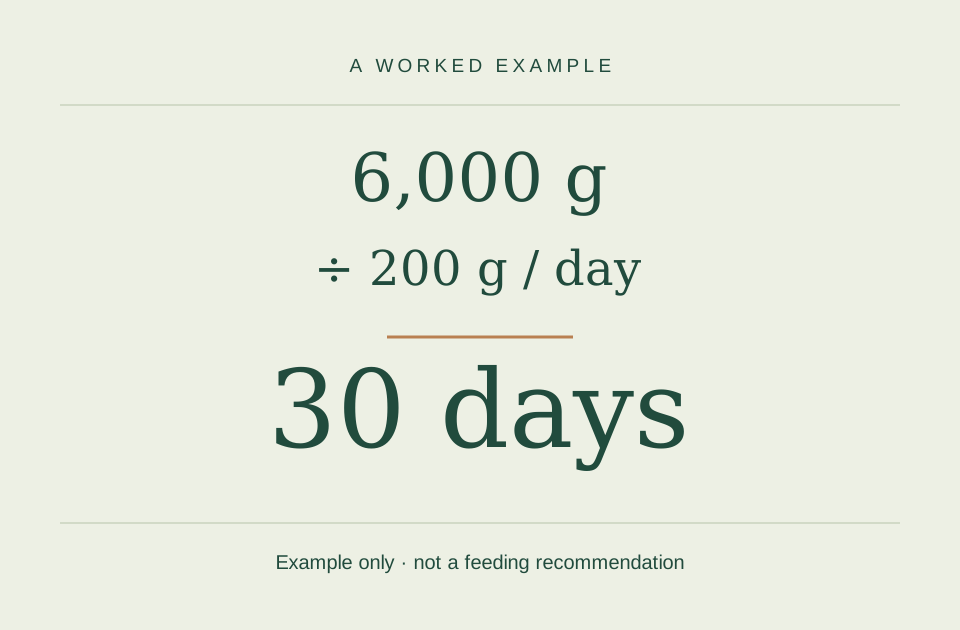 Worked arithmetic example
How long does a bag of dog food last?
Check the supply in a full bag before choosing a repeat delivery interval.
Read the guide AI-generated editorial scene
How should you store dry pet food?
Keep your food reserve organized with the original packaging and storage instructions.
Read the guide