THE SHORT ANSWER
Why is my dog’s poop yellow?
Yellow does not point to one specific cause. When the stool is also loose, food changes, scavenging, stress, infection, or parasites may be relevant. These are possible causes of diarrhea in general, not a diagnosis from the yellow color. [2] Difficulty digesting fat in pancreatic disease can also produce pale or yellowish stool, but color alone cannot establish that condition. [6]
- After a food or routine change
- Note what changed and when. Timing is useful history, not proof of the cause. Explore the possibilities. [2]
- A different texture or shade
- Record whether it is watery, soft, or hard separately from the shade. Read the texture and shade questions.
- Diarrhea repeats or your dog seems unwell
- Ask your veterinarian about ongoing or repeated diarrhea. For illness signs, use the care advice above; do not wait for another photo. [3]
TEXTURE & SHADE
Yellow diarrhea, hard stool, or a paler shade?
What does yellow diarrhea mean in dogs?
Yellow diarrhea describes both a color and loose or watery stool. Food changes, scavenging, stress, infections, and parasites can cause diarrhea; the yellow shade does not select one cause. [2] Record how often it happens, when the change began, and any vomiting or changes in appetite or energy. Contact your veterinarian promptly for blood, black/tarry stool, vomiting, or an unwell dog, and ask about diarrhea that persists or returns. [3] The Runny guide explains diarrhea when a dog is acting normally and episodes that stop and return.
What if my dog’s yellow poop is hard?
Hard yellow stool calls for a separate description of color and consistency. Constipation means passing stool infrequently or with difficulty; stool retained in the colon can become dry and hard as water is absorbed. The yellow shade does not establish constipation or its cause. Note whether your dog strains, seems painful, or makes repeated attempts without producing stool, and discuss these signs with your veterinarian. [8] Use the hard, dry stool guide for the observation details.
Does mustard or pale yellow poop identify a cause?
“Mustard” and “pale yellow” describe shades; they are not diagnoses. Pale or yellowish stool can occur with poor fat digestion in dogs with exocrine pancreatic insufficiency, but a shade match cannot establish that condition. [6] Give your veterinarian the timing, stool consistency, and any appetite changes. Yellow-looking eyes, gums, or skin are a separate observation—jaundice—rather than another name for yellow stool; report those changes to your veterinarian. [7] Read the color guide’s explanation of pale stool and digestion.
Dotted terms open a short explanation. Stay on the page as you read.
01 / UNDERSTAND THE COLOR
A yellow label cannot tell you which story you are in.
You notice it during a morning walk. The shape looks different, the color seems brighter, and suddenly a search for “yellow dog poop” produces several very different explanations. A food change. A parasite. A problem with an organ. It is easy to read a list of possibilities as a list of things your dog might already have.
That is the first distinction to make: a possible explanation is not evidence that it applies. A useful guide should help you understand the possibilities without asking you to choose a diagnosis from a color swatch.
PUT THE OBSERVATION IN CONTEXT
Follow the day around the color.
A yellow-looking photograph cannot show what the dog ate, drank or did during the rest of the day.
Food and timing
Note the usual food and any recent change, with the time it happened.
Appetite and activity
Describe a change from the dog's ordinary behavior rather than writing only a color.
One event or several?
Several photos of one stool are still one observed passage.
A water bowl in a photograph does not measure water intake or hydration.
IN PLAIN ENGLISHBileA fluid made by the liver that helps with fat digestion and carries some waste products into the intestine.A green or yellow appearance does not, by itself, explain what happened to bile or the liver.MSD Veterinary Manual Source checked is a digestive fluid made by the liver and delivered to the intestine. Its pigments do not simply remain unchanged all the way through. Intestinal processing helps produce the pigments that contribute to the color you eventually see. “Brown” is therefore part of a process, not just the color of the food that went in. [7][1]
Brown is an end result, not the starting ingredient.
Pigment travels with bile.
Bile carries bilirubin, one of the pigments involved in this process.
The intestine changes it.
Gut bacteria act on bile pigments; further chemical changes follow.
Other pigments emerge.
The resulting pigments can contribute yellow-orange and brown tones.
Original schematic of a biological pathway. Colors are illustrative, not a stool chart or evidence about an individual dog. [1]
Knowing how a color can arise is not the same as knowing why it appeared in your dog.
02 / LOOK BEYOND THE SHADE
Why ask about vomiting when you came to check a color?
Because a color description and a fluid-loss problem are different kinds of information. If the stool is watery, its water content matters in its own right. Faster passage and reduced absorption are one way diarrhea can develop. The color alone does not show how much fluid has been lost. [2]
Diarrhea can lead to dehydration; vomiting at the same time can make that happen faster. That is why a photograph should not be used to reassure you while the dog is becoming less active, not eating, or vomiting. [3]
Follow the water, not just the color.
Compare a usual absorption pattern with one pathway that can contribute to diarrhea.
The intestine absorbs water into the body as material passes through. The drawing shows direction, not a measured rate.
Faster movement and reduced absorption can leave more fluid in the stool. This does not establish why diarrhea happened—or mean every yellow stool has this mechanism.
Both patterns: the intestine normally absorbs water. Faster transit and reduced absorption can increase water loss in diarrhea; other pathways also exist.
“Less yellow” is not the same as “getting better.”
Imagine that today’s image looks browner, but the owner’s note now says the dog has stopped eating. A color-only comparison would miss the important new information. The lesson is not to ignore color; it is to keep color, stool texture, and the dog’s condition as separate observations instead of compressing them into one “better” label.
A small photography note—not the whole lesson
Compare images in similar lighting when possible. A screen rendering is not a chemical measurement. Do not apply a warming filter to “confirm” yellow, and do not discard the first image just because a second one looks different. Record that the lighting changed.
03 / POSSIBLE EXPLANATIONS, WITHOUT GUESSING
Four avenues a conversation may explore.
These are not equally likely diagnoses, a complete list, or a sequence to test at home. Some are broad explanations for diarrhea rather than explanations specific to yellow. The point is to understand what extra information would matter.
What changed around food or routine?
New food, treats, scavenging, food intolerance, and stress can be relevant to diarrhea. Tell the veterinarian what changed and when. Timing makes a useful lead, but “after” does not establish “because of.” [2]
Useful next detail: the actual food or exposure—not just “diet changed.”Is an infection or parasite part of the picture?
These are also possible causes of diarrhea. A photo cannot rule them in or out. Stool testing may look for organisms, eggs, or other evidence that is not visible in an ordinary image; sometimes different tests are needed. [5]
Useful next question: would a sample help, and how should it be collected?Is digestion itself being affected?
Pancreatic disease is one setting in which difficulty digesting fat can produce pale or yellowish stool. That is a reason for veterinary investigation in the appropriate context—not a reason to diagnose pancreatic disease from this page or start supplements. [6]
Useful next detail: persistent changes and the dog’s wider history, not a shade match.Are there signs beyond the stool?
Yellow-looking eyes, gums, or skin are a different observation from yellow stool. The word IN PLAIN ENGLISHJaundiceA yellow discoloration noticeable in body tissues such as the eyes, skin or gums.The term refers to tissues. Yellow stool is a separate observation.MSD Veterinary Manual Source checked refers to yellowing of tissues and belongs in a veterinary conversation. Do not treat the two observations as interchangeable. [7]
Useful next detail: what changed in the dog, as well as what changed on the ground.WHAT AN EXAMINATION ADDS
Why a clearer photo is not always the next missing piece.
A veterinarian can combine the history with a physical examination, then decide whether testing will help. Stool tests, blood work, or imaging answer different questions; they are not interchangeable with a more detailed color description. Not every dog needs all of these tests. [5]
Think of the photo as a bookmark in the story. It can preserve what something looked like at that moment. It cannot fill in the hours before it, examine the dog, or tell you what a laboratory would find. This is where the limits of a photo become practical rather than just a disclaimer.
04 / SAME LABEL. DIFFERENT CONVERSATION.
The missing information can matter more than the extra photograph.
Compare these two authored notes. They are not real patients, and neither is a diagnosis.
“Yellow poop.
Three photos.”
We do not yet know whether that means three bowel movements, or three views of the same event.
“One event.
A clearer timeline.”
- 8 am · first noticedEarlier stool was not seen.
- One bowel movementThree photos refer to that same event.
- Yesterday · new treatRecorded as an exposure, not a proven cause.
- Overnight · unknownNot observed is not the same as absent.
The gain is not a longer note. It is the removal of three assumptions: photo count equals event count; first noticed equals exact onset; a recent treat must be the cause.
Ask about the dog.
Appetite, activity, water intake, and vomiting add information that the image does not contain. Record a change from that dog’s usual behavior rather than making the photo speak for it. [4]
Preserve what is unknown.
“I did not see the overnight period” is more honest than “nothing happened overnight.” A useful record leaves uncertainty visible so the next conversation starts from what is actually known.
Another example: the color improves, but appetite does not.
In this fictional comparison, the later photo looks closer to brown. The owner also reports that the dog is now refusing food. Calling the whole situation “improved” would hide the new concern. Keep the two observations separate and contact a veterinarian about diarrhea with poor appetite; do not wait for a more convincing photo. [3]
05 / USE THE DISTINCTION
A useful brief keeps three things apart.
PetCheck’s existing brief structure separates visible information, owner-reported context, and limitations. The authored example below uses those real information fields—not a fabricated score or a promised diagnosis.
- 01From the image
- The pictured material appears yellow-tan and soft. Lighting and the image alone limit interpretation.
- 02From the owner
- First noticed at 8 am. One bowel movement was photographed three times. A new treat was given yesterday; earlier stool and overnight behavior are unknown.
- 03Not established
- The cause, exact onset, and whether the treat is related. This example contains no clinical assessment or recommended treatment.
Authored for this guide. Not generated by the analysis engine. No assessment, saved record, or personal data.
Now start with your own observation.
The button opens the existing photo-check flow. Use your own image, confirm the visible information, and add your dog’s context. This example is not copied into your result or record.
Organize my photo & observations Educational, non-diagnostic guidance. Do not delay veterinary care to complete an upload.QUESTIONS WORTH SETTLING
Before you leave with the wrong conclusion.
Does yellow poop mean liver disease?
No. Stool color alone cannot establish liver disease. Jaundice means a yellow tinge in tissues such as the eyes or gums; it is not another name for yellow stool. Tell a veterinarian about yellow-looking tissues or other illness signs instead of trying to settle this from a stool photo. [7]
Does a recent food change explain everything?
A food change is useful history, not a confirmed cause. Note what changed and when, but also report whether the stool change repeats and whether appetite, activity, or vomiting have changed. A plausible explanation should not erase signs that the dog is unwell. [2]
Can a photograph rule out parasites?
No. A photograph cannot replace the tests used to look for intestinal parasites. A veterinarian may recommend a stool sample and sometimes more than one testing method. The absence of visible worms is not a laboratory result. [5]
Should I wait for a fixed 48-hour countdown?
No countdown overrides illness signs. Contact a veterinarian promptly for diarrhea with vomiting, poor appetite, lethargy, blood, or black/tarry stool. For an otherwise well dog, ask your veterinarian about ongoing or repeated diarrhea rather than assuming a universal safe waiting period. [3]
THE EVIDENCE & ITS LIMITS
Named sources. Specific roles.
These sources support the biology, history-taking, and safety points above. They do not endorse PetCheck, validate a photo diagnosis, or turn our diagrams and fictional notes into clinical evidence. The explanations and visuals are editorial work, not an independent veterinary review.
- 01MSD Veterinary ManualBilirubin synthesis and metabolism in animals ↗
Bile pigments and their processing in the intestine. Does not provide a photo-based color diagnosis.
- 02VCA Animal HospitalsDiarrhea in dogs ↗
Water absorption, diarrhea cause categories, and the importance of examination and history.
- 03Cornell University College of Veterinary MedicineDiarrhea ↗
When veterinary advice is needed, fluid loss, and why vomiting alongside diarrhea matters.
- 04VCA Animal HospitalsDiarrhea questionnaire and checklist for dogs ↗
Duration, actual bowel movements, food exposure, appetite, activity, and explicitly uncertain answers.
- 05VCA Animal HospitalsTesting for diarrhea ↗
What examination and laboratory testing can add. Not every dog needs every test.
- 06VCA Animal HospitalsNutrition and pancreatic disease in dogs ↗
Pale or yellowish stool can occur with fat maldigestion in exocrine pancreatic insufficiency; this is not proof of a diagnosis.
- 07MSD Veterinary ManualDisorders of the liver and gallbladder in dogs ↗
Bile production and the distinction between yellow stool and jaundice of tissues.
- 08VCA Animal HospitalsConstipation in dogs ↗
Infrequent or difficult stool passage, water absorption from retained stool, and signs to report. Does not explain yellow color or establish a diagnosis from appearance.
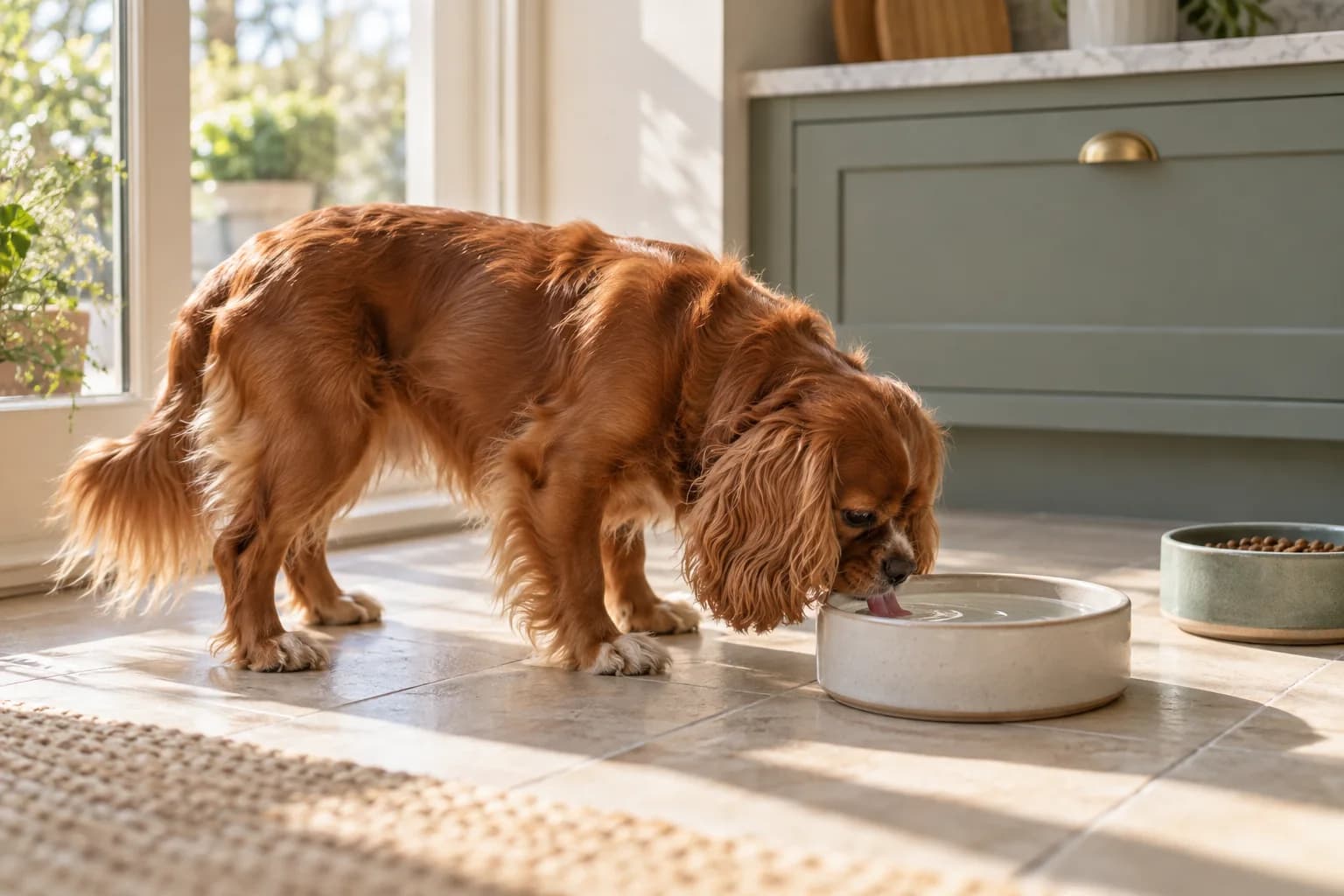
AI-generated editorial scene, not a patient case or evidence of illness, treatment, or a PetCheck result. The teaching diagrams explain separate ideas; they are not clinical images.
FOR ANOTHER VISIT
Keep this guide close.
Save it to read again, or copy a link to share.
ONE QUESTION CAN LEAD TO ANOTHER
A useful next read.
Choose the question that fits what you want to understand next.
 AI-generated editorial scene
Loose or watery stool
When texture changed too, move from color to the pattern between bowel movements.
Read the guide AI-generated editorial scene
A sudden change
Connect the observation to a timeline while leaving the cause open.
Read the guide