Dotted terms open a short explanation. Stay on the page as you read.
01 / SOMETHING THE BODY MAKES
Not every unfamiliar-looking layer
is something the dog swallowed.
There is a translucent film over the stool. It looks unfamiliar, so the search begins: food wrapper, worm, or something from inside the bowel? Before choosing one of those stories, there is a more useful fact to understand: the intestine itself produces mucus.
PUT THE OBSERVATION IN CONTEXT
Add the context around the coating.
The surface description is one part of the account. The dog's behavior and repeated events belong beside it.

Describe the coating
Use plain words for what looked different and where it appeared.
Describe the pattern
Record whether it appeared once or during separate observed passages.
Describe the dog
Keep changes in appetite, activity, vomiting and effort in the same account.
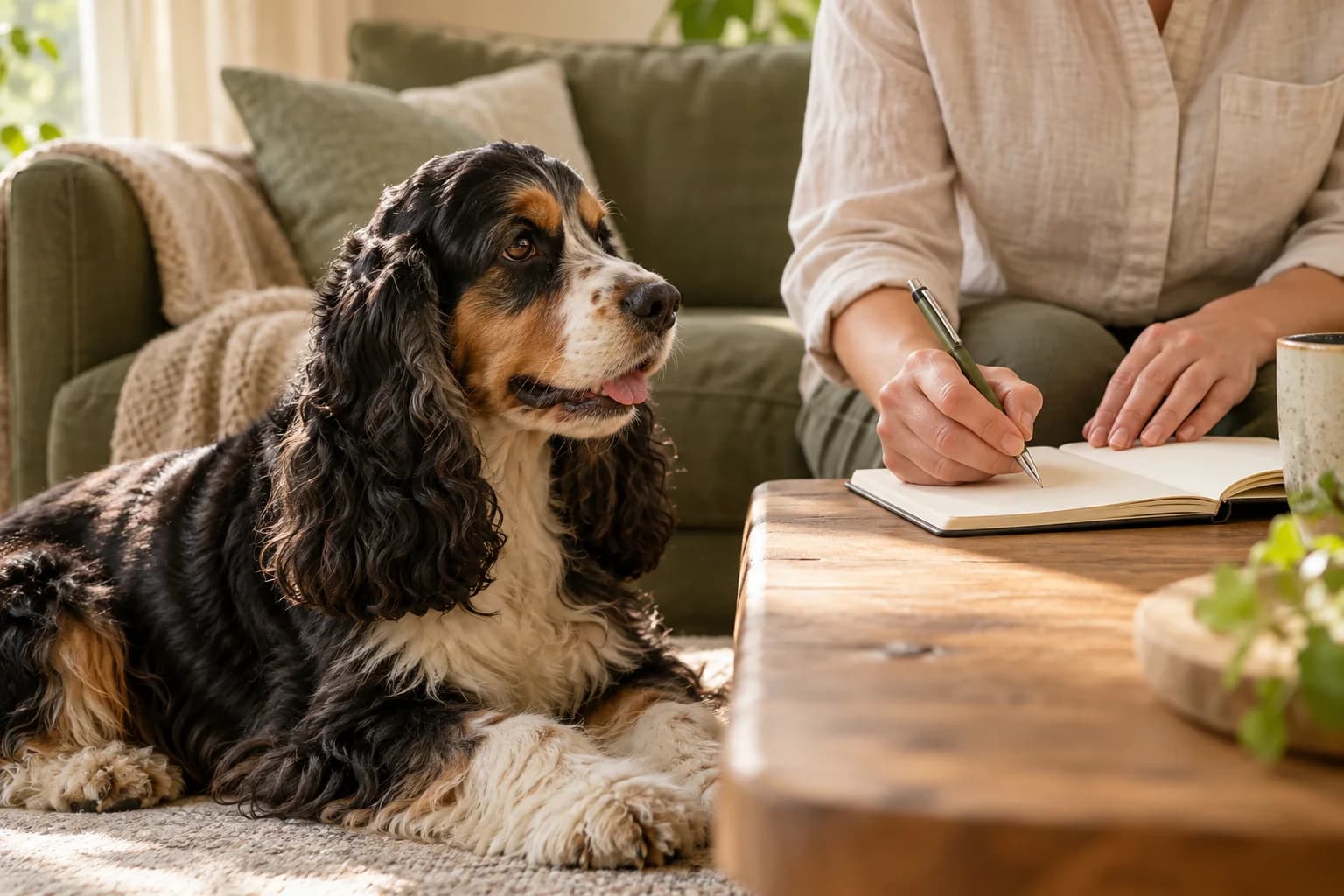
An ordinary-looking dog in an editorial image does not establish that a stool change is harmless.
IN PLAIN ENGLISHMucusA slippery secretion made by the bowel lining. Mucus-producing cells help protect and lubricate that surface.Describe a coating you noticed separately from the stool underneath it.MSD Veterinary Manual Source checked is a secretion that helps lubricate the passage of stool. It is not simply waste with a new color. In the colon, mucus-producing goblet cells sit among the lining cells. Inflammation can stimulate extra secretion while also altering the bowel’s handling of water and movement. A visible coating is therefore a clue to describe, not an ingredient list or a diagnosis. [1][2]
A moving stool. A slippery interface.
The substance on the surface and the cells beneath it are not the same thing.
Original teaching illustration, not a biopsy or a measurement. Layers are enlarged and simplified. It cannot identify material in your dog’s photo.
A secretion from the lining
is not the same as the lining itself.
A gelatinous appearance does not by itself show that tissue has been shed. Nor does calling it “mucus” prove that everything is normal. The question is what you actually saw, how it differs from the dog’s usual stool, and what accompanies it.
Mucus, mucosa, colitis: three different words.
Mucus is the secreted material. Mucosa is the tissue lining. Colitis means inflammation of the colon. These words name different things; none is a cause established by a photograph. The cutaway is explanatory, not an image of your dog’s intestinal wall. [2]
02 / DESCRIBE A FEATURE BEFORE NAMING A DISEASE
Where is the coating?
What is underneath it?
“Slimy poop” compresses several observations into one phrase. Is the stool still formed under a surface layer? Is there loose stool mixed with pale material? Is the material beside the stool rather than coating it? A useful account preserves those differences without pretending the picture identifies the substance.
Describe where the material is.
These are example descriptions—not diagnoses or levels of danger.
“A translucent, jelly-like layer over part of the stool.”
“A separate pale, jelly-like patch next to the stool.”
“A shiny area. I could not tell whether it was material or reflected light.”
Illustrations are deliberately separated from clinical photos. Position and appearance help description; neither proves mucus, tissue or a parasite.
Describe the stool and the extra material separately: shape, visible color, surface or separate location, and when you noticed it. A photo can preserve the arrangement, but it cannot supply the dog’s appetite or whether repeated attempts produced stool. Those are observations from the owner, not details to invent from the image. [5]
Do not handle or pull material apart just to settle its identity. Keep the original photograph, wash your hands after cleaning up, and ask the clinic whether it wants a sample and how to bring it. An uncertain description is more useful than a confident label chosen from an online picture.
03 / THE AMOUNT OF SHINE IS NOT A TRIAGE TOOL
Look beyond the coating
before deciding what it means.
Mucus can accompany large-bowel problems with frequent small passages, urgency or straining. More than one cause can create that pattern, including dietary factors, stress, infections and parasites. The pattern helps the veterinary conversation; it does not let this page diagnose IN PLAIN ENGLISHColitisInflammation of the colon, the main part of the large intestine.Several causes can lead to this inflammation. The word does not identify the cause in an individual pet.MSD Veterinary Manual Source checked or choose its treatment. [3]
The coating stays the same.
The account becomes more useful.
Change the account, not the dog’s diagnosis. This is not a symptom checker.
Same teaching image
Jelly-like surface material
Both views belong to a fictional teaching case. There is no all-clear option and no recommended waiting period.
The teaching picture did not become more dramatic when the fuller account appeared. It did not need to. Refusing food and repeated straining add information that the surface could never have supplied. Do not turn “only a little mucus” into a reason to discount those signs. [4][3]
Likewise, a later stool with less visible coating does not erase earlier concerns. Preserve the different observations rather than compressing them into a single recovery score. The practical question is not “Which picture looks worst?” but “What is happening to this dog now?”
04 / A BETTER QUESTION FOR THE CONSULTATION
“Colitis” describes a problem.
It does not finish the explanation.
A word can make uncertainty feel resolved. But naming inflammation does not establish why it happened. The clinical tasks are to locate the problem, investigate plausible causes and decide what care is appropriate. History, examination and selected tests can each contribute information that a photo cannot. [6][7]
A name for the sign is not the cause.
Jelly-like material, stool shape and the owner’s observations.
A veterinarian considers the pattern and examines the dog.
History and selected tests may be needed. “Colitis” is not a complete cause.
This sequence structures a clinical conversation; it does not automate a diagnosis. This diagram neither orders tests nor tells you to delay care until a cause is known.
For the owner, preparation need not become a research project. Bring a small, accurate account: what changed, whether it happened again, how the dog is acting, and relevant food or medication details. Let “not checked” remain not checked. The clinic can decide which missing information matters.
“A little slime. Probably just stress, so the dog is fine.”
The amount has become reassurance; a possible cause has become an answer.
“Jelly-like material on brown stool. Repeated straining afterward. Now refusing food. Calling the veterinarian.”
The dog’s condition remains visible. The coating’s identity and the underlying cause are not claimed as proven.
A photo should not choose an antibiotic, dewormer or anti-diarrheal.
Similar-looking stool can arise for different reasons, so treatment follows a veterinary assessment rather than a visual match. Do not choose or repeat an unprescribed medicine to make the coating disappear. For prescribed medicines, follow your veterinarian’s directions and discuss changes with the clinic. Human anti-diarrheal drugs can be unsuitable for dogs unless a veterinarian directs their use. [7][4]
Describe the surface.
Keep the whole dog in view.
PetCheck helps organize visible features and your observations. It does not confirm that a shiny layer is mucus, diagnose colitis or replace a veterinary examination.
Describe your own stool photoNo photo selected. No check has run. These teaching examples are not saved, sent or prefilled into your record.SOURCES, SCOPE & LIMITS
Evidence for the explanation.
Not a diagnosis by illustration.
The diagrams and records are original teaching material, not patient images, clinical test results or validated scoring tools. The sources support the stated explanations; they do not endorse PetCheck. No independent veterinarian has reviewed this article.
- 01VetsterMucus in the Stool in Dogs ↗
Mucus lubricates stool passage; small occasional amounts and persistent or excessive mucus need different context.
- 02MSD Veterinary ManualColitis in Small Animals ↗
Goblet-cell secretion, altered colonic function and the meaning of colitis. The drawing is an original simplified explanation, not histology.
- 03VCA Animal HospitalsColitis in Dogs ↗
Mucus can accompany frequent small passages and straining; several causes can produce a similar pattern.
- 04Cornell University College of Veterinary MedicineDiarrhea ↗
Blood, black/tarry stool, vomiting, reduced appetite and persistent diarrhea warrant veterinary attention; avoid human anti-diarrheal drugs unless directed.
- 05VCA Animal HospitalsDiarrhea Questionnaire and Checklist for Dogs ↗
Keep appearance, frequency, duration and the dog's accompanying signs distinct in the history; unknown information stays unknown.
- 06MSD Veterinary ManualIntroduction to Digestive Disorders of Dogs ↗
Locating a digestive problem, investigating its cause and deciding on treatment are separate clinical tasks.
- 07VCA Animal HospitalsDiarrhea in Dogs ↗
Possible causes, whole-dog assessment and urgent associated illness; appearance alone does not select treatment.
FOR ANOTHER VISIT
Keep this guide close.
Save it to read again, or copy a link to share.
ONE QUESTION CAN LEAD TO ANOTHER
A useful next read.
Choose the question that fits what you want to understand next.
 AI-generated editorial scene
Loose or watery stool
Add the pattern of bowel movements to the description of a coating.
Read the guide AI-generated editorial scene
White specks
Distinguish a layer from separate pieces without identifying either from a photo alone.
Read the guide