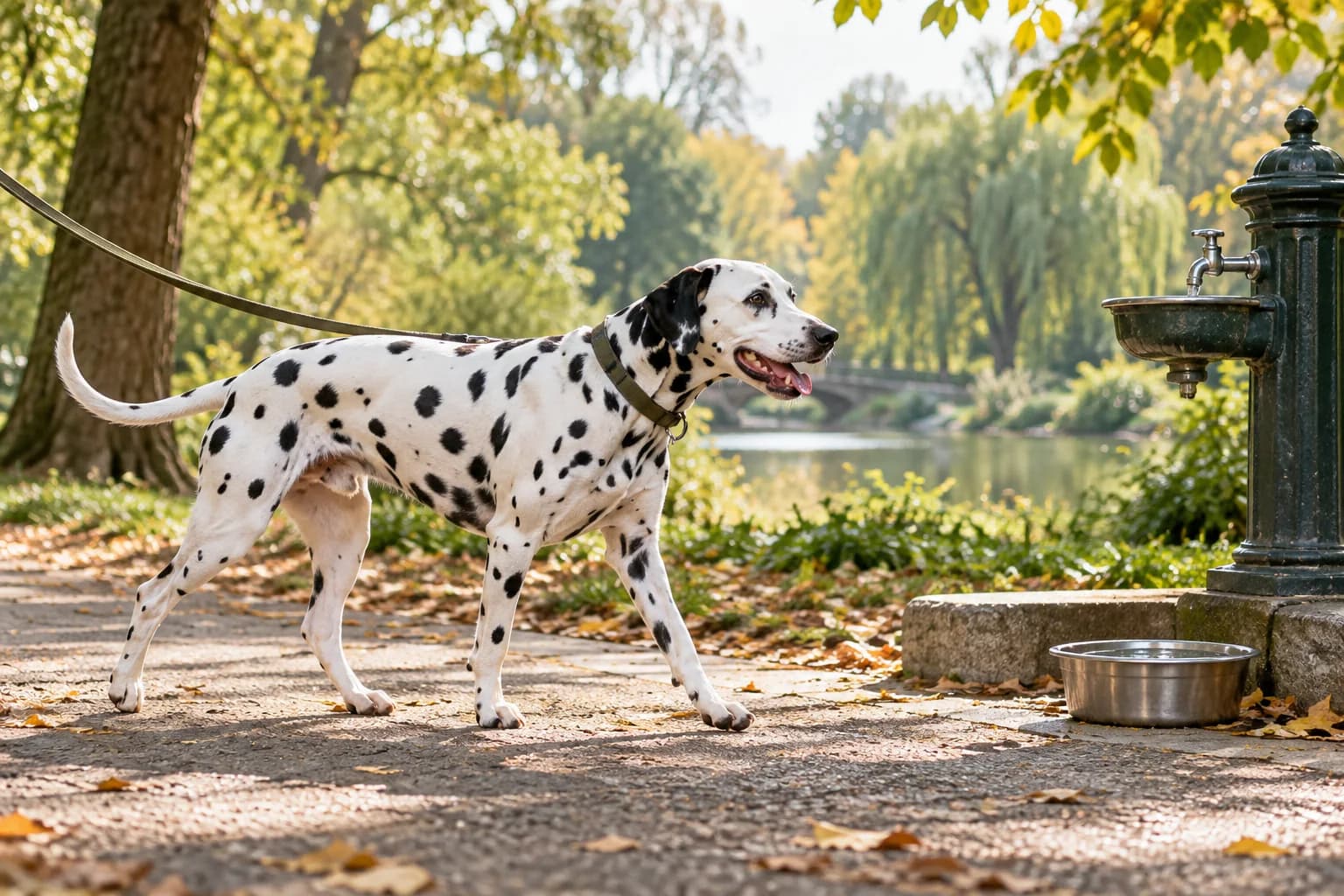
01 / THE COLON IS NOT JUST A STORAGE BAG
Hardness can be part of a loop,
not the beginning of the story.
You notice a few pebble-like pieces during a walk. The first explanation is tempting: “Not enough water.” But that conclusion leaves out the journey before the pieces reached the ground.
The colon absorbs water. When material stays there longer, it can become drier and harder to pass. Continued retention can therefore reinforce the difficulty that began it. The dry appearance does not reveal whether reduced water intake, slow movement, pain, a restriction or another problem came first. [1][2]
Staying longer can change what must pass.
These are two schematic conditions, not two timed stages in your dog.
Water absorption is a normal job of the colon.
Drier contents can then become harder to move.
Simplified cross-section, not a diagnostic image. Drop counts, colors and shapes are not measurements; no waiting period is implied.
Do not ask only, “Why is it dry?”
Ask, “Why was it hard to pass?”
A narrow route, ineffective propulsion, or reluctance to defecate because it hurts are different problems. A photograph of the final pieces cannot sort them into a treatment plan. A water bowl remains important, but it is not an examination of the bowel. [2]
For your account, use “hard-looking” when that is all the image supports. Do not squeeze or handle feces to prove a texture. Include what you actually witnessed during passage; it may tell the clinic more than another close-up.
Constipation, obstipation and motility—what do the words mean?
Constipation means infrequent or difficult fecal passage. Obstipation describes severe, intractable retention in which the accumulated feces cannot be evacuated. Motility is the movement that propels intestinal contents. These are not three picture scores to assign at home. [2]
02 / SUCCESSFUL OUTPUT AND CONTINUING DIFFICULTY CAN COEXIST
A few pieces passed.
Did the problem pass with them?
Imagine sending “He finally pooped” to another family member. The sentence sounds reassuring, but it may hide a second fact: the dog kept trying afterward. A record should preserve the successful passage and the continuing difficulty, not let one cancel the other.
PUT THE OBSERVATION IN CONTEXT
Keep the effort in the story.
A few pieces passing does not tell you whether difficulty continued. Describe the whole event.
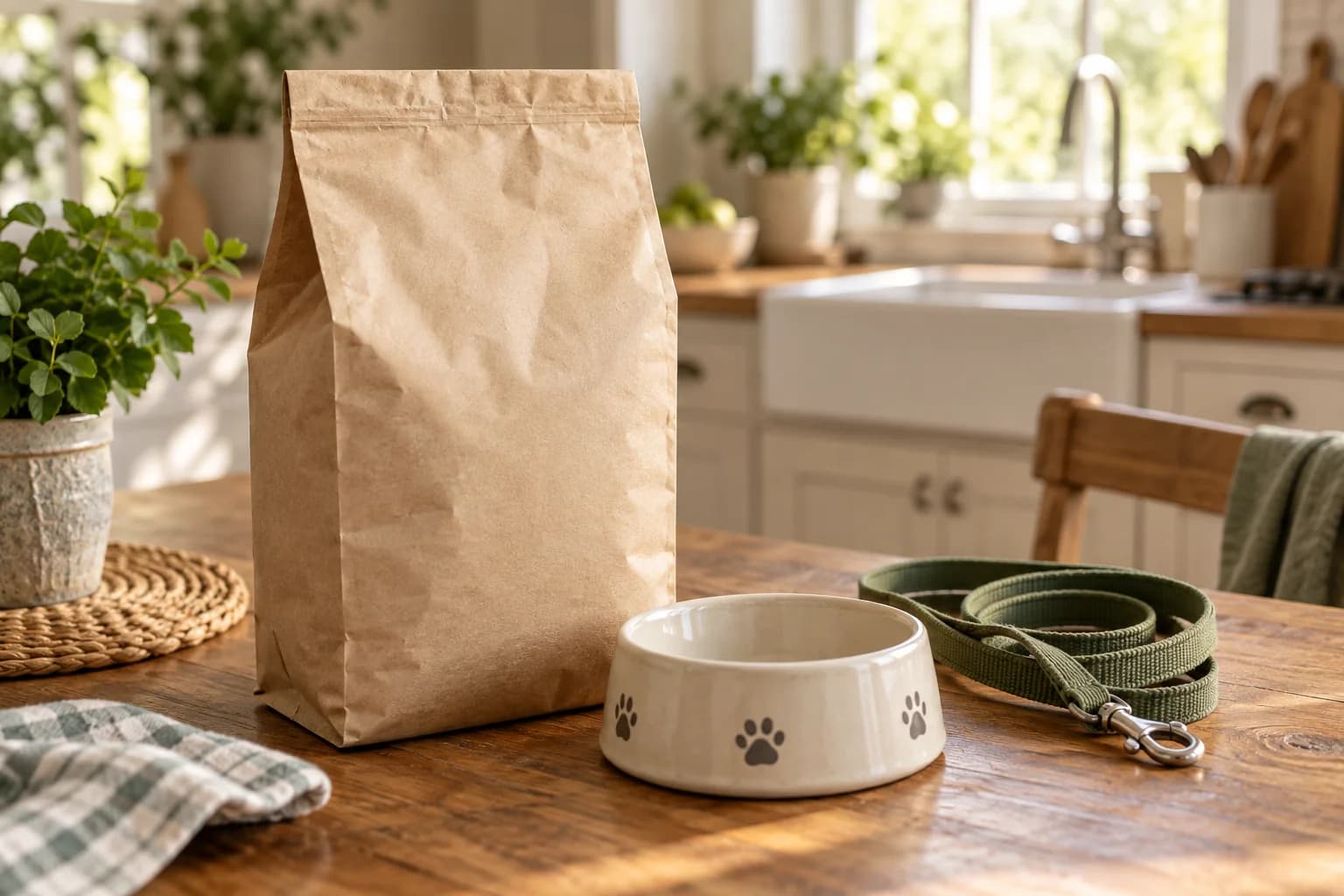
What passed
Record the appearance and amount in ordinary words.
What continued
Describe repeated attempts, discomfort and what output was actually seen.
What you can bring
Have the food and medicine information available for the conversation.
The photograph is not a treatment demonstration. Follow the guide's advice before trying a remedy.
“Something came out”
does not say the difficulty ended.
The same event is described with or without the rest of the walk. Neither view diagnoses constipation.
Fictional education, not a live case, risk score or treatment selector. No example is saved or sent. Urinary difficulty is a separate urgent concern.
There is an even less intuitive limit: liquid material can sometimes pass around a retained hard fecal mass. A later wet patch therefore does not, by itself, prove that a retention problem has cleared. This is an explanation of why signs can overlap—not a way to diagnose impaction from a photo. [1]
Straining also occurs with other conditions. Colon inflammation can create urgency and frequent small passages; urinary obstruction involves a different route altogether. Report whether stool or urine actually emerged and mark what you do not know. If urine is not passing, obtain immediate care rather than choosing the closest-looking stool example. [5][4]
Keep the question precise: “What did I see come out, and what difficulty continued?” It is more useful than trying to decide whether today belongs in a constipation or diarrhea folder.
03 / WHY A REASONABLE REMEDY IS NOT A UNIVERSAL ONE
“Add fiber” is not
a complete explanation.
Online advice often treats fiber as one substance with one predictable effect. It is a family of materials. Different fibers vary in how they interact with water and how intestinal bacteria ferment them; their effects are not interchangeable. A bigger spoonful is not necessarily a better match. [3]
More bulk is not the same
as an easier way out.
Fiber can help selected patients. That does not make every fiber product the same remedy.
Moisture
Hydration affects how contents behave. A photograph cannot measure it.
Movement
The bowel must propel its contents. Adding material does not identify a motility problem.
Passage
A restricted route needs assessment. Bulk is not a way to rule out obstruction.
Crude fiber ≠ total dietary fiber.
The percentage alone does not explain the fiber types or predict which diet fits this dog.
An explanatory framework, not a feeding formula. No dose, product, fiber ranking or home obstruction test is provided.
Clinical constipation management may use a low- or high-fiber diet depending on the problem. That apparently contradictory advice makes sense once the goal is the individual animal’s passage—not simply increasing a number on a bag. [1]
Hydration also matters before adding fiber, because fiber can contribute to impaction in a poorly hydrated, constipated colon. This is not a claim that fiber is dangerous for every dog; it is a reason not to prescribe it from a dry-looking photograph. [2]
Nor can two food labels be ranked by crude fiber alone. Guaranteed analysis reports a maximum, and crude fiber does not include the whole soluble-fiber fraction. The same label heading therefore does not promise the same total fiber profile or effect. Bring the complete food name and label to the discussion instead of choosing a treatment by the largest percentage. [7][3]
Why not try a laxative, oil or an enema first?
A clinician may need to distinguish a passage problem from an obstruction and assess hydration before treatment. Stimulant laxatives are contraindicated with bowel obstruction, and orally given mineral oil carries an aspiration risk. Do not give laxatives, oils, enemas or a new supplement without veterinary direction. This page provides no dose or procedure. [2][6]
04 / BRING AN ACCOUNT, NOT A SELF-DIAGNOSIS
The walk may contain
more information than the picture.
A useful call can be short. Describe the change, whether material passed, whether attempts continued, and how the dog is now. Mention medicines and possible swallowed objects. Do not wait to collect every detail before calling about a painful or deteriorating dog.
The output. The effort. The context.
What passed?
First observed change, amount as seen, and the last stool actually witnessed.
What continued?
Attempts, discomfort, appetite, vomiting, and any difficulty passing urine.
What changed?
Food, medicines, activity, painful movement, and possible swallowed objects.
Call first when care is needed. These prompts are not a form you must finish, and no personal record is collected here.
“Dry pieces. Must need more fiber. Some came out, so it is over.”
The texture has been turned into a cause, a remedy and an all-clear without the missing information.
“A few hard-looking pieces passed, but repeated attempts and discomfort continued. Appetite is reduced. I am calling the clinic and can describe the food and medicines.”
Observed output, continuing difficulty, current signs and the next real action remain distinct.
Examination and, when appropriate, imaging can investigate retained contents or an obstructed route. A stool picture cannot replace those views of what is still inside. The clinic can advise whether a sample is needed and how to bring it. [6]
Keep the appearance.
Keep the effort in the story.
PetCheck organizes visible features and the context you add. It cannot measure hydration, confirm that the bowel emptied, rule out obstruction or choose a fiber supplement.
Describe an existing stool photoNo photo selected. No check has run. The examples are not saved, sent or prefilled. Do not delay care to use this tool.SOURCES, SCOPE & LIMITS
Understand the mechanism.
Do not diagnose from the diagram.
The sources support the stated concepts, not PetCheck as a product. This AI-assisted article has not been independently veterinarian-reviewed. Its diagrams and fictional accounts are original educational material, not clinical photographs, measured transit studies or a symptom checker.
- 01VCA Animal HospitalsConstipation in Dogs ↗
Water absorption and retained stool; liquid material may pass around retained feces. Examination and the underlying cause guide treatment, which may include either low- or high-fiber dietary management.
- 02MSD Veterinary ManualConstipation, Obstipation, and Megacolon in Small Animals ↗
Transit and retention, impaired movement and physical restriction. Hydration matters before fiber supplementation; severe retention is not a home-treatment problem.
- 03MSD Veterinary ManualNutritional Requirements of Small Animals — Fiber ↗
Fibers differ in their physiological effects and fermentability. Crude fiber is not an adequate description of total fiber or its likely effects.
- 04American College of Veterinary SurgeonsUrinary Obstruction in Dogs ↗
Inability to urinate requires immediate veterinary attention. A stool article must not misdirect a dog with urinary obstruction into a constipation remedy.
- 05VCA Animal HospitalsColitis in Dogs ↗
Urgency and frequent straining can accompany colon inflammation. Posture alone does not establish fecal retention or its cause.
- 06MSD Veterinary ManualGastrointestinal Obstruction in Small Animals ↗
Obstruction is an emergency problem; vomiting, pain and even diarrhea may occur. History, examination and diagnostic imaging answer questions a stool photograph cannot.
- 07MSD Veterinary ManualDog and Cat Foods — Label Information ↗
Guaranteed-analysis crude fiber is a maximum, not a complete fiber profile. A label percentage alone is not a clinical diet comparison.
FOR ANOTHER VISIT
Keep this guide close.
Save it to read again, or copy a link to share.
ONE QUESTION CAN LEAD TO ANOTHER
A useful next read.
Choose the question that fits what you want to understand next.
 AI-generated editorial scene
My dog has not pooped in 24 hours. What should I check?
Separate a hard stool you saw from an interval when you did not see stool passed.
Read the guide AI-generated editorial scene
Why is my dog pooping more often?
Compare trips, attempts and actual output rather than treating every outing as a bowel movement.
Read the guide