CAT CARE · HOME LAYOUT
How should I set up litter boxes in a multi-cat home?
Give each cat more than one safe route to toileting resources, then audit access from the cat's point of view.
THE DIRECT ANSWER
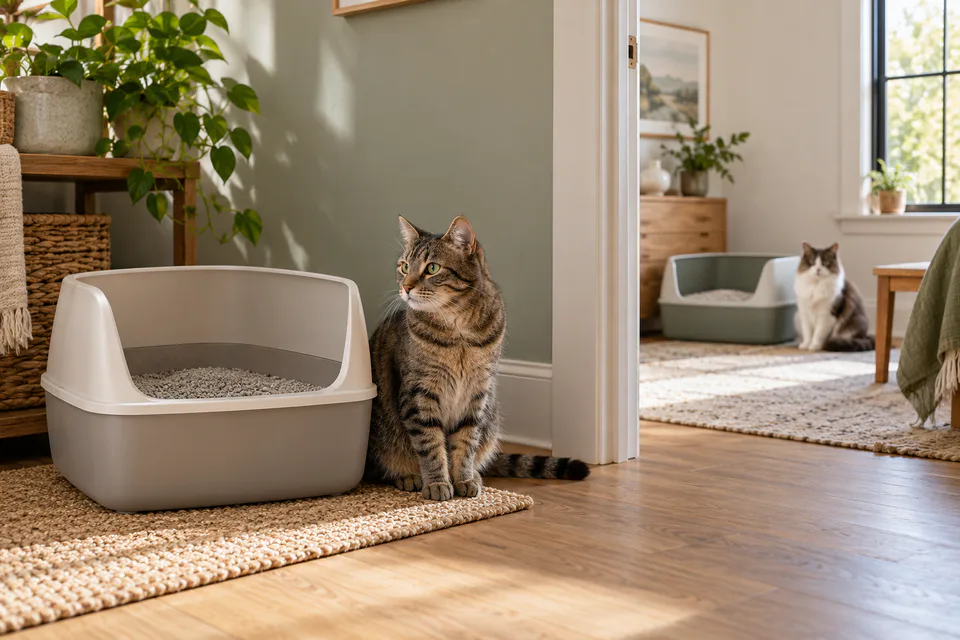
Start with one litter box for each cat plus one extra, and place the boxes in separate locations rather than lining them up as one station. Choose quiet, accessible places away from food and water, with a route that another cat cannot easily block. In a multi-level home, include a box on each level and keep an older or mobility-limited cat's most-used level covered. The count is a starting point: watch whether every cat can approach, enter and leave without being cornered, and ask a veterinarian about new house-soiling because medical problems can be involved.
Sources: FelineVMA: Feline House-Soiling · FelineVMA: Setting Up the Environment for Success
Use the box count as a floor, then separate the locations
FelineVMA gives the general rule of one box per cat plus one extra. For three cats, that produces a starting count of four boxes—not a promise that four boxes will work in every floor plan.
Boxes placed side by side may be experienced as one large toileting area. Separation matters because one cat, one noise or one blocked doorway can make a clustered station unavailable all at once.
Keep the inventory and the location map together. A household can meet the numerical rule while still offering only one practical route.
| Question | Record | Do not assume |
|---|---|---|
| How many? | One per cat plus one extra as the general starting point | That the count solves access conflicts |
| Where? | Distinct rooms or zones, not one clustered row | That two adjacent boxes are two safe choices |
| Who can reach it? | Route, doorway, stairs and likely blocking points | That an open door means every cat feels safe |
| What changed? | New pet, move, noise, mobility or cleaning change | That the newest change is the diagnosis |
Sources: FelineVMA: Feline House-Soiling
Map the approach and the exit, not only the box
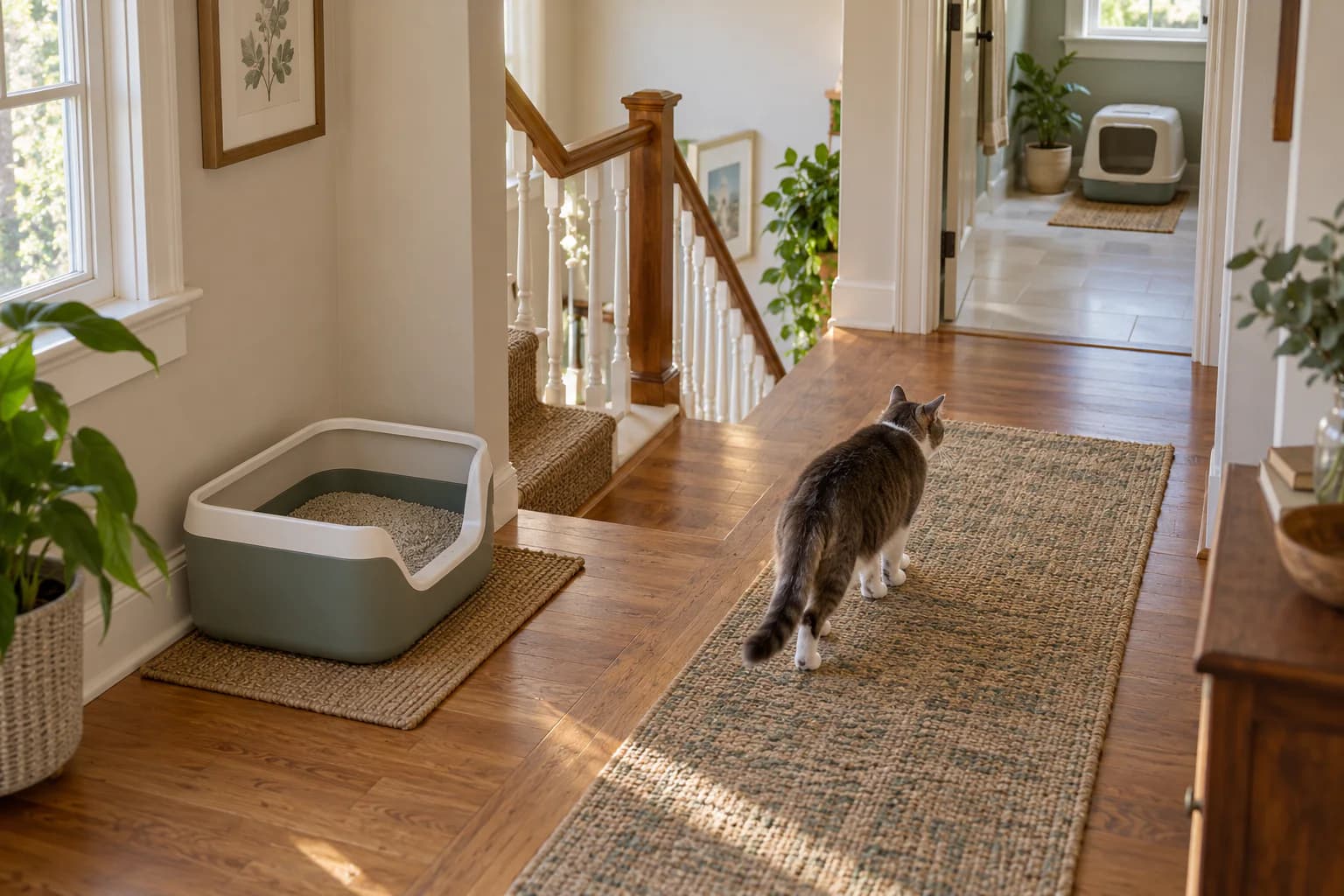
A quiet location can still fail if it is at the end of a narrow hall or inside a closet where another cat can guard the only exit. Stand at cat height and trace the approach, sight lines and escape choices.
Keep toileting areas away from food and water. Spread key resources through the home so one socially confident cat does not control every route.
For a multi-level home, include a box on each level. Put an accessible box on the level where an older cat spends the most time rather than requiring repeated stair use.
Sources: FelineVMA: Feline House-Soiling · FelineVMA: Setting Up the Environment for Success
A fictional three-cat floor-plan audit
Fictional example: Maple, Sora and Finch have four boxes. Two are together in the laundry room, one is behind a basement door and one is upstairs near Maple's resting area.
The owner records that the two laundry boxes behave like one location, the basement route can be blocked at the stairs and Finch rarely goes upstairs. The next action is to test separated accessible locations, not to label Finch stubborn.
This example demonstrates a layout review. It is not a behavioral diagnosis and does not predict which box or litter an individual cat will prefer.
| Location | Observed constraint | Next question |
|---|---|---|
| Laundry pair | Two boxes touch; appliance noise | Can one move to a separate quiet zone? |
| Basement | Single stair route | Can another cat block approach or exit? |
| Upstairs | Accessible to Maple; Finch rarely visits | Does Finch have a safe same-level option? |
| Fourth location | Not yet chosen | Which dispersed route adds a real choice? |
Check entry, size and cleaning without changing everything at once
FelineVMA notes that bigger boxes are generally better and that older cats may need a low entry. A low side must still be smooth and free of sharp cut edges.
Remove waste at least daily and follow the box and litter instructions. The FelineVMA handout advises soap and hot water for periodic box washing and avoiding strong or ammonia-based chemicals.
When investigating a problem, avoid changing box, litter, location and cleaning product all at once. A dated change log makes the response interpretable.
Sources: FelineVMA: Feline House-Soiling
Record access patterns without policing the cats
Write down which route was open, whether another cat was nearby, and what the cat did before and after. Do not corner a cat near a box to test willingness.
My Pet Notes stores a local household map in this browser. It does not monitor box use, identify an individual cat or rule out disease.
Bring a concise layout and timeline to the veterinarian when a toileting change is new, persistent or accompanied by physical signs.
- Box count and actual locations are both recorded.
- Approach and exit cannot be easily blocked.
- Food and water are separate from toileting areas.
- Medical warning signs override a layout experiment.
FROM THE GUIDE · INTO THEIR EVERYDAY
A multi-cat litter-box map
Record locations, routes and possible blocking points. This does not diagnose house-soiling.
Draft my litter-box mapChoose their notebook, add your own details, then save. Free, no account. Notes stay in this browser.
THE NEXT QUESTIONS
What else might you be wondering?
Do two litter boxes beside each other count as two locations?
They are two physical boxes, but FelineVMA notes that cats may regard nearby boxes as one large toileting area. Separate locations provide different routes and choices.
Sources: FelineVMA: Feline House-Soiling
Should every box be in a hidden room?
Privacy matters, but a hidden location with one narrow entrance can allow cornering or blocking. Choose quiet places with safe approach and exit routes.
Sources: FelineVMA: Feline House-Soiling
Will adding a box stop house-soiling?
It may improve access, but it does not identify the cause or exclude a medical problem. New or concerning changes need veterinary assessment.
Sources: FelineVMA: Feline House-Soiling
LOOK CLOSER AT THE EVIDENCE
Sources & what they establish
Official guidance, research findings and PetCheck’s practical interpretations have different roles. These notes explain how the sources were used.
Feline veterinary caregiver guidance
FelineVMA house-soiling handout
Supports the general one-per-cat-plus-one rule, separated locations, safe routes, multi-level access and routine cleaning.
Limit: The rule is a starting point and does not diagnose an individual cat's house-soiling.
Sources: FelineVMA: Feline House-Soiling
Feline environmental guidance
FelineVMA environment setup
Supports multiple separated resources and locations that give cats safety, control and choice.
Limit: It cannot determine which resource arrangement a particular household will accept.
Sources checked 2026-10-24. Examples are fictional and illustrate reasoning, not patient outcomes. This is an editorial source review, not independent veterinary review. How we prepare these guides →
FOR ANOTHER VISIT
Keep this guide close.
Save it to read again, or copy a link to share.
ONE QUESTION CAN LEAD TO ANOTHER
A useful next read.
Choose the question that fits what you want to understand next.
 AI-generated editorial scene
How should I introduce a new cat to my resident cat?
Keep the new-cat transition and its temporary separated resources distinct from the long-term household layout.
Read the guide AI-generated editorial scene
What should I write down before my pet’s vet visit?
Bring a new toileting change and its physical signs into a bounded veterinary timeline.
Read the guide