CAT CARE · INTRODUCTIONS
How should I introduce a new cat to my resident cat?
Prepare separate resources, move through scent and visual steps slowly, and let either cat's discomfort pause the process.
THE DIRECT ANSWER
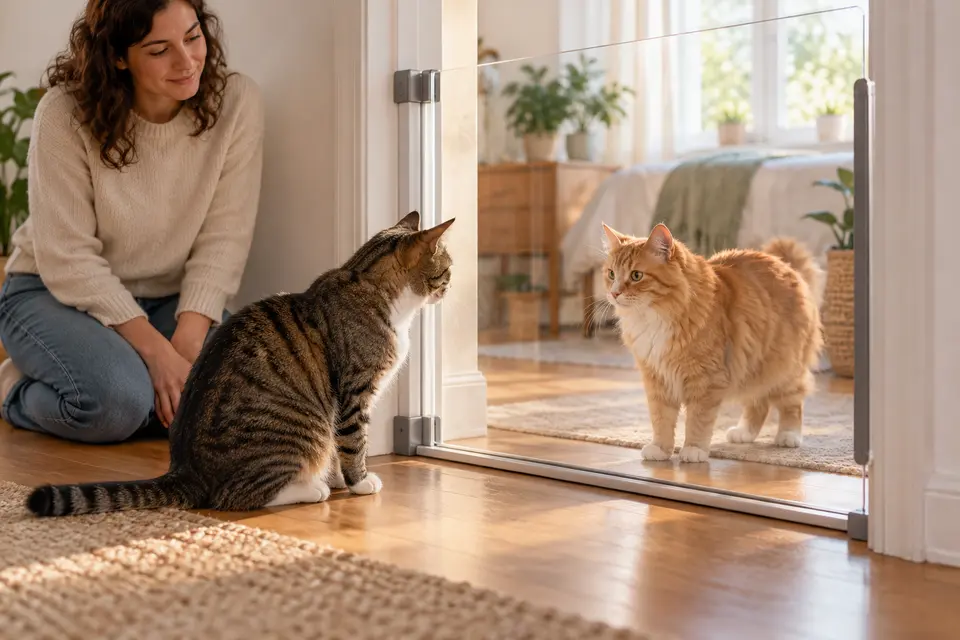
Begin with veterinary health checks and a secure transition room for the new cat, with its own food, water, litter, hiding, resting, scratching and elevated spaces. Keep the cats physically separate while the newcomer settles. Then introduce scent, closed-door activity and brief visual access through a secure barrier only as both cats remain comfortable. Do not use a calendar deadline, force contact, punish hissing or pick up cats during a tense moment. Pause or step back when either cat shows tension.
Sources: FelineVMA: How to Introduce a New Cat to Other Cats in Your Home · FelineVMA: 2024 Intercat Tension Guidelines
Prepare two complete spaces before the first meeting
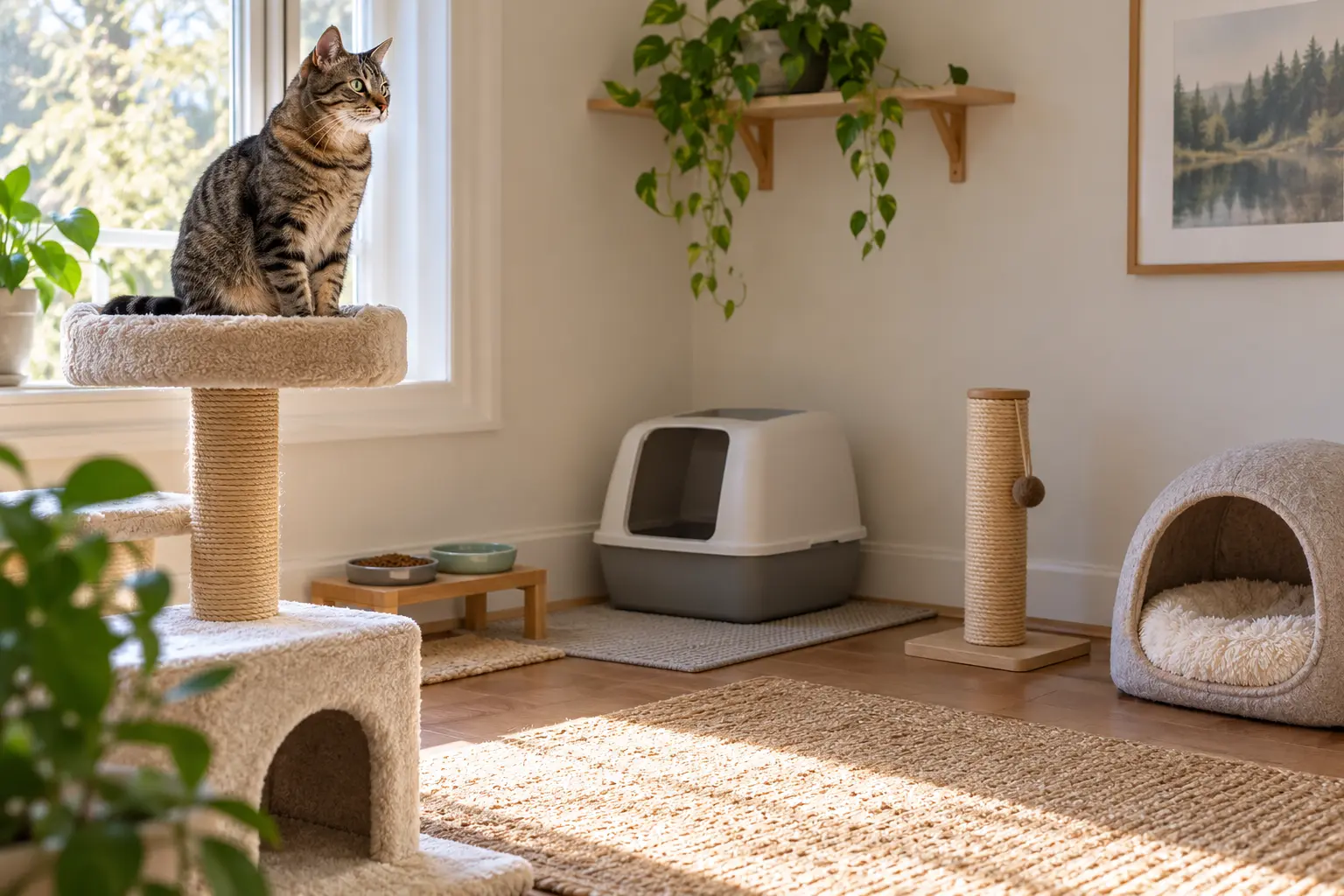
FelineVMA advises a quiet transition room that can be secured against unsupervised interaction. It needs the new cat's own essentials rather than borrowed access to the resident cat's resources.
Spread resources rather than placing food, water, litter and resting places in one congested corner. The purpose is to reduce competition and give each cat choices, not to guarantee friendship.
Keep the familiar routines and resting areas of the resident cat intact where practical. A newcomer should not arrive by suddenly removing the resident cat's only preferred resource.
| Part | What to confirm | What it does not prove |
|---|---|---|
| Health check | Both cats have current veterinary guidance | That behavior concerns are medical-free forever |
| Transition room | Door secures; food, water, litter, rest, scratch and height are available | That the new cat is ready to meet |
| Resident space | Usual routes and resources remain available | That resource competition cannot occur |
| Barrier | Stable, tall and supervised for visual sessions | That direct contact is safe |
Sources: FelineVMA: How to Introduce a New Cat to Other Cats in Your Home
Use behavior—not elapsed days—as the gate
The FelineVMA handout says introductions may take days, months or longer and advises against moving forward until each cat is comfortable with the current step. That makes a fixed seven-day promise inappropriate.
Start with settling, then scent items, activity on opposite sides of a closed door, supervised exploration at different times, and visual access. Each step is a separate observation.
Hissing, growling, pacing, avoidance, litter changes or a sharp change in normal behavior are reasons to stop and create more distance—not reasons to discipline the cat.
Sources: FelineVMA: How to Introduce a New Cat to Other Cats in Your Home · FelineVMA: 2024 Intercat Tension Guidelines
A fictional introduction log without a deadline
Fictional example: new cat Juniper explores her transition room and eats normally. Resident cat Moss sniffs a towel from several feet away, then leaves. The owner records both choices without arranging a face-to-face meeting.
On the next attempt Moss growls at the closed door. The owner ends the session and moves Moss's play activity farther away. The record says 'paused at closed-door step'; it does not label either cat aggressive.
This example illustrates a decision boundary. It is not a tested protocol, a promise of compatibility or a substitute for individual veterinary or behavior advice.
| Stage | Observed | Boundary kept |
|---|---|---|
| Transition room | Juniper explored and used resources | No visual access |
| Scent item | Moss sniffed, then walked away | No item placed beside a trapped cat |
| Closed door | Moss growled | Session ended; distance increased |
| Next step | Not chosen yet | Comfort, not the date, decides |
Plan how to end a tense moment before it happens
Keep a large towel, cushion or piece of cardboard nearby to block visual contact if tension rises. FelineVMA specifically cautions against picking up cats during a tense moment because redirected behavior can injure a nearby person or animal.
Close a barrier and return each cat to a complete space. Do not chase, corner or stage another attempt immediately.
If conflict persists or normal eating, toileting or rest changes, contact the veterinary team and describe the sequence rather than sending only a dramatic clip.
Sources: FelineVMA: How to Introduce a New Cat to Other Cats in Your Home · FelineVMA: 2024 Intercat Tension Guidelines
Record one accepted step and one reason to pause
A useful note names the setup, distance, barrier, each cat's behavior and who ended the session. Avoid global labels such as dominant, jealous or friendly.
My Pet Notes stores the draft locally in this browser. It does not monitor the cats, contact a professional or decide when to progress.
Keep the next step blank until the current observations support it.
- Each cat has complete separated resources.
- The current stage and barrier are named.
- Both cats' behavior is recorded separately.
- The stop signal changes the plan.
FROM THE GUIDE · INTO THEIR EVERYDAY
A calm cat-introduction log
Record each cat's response and the current boundary separately. This does not predict compatibility.
Draft my introduction logChoose their notebook, add your own details, then save. Free, no account. Notes stay in this browser.
THE NEXT QUESTIONS
What else might you be wondering?
How many days should a cat introduction take?
There is no universal duration. Progress depends on both cats remaining comfortable at the current step; some introductions take much longer than others.
Sources: FelineVMA: How to Introduce a New Cat to Other Cats in Your Home
Should I let the cats work it out face to face?
No. Use gradual, supervised steps and secure separation. Do not force proximity or allow unsupervised contact during the introduction process.
Sources: FelineVMA: How to Introduce a New Cat to Other Cats in Your Home · FelineVMA: 2024 Intercat Tension Guidelines
Does one hiss mean the introduction has failed?
A hiss is information that the current setup may be too difficult. End calmly, increase distance and reassess rather than punishing or declaring permanent incompatibility.
Sources: FelineVMA: How to Introduce a New Cat to Other Cats in Your Home
LOOK CLOSER AT THE EVIDENCE
Sources & what they establish
Official guidance, research findings and PetCheck’s practical interpretations have different roles. These notes explain how the sources were used.
Feline veterinary caregiver guidance
FelineVMA step-by-step introduction
Supports separate resources, transition space and staged scent, door and visual work at each cat's pace.
Limit: Does not predict an individual pair's timeline or guarantee compatibility.
Sources: FelineVMA: How to Introduce a New Cat to Other Cats in Your Home
Professional guideline
2024 Intercat Tension Guidelines
Supports recognizing subtle tension and preventing resource competition and forced interaction.
Limit: Persistent conflict requires individualized veterinary or behavior assessment.
Original editorial workflow
Juniper and Moss's fictional log
Shows how a stop signal changes the next action without labeling either cat.
Limit: Not real animals or a tested outcome.
Sources checked 2026-10-23. Examples are fictional and illustrate reasoning, not patient outcomes. This is an editorial source review, not independent veterinary review. How we prepare these guides →
FOR ANOTHER VISIT
Keep this guide close.
Save it to read again, or copy a link to share.
ONE QUESTION CAN LEAD TO ANOTHER
A useful next read.
Choose the question that fits what you want to understand next.
 AI-generated editorial scene
How can I help my cat get comfortable with a carrier?
Prepare transport separately from the room, resource and barrier stages of the introduction.
Read the guide AI-generated editorial scene
What should I write down before my pet’s vet visit?
Carry appetite, litter-box or health concerns into a bounded veterinary timeline.
Read the guide