OBSERVATION · URGENT HANDOFF
How should I record a possible pet seizure for the veterinarian?
Preserve the clock, what happened before and after, and recovery without restraining your pet or delaying emergency care.
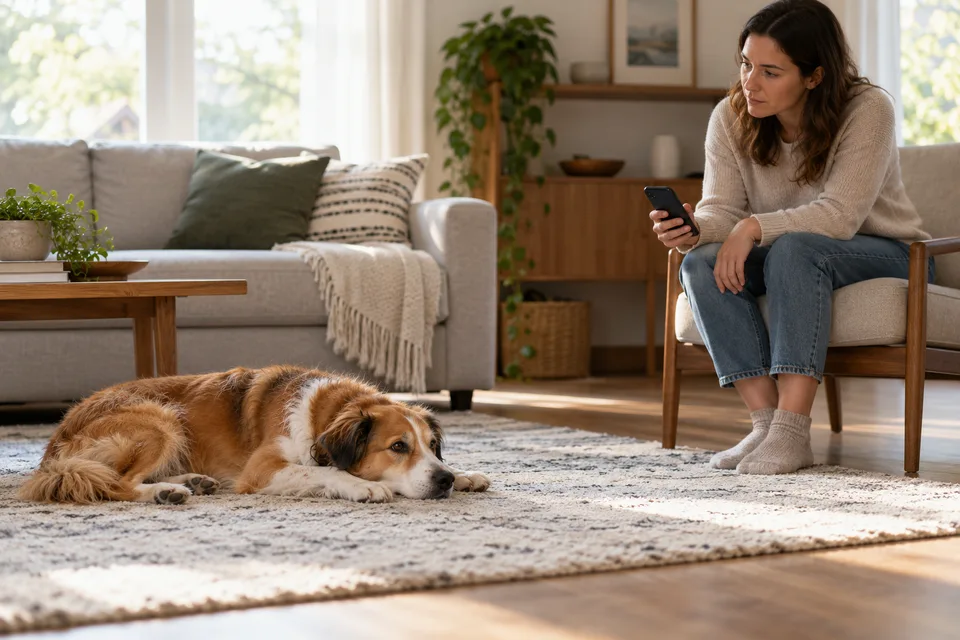
THE DIRECT ANSWER
Start a timer as soon as you safely can, clear nearby hazards, and keep your hands and objects away from your pet's mouth. Do not restrain the movements. If another person is available, a short video from a safe distance can help, but the clock and urgent care come first. Record what happened immediately before the episode, which body areas moved, awareness or responsiveness, urine or stool, the stop time, and how long recovery took. Cornell identifies a seizure lasting more than five minutes as an emergency; repeated episodes or any concern about safe breathing, injury or recovery also warrants immediate veterinary direction.
Sources: Cornell: Managing seizures · Cornell: Idiopathic epilepsy in dogs
Use the first safe minute for time and space
Note the clock time or start a timer, then move furniture, sharp objects, other animals and people away if that can be done safely. Cornell advises against restraining the pet or putting anything in the mouth.
Dim stimulation when practical and observe from a safe position. A video is optional evidence, not the task that outranks breathing, injury prevention or transport.
If the episode passes five minutes, Cornell treats it as an emergency. Do not wait for a neat endpoint to contact emergency care.
| Priority | Record or action | Do not do |
|---|---|---|
| 1 | Start time and current duration | Guess later from memory |
| 2 | Clear hazards and protect space | Hold the pet down |
| 3 | Call/leave when emergency direction applies | Delay for a longer video |
| 4 | Observe from a safe distance | Put hands or objects in the mouth |
Sources: Cornell: Managing seizures
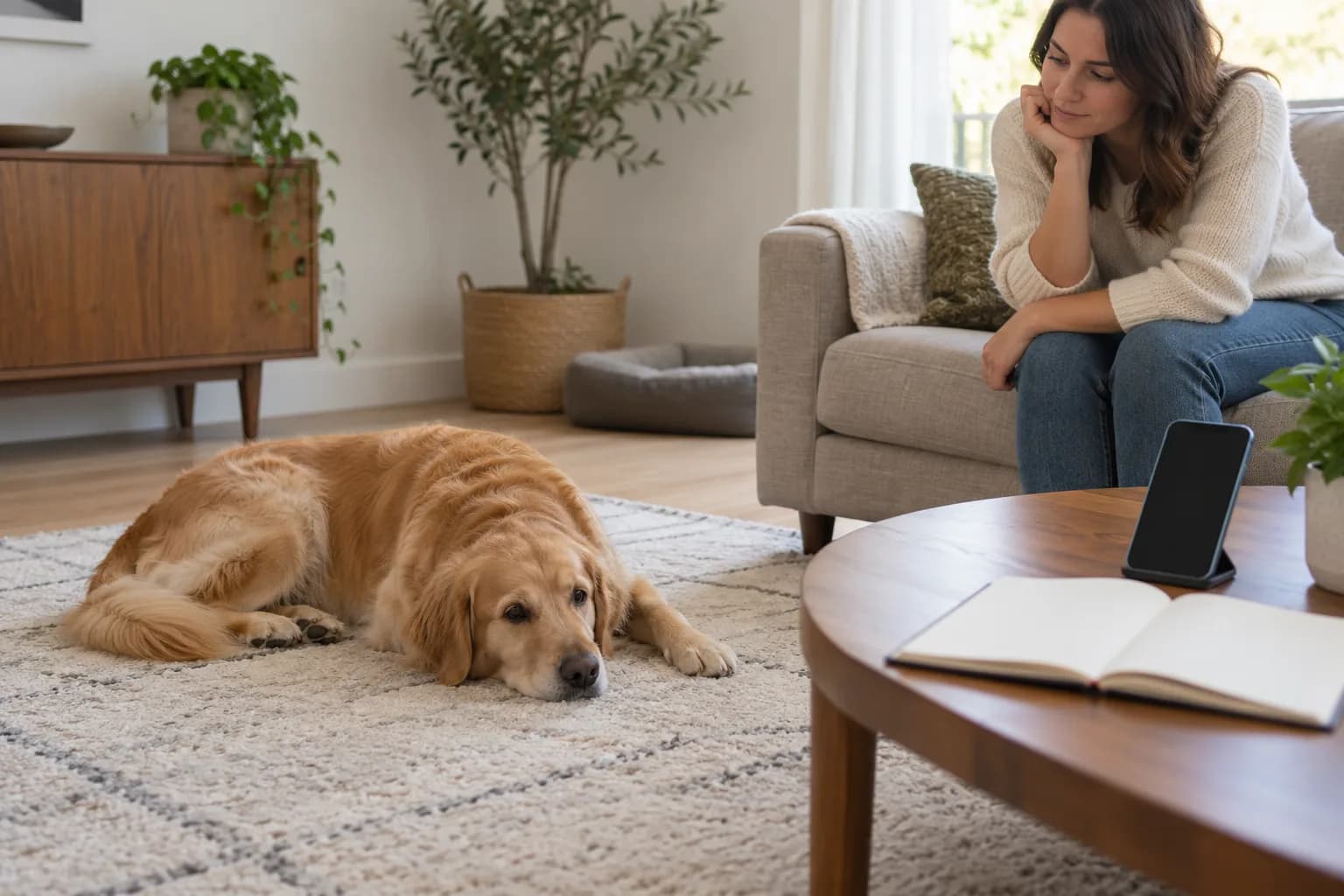
Describe before, during and after as separate phases
Cornell describes pre-ictal, ictal and post-ictal phases. You do not need to label the event; the useful contribution is a plain timeline.
Before: note sleep, activity, eating, medication timing or unusual behavior only if actually observed. During: describe body areas, posture, movement, responsiveness, breathing appearance and elimination. After: describe confusion, pacing, vision difficulty, appetite, weakness and return toward usual behavior.
Write 'not observed' where nobody saw the transition. Missing information is safer than an invented continuous story.
Sources: Cornell: Idiopathic epilepsy in dogs
A fictional episode record
Fictional example: At 7:42 pm, Avery hears a bowl move and sees Luna on her side. A timer begins at 7:42:18. Luna's limbs move rhythmically; Avery does not touch her and records from the doorway while another adult calls the clinic.
Visible movement stops at 7:43:06. Luna appears disoriented and paces for several minutes. Avery records the uncertainty about the true start rather than subtracting an invented number.
This demonstrates documentation, not proof that Luna had a seizure or that a similar event can wait at home.
| Field | Entry | Limit |
|---|---|---|
| Start | Seen at 7:42; timer at 7:42:18 | True onset unknown |
| During | Side posture; rhythmic limb movement | No cause assigned |
| Stop | Visible movement ended 7:43:06 | Clinic interprets duration |
| Recovery | Pacing and disorientation observed | Does not replace examination |
Keep the handoff short enough to use
Lead with current status, start time, duration and whether recovery is continuing. Then add recent medications, possible exposures, prior similar events and relevant illness history without speculating about cause.
Preserve the original video file and timeline. Do not edit out the beginning or recovery merely to make it shorter; tell the clinic what the file includes.
Ask the clinic where to go and what to do during transport. Service and intake instructions can change.
Sources: Cornell: Managing seizures · Cornell: Emergency and Critical Care
Draft a bounded note after safety is handled
My Pet Notes can hold the observable timeline in this browser. It does not monitor the pet, contact a clinic or interpret a video.
Include gaps and the exact source of each fact—seen directly, heard from another person or reconstructed from a device timestamp.
Bring the note and original video to the veterinary team rather than seeking a diagnosis from the image alone.
- Start and stop times are separate from estimates.
- Before, during and recovery observations are separated.
- No one restrained the pet or approached the mouth.
- Emergency care was not delayed for documentation.
FROM THE GUIDE · INTO THEIR EVERYDAY
A possible-episode timeline
Keep timing, before/during/after observations and recovery together. This does not diagnose the event.
Draft my episode timelineChoose their notebook, add your own details, then save. Free, no account. Notes stay in this browser.
THE NEXT QUESTIONS
What else might you be wondering?
Should I put something in my pet's mouth?
No. Cornell advises keeping fingers and objects away from the mouth and not restraining the pet. Clear nearby hazards instead.
Sources: Cornell: Managing seizures
Is a video more important than timing?
No. Start the clock and protect safety first. Film only from a safe distance when it does not delay urgent contact or transport.
Sources: Cornell: Managing seizures
Can a video confirm a seizure?
It can preserve movement and context for the veterinary team, but it cannot by itself confirm the event type or cause.
Sources: Cornell: Idiopathic epilepsy in dogs
LOOK CLOSER AT THE EVIDENCE
Sources & what they establish
Official guidance, research findings and PetCheck’s practical interpretations have different roles. These notes explain how the sources were used.
University veterinary caregiver guidance
Cornell seizure response
Supports timing, clearing hazards, safe video when possible, keeping hands away from the mouth and the five-minute emergency boundary.
Limit: It does not let an owner diagnose an individual event from appearance.
Sources: Cornell: Managing seizures
University veterinary overview
Cornell epilepsy phases
Supports separating observations before, during and after an event and preserving episode history.
Limit: Phase descriptions do not prove that a recorded event was epileptic.
Sources: Cornell: Idiopathic epilepsy in dogs
Sources checked 2026-10-25. Examples are fictional and illustrate reasoning, not patient outcomes. This is an editorial source review, not independent veterinary review. How we prepare these guides →
FOR ANOTHER VISIT
Keep this guide close.
Save it to read again, or copy a link to share.
ONE QUESTION CAN LEAD TO ANOTHER
A useful next read.
Choose the question that fits what you want to understand next.
 AI-generated editorial scene
How should I choose an emergency veterinary clinic before I need one?
Keep a verified emergency route ready without delaying care to finish an episode record.
Read the guide AI-generated editorial scene
What should I write down before my pet’s vet visit?
Place the episode timeline inside the wider history without deciding its cause.
Read the guide