VET VISIT · SAMPLE HANDOFF
How should I prepare a pet urine sample for the veterinarian?
Confirm the requested collection method, container, amount and timing before collecting, then label and hand off exactly what happened.
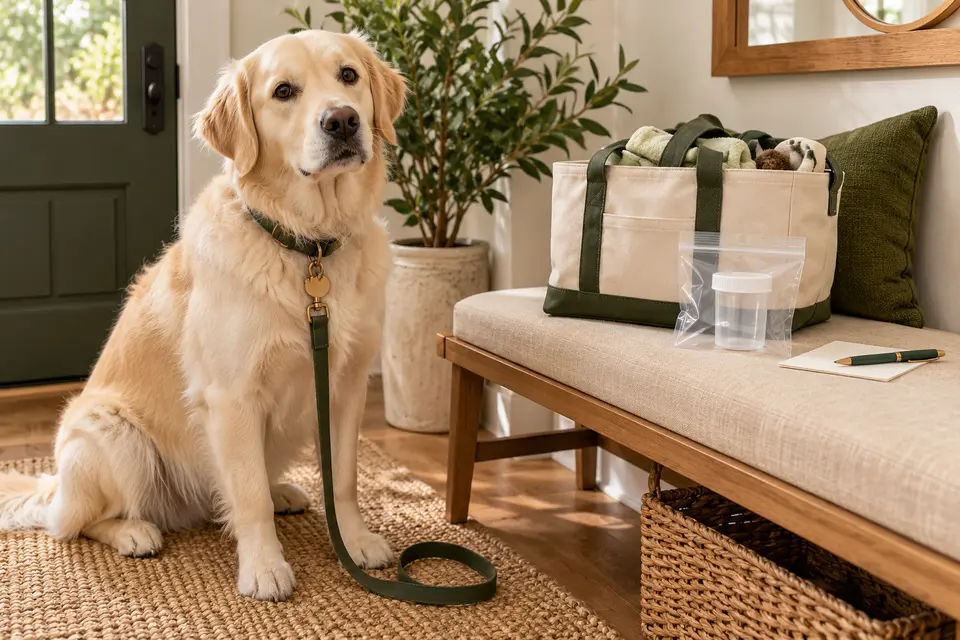
THE DIRECT ANSWER
Call the veterinary clinic before collecting. Ask whether a home free-catch sample is suitable for the intended test, what container and amount it wants, and how soon to deliver or refrigerate it. Record the pet, collection date and time, method, storage and any contamination concern. Do not perform cystocentesis or catheterization at home, and do not assume a free-catch sample can answer the same question as a clinic-collected sample.
Sources: VCA Animal Hospitals: Urinalysis · Cornell Animal Health Diagnostic Center: Samples for Urinalysis · Cornell Animal Health Diagnostic Center: Samples and Submissions
The test question determines the useful sample
VCA describes three collection routes: cystocentesis, catheterization and mid-stream free catch. Free catch is non-invasive and can be collected at home, but it is more likely to contain material from the lower urinary tract or environment.
Cornell notes that suspected urinary infection is commonly evaluated with a cystocentesis sample because it limits external contamination. That is a clinic procedure, not an at-home technique. A sample already collected by another method may not suit a culture or another intended test.
Before preparing equipment, ask the receiving clinic five questions. Write down its answers rather than replacing them with a generic web rule.
| Question | Why it changes the plan | Record |
|---|---|---|
| Is home free catch suitable? | Collection route affects contamination and test use | Requested method |
| Which container? | The clinic or laboratory may specify sterile or rigid containers | Container supplied or approved |
| How much? | Requirements differ by test and laboratory | Clinic's requested minimum |
| When should I collect? | Timing may matter for the intended analysis | Date/time window |
| How should I store and deliver it? | Delay and temperature can affect handling | Exact handoff instruction |
Sources: VCA Animal Hospitals: Urinalysis · Cornell Riney Canine Health Center: Urinary tract infections
Keep a home free-catch attempt simple and clean
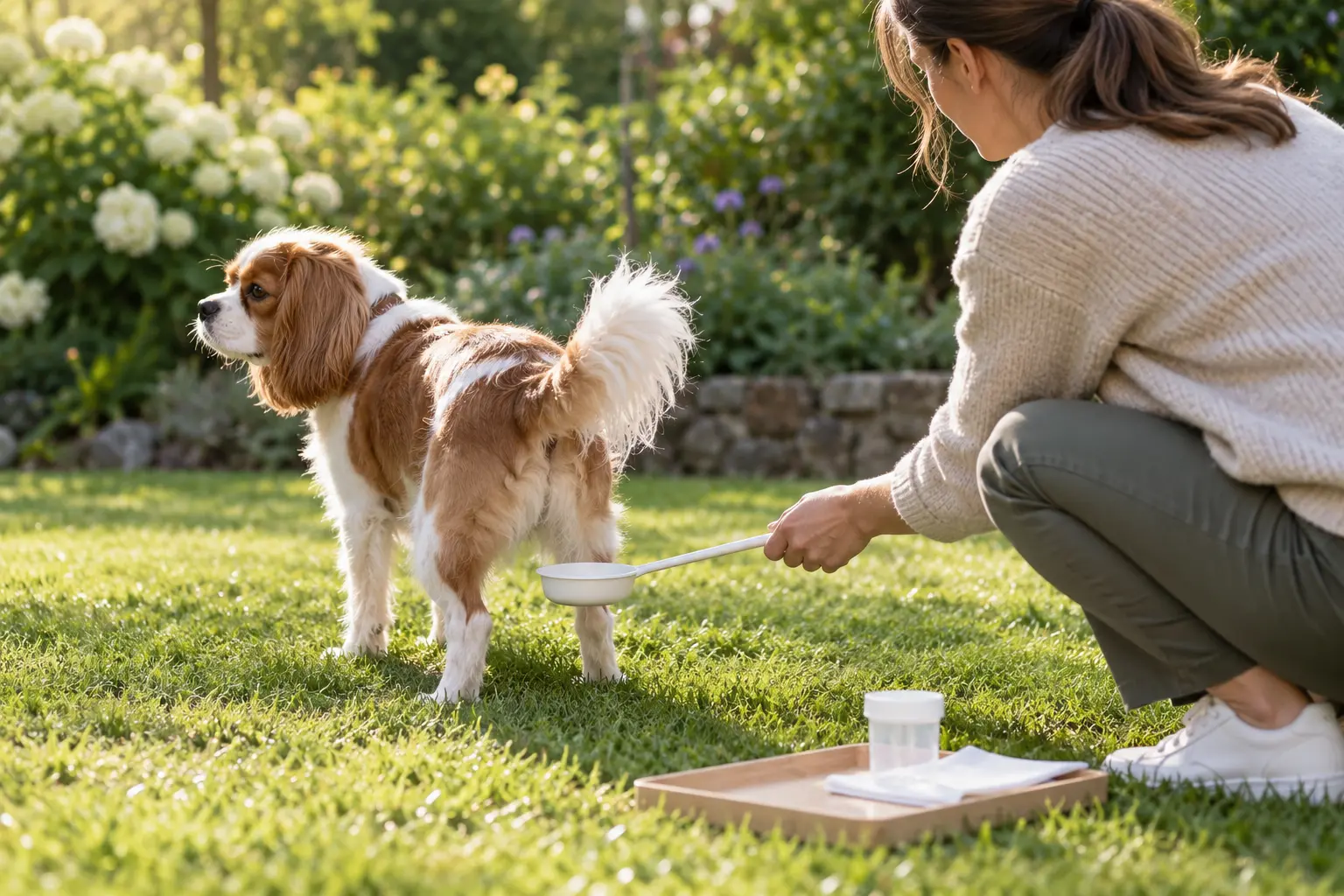
If the clinic approves home free catch, use its container and technique. VCA describes mid-stream collection into a sterile container; some animals or household setups make this difficult. Do not chase, restrain unsafely or repeatedly delay urination for a perfect catch.
Keep the lid and inside of the container free from hand, ground, litter, grass and cleaning-product contact as far as the clinic directs. If contamination occurs or the sample comes from a non-absorbent litter setup, disclose it rather than silently filtering or transferring the sample.
Do not add preservatives, water or cleaning agents. Do not pour the sample through a household strainer or use an unapproved food container merely because it closes.
Sources: VCA Animal Hospitals: Urinalysis · Cornell Animal Health Diagnostic Center: Samples and Submissions
A fictional sample that stays honest about its limits
Fictional example: Priya's clinic asks for a free-catch sample from dog Cedar, supplies a container, and gives same-morning delivery instructions. Cedar urinates at 7:20 a.m.; Priya catches part of the stream without contacting the ground.
Priya closes the supplied container, records the time and follows the clinic's storage direction. She does not write 'sterile' because a home free-catch sample has a different contamination profile from cystocentesis.
At handoff, Priya says the first few seconds were missed and the container did not touch grass. These details help the receiving team judge the sample; they do not prove it is suitable for every test.
| Field | Fictional entry | Limit retained |
|---|---|---|
| Requested method | Home free catch | Clinic confirmed it for this test |
| Collected | 7:20 a.m. | Part of stream; exact volume not claimed here |
| Container | Clinic-supplied screw-top cup | Not a product recommendation |
| Contact | Cup did not touch ground | Environmental contamination still possible |
| Storage/delivery | Clinic's same-morning instruction followed | No universal time or temperature invented |
Label the sample and protect the handoff
Cornell's laboratory instructions call for patient identification and the fluid type on urine samples, plus pertinent history. Its general guidance specifies a rigid plastic container with a tight-fitting lid to prevent leakage and says not to use bags as the sample container.
Use the receiving clinic's privacy and identification process. Place the closed primary container in any secondary packaging it requests. A zip bag may contain a cup for transport, but it is not itself the sample cup.
Record collection time, storage start and delivery time. If the sample warms, leaks, freezes, is mixed up or is delayed, tell the clinic and ask whether to recollect.
Sources: Cornell Animal Health Diagnostic Center: Samples for Urinalysis · Cornell Animal Health Diagnostic Center: Samples and Submissions
Use laboratory guidance only for the laboratory it describes
Cornell's Animal Health Diagnostic Center requests at least 10 mL for its urinalysis workflow and refrigeration when there is a delay. Those are useful examples of why amount and handling matter, not universal owner instructions for every clinic and test.
Your clinic may want a different amount, a fresh sample collected on site, or a different container. Follow the receiving service's directions. Do not collect extra by prolonging or manipulating urination.
My Pet Notes can keep the request and handoff facts in this browser. It does not label a specimen, assess contamination, send results or interpret a urinalysis.
- The clinic confirmed the collection method for the intended test.
- The container and requested amount are known.
- Pet, date, time, method and storage are recorded.
- Any delay, leak or contamination concern will be disclosed.
Sources: Cornell Animal Health Diagnostic Center: Samples for Urinalysis
FROM THE GUIDE · INTO THEIR EVERYDAY
A urine-sample handoff
Record the clinic's request and what actually happened. This does not establish that a sample suits every test.
Draft my sample handoffChoose their notebook, add your own details, then save. Free, no account. Notes stay in this browser.
THE NEXT QUESTIONS
What else might you be wondering?
Can I use a clean kitchen container?
Use the container the receiving clinic supplies or approves. A household container may contain residue or fail the clinic's requirements.
Sources: Cornell Animal Health Diagnostic Center: Samples and Submissions
How long can I keep the sample in the refrigerator?
Ask the receiving clinic for the intended test. Cornell's laboratory refrigerates delayed samples, but this article does not create one storage limit for every clinic or analysis.
Sources: Cornell Animal Health Diagnostic Center: Samples for Urinalysis
Is a free-catch sample the same as cystocentesis?
No. Free catch is non-invasive but more exposed to contamination; cystocentesis is a veterinary procedure that obtains urine directly from the bladder.
Sources: VCA Animal Hospitals: Urinalysis · Cornell Riney Canine Health Center: Urinary tract infections
LOOK CLOSER AT THE EVIDENCE
Sources & what they establish
Official guidance, research findings and PetCheck’s practical interpretations have different roles. These notes explain how the sources were used.
Veterinary clinical explanation
VCA collection methods
Distinguishes cystocentesis, catheterization and free catch, including contamination tradeoffs.
Limit: Does not tell an individual owner which route a specific test requires.
Sources: VCA Animal Hospitals: Urinalysis
University laboratory guidance
Cornell sample handling
Shows why container, identification, volume, delay and refrigeration instructions matter.
Limit: The laboratory's specifications are not universal rules for every receiving clinic.
Sources: Cornell Animal Health Diagnostic Center: Samples for Urinalysis · Cornell Animal Health Diagnostic Center: Samples and Submissions
Original editorial workflow
Cedar's fictional handoff
Separates collection facts from suitability claims.
Limit: Not a real specimen, diagnosis, culture result or tested home protocol.
Sources checked 2026-10-21. Examples are fictional and illustrate reasoning, not patient outcomes. This is an editorial source review, not independent veterinary review. How we prepare these guides →
FOR ANOTHER VISIT
Keep this guide close.
Save it to read again, or copy a link to share.
ONE QUESTION CAN LEAD TO ANOTHER
A useful next read.
Choose the question that fits what you want to understand next.
 AI-generated editorial scene
What should I write down before my pet’s vet visit?
Bring collection facts and the original concern together for the visit.
Read the guide AI-generated editorial scene
How to collect a dog stool sample for the vet
If another specimen is requested, keep its container and handling instructions separate.
Read the guide