CAT HOME · NORMAL BEHAVIOR
Where should I put my cat's scratching posts and pads?
Match location, orientation and stability to what your cat actually uses—without punishment or forced paws.
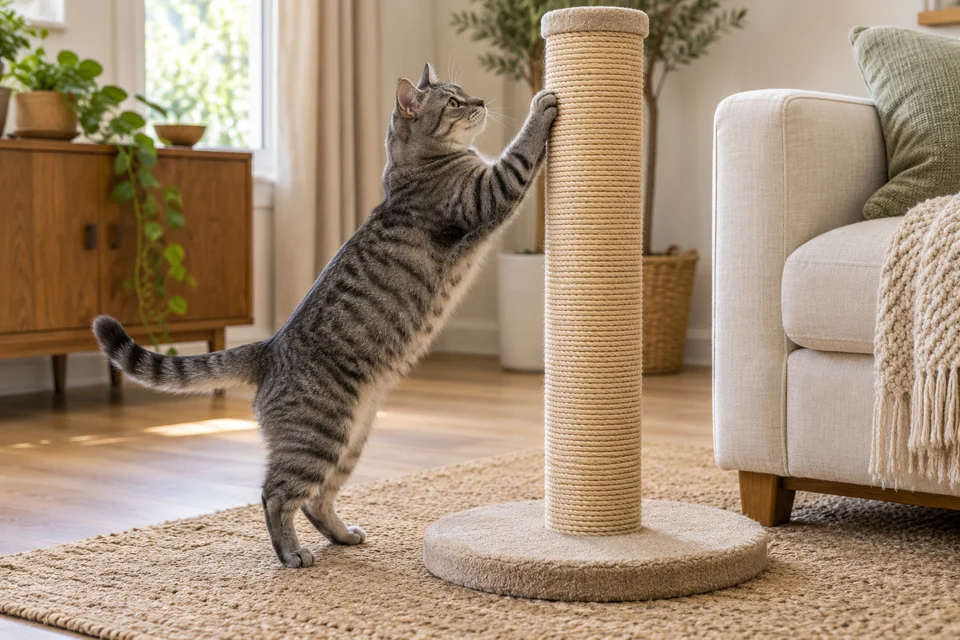
THE DIRECT ANSWER
Place a sturdy scratching surface near the location your cat already chooses and consider another near a favorite sleeping place. Offer an orientation and texture that match observed preferences: some cats use vertical posts, others horizontal or angled pads. A vertical option needs room for a full stretch and a stable base. Reward voluntary use; do not hold the cat's paws against it or punish scratching. The aim is an acceptable outlet for a normal behavior, not eliminating scratching or diagnosing distress from one scratched sofa.
Sources: FelineVMA: Training techniques—undesirable scratching · ASPCA: Destructive scratching—surface choice and handling cautions
Read the existing choice before moving it
FelineVMA describes scratching as normal marking and claw-maintenance behavior. Location matters: a post hidden where the cat rarely goes may not answer the same need as the sofa corner.
Make a short observation list: where, horizontal or vertical, material, and context such as after waking. Avoid assuming the most expensive post is the best match.
Separate what you know from what you inferred. A scratched carpet shows a surface was used; unless you saw it happen, it does not reveal which cat used it or why.
| Observation | Option to investigate | Do not conclude |
|---|---|---|
| Sofa arm scratched upright | Stable vertical post near that spot | The cat is being spiteful |
| Carpet used horizontally | Stable horizontal pad nearby | Every vertical post is unsuitable |
| Scratching after a nap | Surface near the resting area | One location meets every need |
| Marks found, event unseen | Observe without confrontation | Which cat or motive is certain |
Sources: FelineVMA: Training techniques—undesirable scratching
Check stability before comparing textures
ASPCA supports providing different surfaces and orientations, with a stable structure and room to stretch. A wobbling post confounds the comparison: the cat may be avoiding movement rather than disliking sisal.
Our household method is to keep a safe familiar option available while testing one plausible change. Write 'moved the same post beside the sofa' or 'added a horizontal cardboard pad beside the bed.' If location, material and orientation all change at once, you cannot tell which mattered.
A post and a pad serve different possible preferences; neither photo is a tested recommendation. Inspect actual equipment for exposed fasteners, loose parts and instability, following its maker's directions.
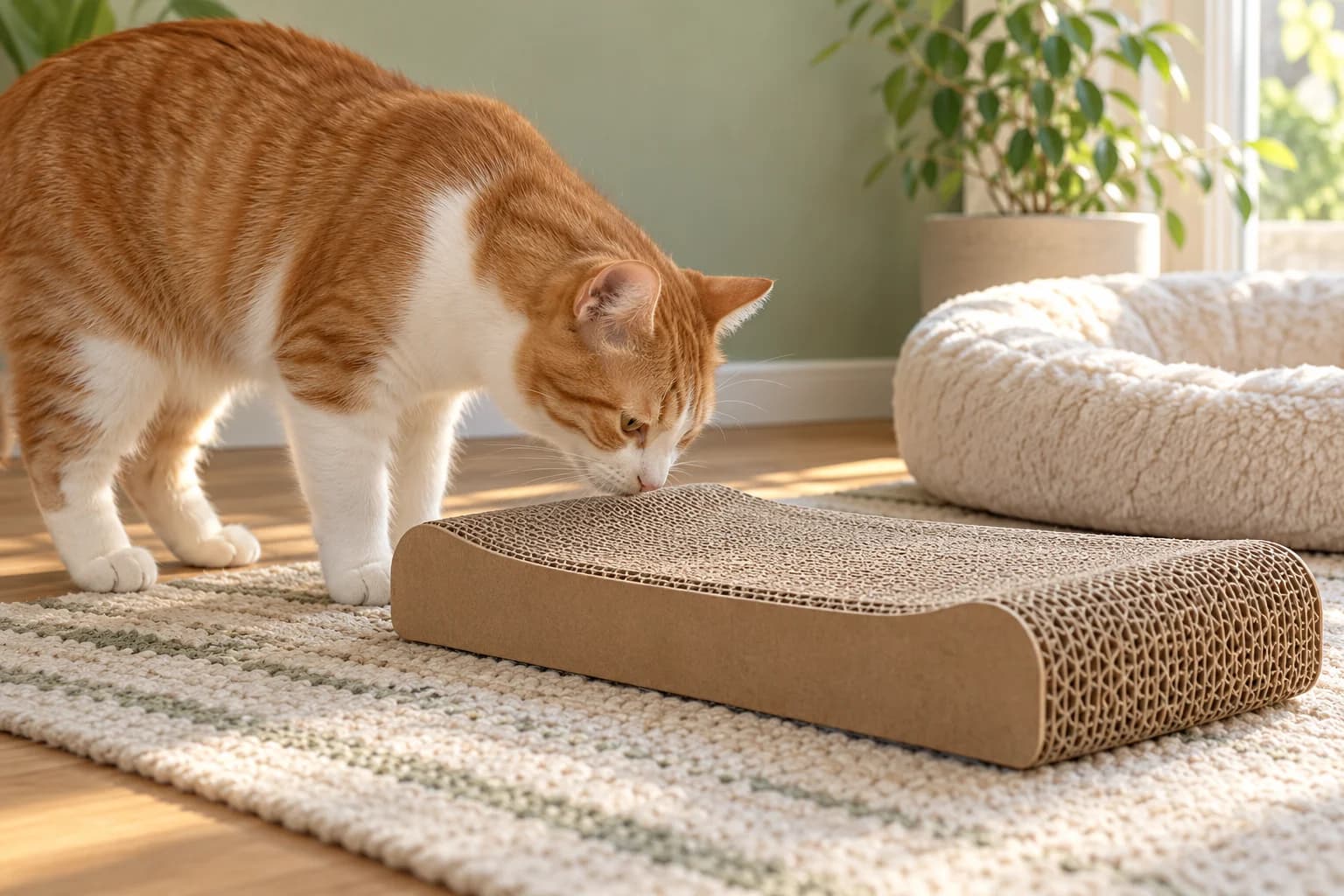
Sources: ASPCA: Destructive scratching—surface choice and handling cautions
A fictional placement comparison
Fictional example: Quinn has a tall stable post behind a spare-room door, but cat Pip scratches the living-room sofa arm. Quinn moves that same post beside the chosen arm and protects the furniture without startling Pip.
Across several ordinary opportunities, Quinn records two observed uses of the post and one sofa scratch. The spare-room post had previously been unobserved, not proven unused.
These invented counts demonstrate a careful record. They are not a success rate, a required trial length or proof that location alone explains Pip's behavior.
| Setup | Observed | Next question |
|---|---|---|
| Post behind spare-room door | Use not observed | Was it accessible and relevant? |
| Same post by sofa arm | Two post uses, one sofa scratch | Keep observing voluntary choices |
| Pad near sleeping spot | Not yet tried | Would a horizontal option help? |
Support the chosen outlet without punishment
FelineVMA recommends positive reinforcement and avoiding punishment. Reward the cat when it voluntarily uses the intended surface with an appropriate preferred reward; do not turn every approach into handling.
The ASPCA page also warns against forcing paws onto a post. Some older material on that page suggests startling deterrents; this guide does not adopt them and follows FelineVMA's non-aversive approach instead.
Do not discard a familiar usable scratcher merely because it looks worn. Distinguish normal wear from actual damage that makes it unstable or exposes hazardous parts.
Sources: FelineVMA: Training techniques—undesirable scratching · ASPCA: Destructive scratching—surface choice and handling cautions
Save a preference map rather than a verdict
In a multi-cat home, name the cat only when identification was observed. Keep access to scratching choices separate from the litter-box count; the litter guide addresses another resource.
My Pet Notes can hold a local location-and-preference sketch. It does not identify cats from photos, diagnose behavior or measure use automatically.
Bring a sudden change or unresolved concern to the veterinary team, along with what changed in the room. A simple note of a move, new pet or replaced surface is more useful than a label such as 'bad behavior.'
- Chosen locations and orientation are observed, not assumed.
- The structure is stable and offers usable space.
- Reward is voluntary; no forced paws or punishment.
- Sudden changes are discussed with the veterinarian.
FROM THE GUIDE · INTO THEIR EVERYDAY
My cat's scratching preference map
Record location, orientation and voluntary use without assigning motives.
Draft my scratching mapChoose their notebook, add your own details, then save. Free, no account. Notes stay in this browser.
THE NEXT QUESTIONS
What else might you be wondering?
Why is a new post ignored?
Location, stability, texture and orientation may not match the cat's choice. Observe those separately; ignoring one post does not prove that scratching cannot be redirected.
Sources: FelineVMA: Training techniques—undesirable scratching · ASPCA: Destructive scratching—surface choice and handling cautions
Should I show my cat by moving its paws?
No. Do not force paws against the surface. Encourage and reward voluntary investigation and use.
Sources: ASPCA: Destructive scratching—surface choice and handling cautions
Can I remove the old post once it looks worn?
Not merely for appearance. Keep a familiar usable surface, but inspect for instability or damage and replace unsafe equipment.
Sources: ASPCA: Destructive scratching—surface choice and handling cautions
LOOK CLOSER AT THE EVIDENCE
Sources & what they establish
Official guidance, research findings and PetCheck’s practical interpretations have different roles. These notes explain how the sources were used.
Feline veterinary guidance
FelineVMA scratching and reinforcement
Supports appropriate locations, stable surfaces, orientation choice and non-punitive reinforcement.
Limit: A preference map is not a diagnostic behavioral assessment or a guarantee of furniture protection.
Sources: FelineVMA: Training techniques—undesirable scratching
Animal welfare organization guidance
ASPCA surface choice and forced handling caution
Supports variety, stability, full stretching space and not forcing paws onto the post.
Limit: Its older aversive-deterrent suggestions are not adopted; the guide follows FelineVMA's non-aversive approach.
Sources: ASPCA: Destructive scratching—surface choice and handling cautions
Sources checked 2026-10-26. Examples are fictional and illustrate reasoning, not patient outcomes. This is an editorial source review, not independent veterinary review. How we prepare these guides →
FOR ANOTHER VISIT
Keep this guide close.
Save it to read again, or copy a link to share.
ONE QUESTION CAN LEAD TO ANOTHER
A useful next read.
Choose the question that fits what you want to understand next.
 AI-generated editorial scene
How should I set up litter boxes in a multi-cat home?
Map the separate resource of litter access without assuming a scratcher solves household tension.
Read the guide AI-generated editorial scene
How should I introduce a new cat to my resident cat?
Plan a new-cat transition separately from everyday scratching choices.
Read the guide