HOME ORGANIZATION · MEDICINES
How should I organize and store pet medicines at home?
Give each medicine an identifiable, appropriate storage place. Separate current supplies from unresolved items without inventing a dose or a universal temperature rule.
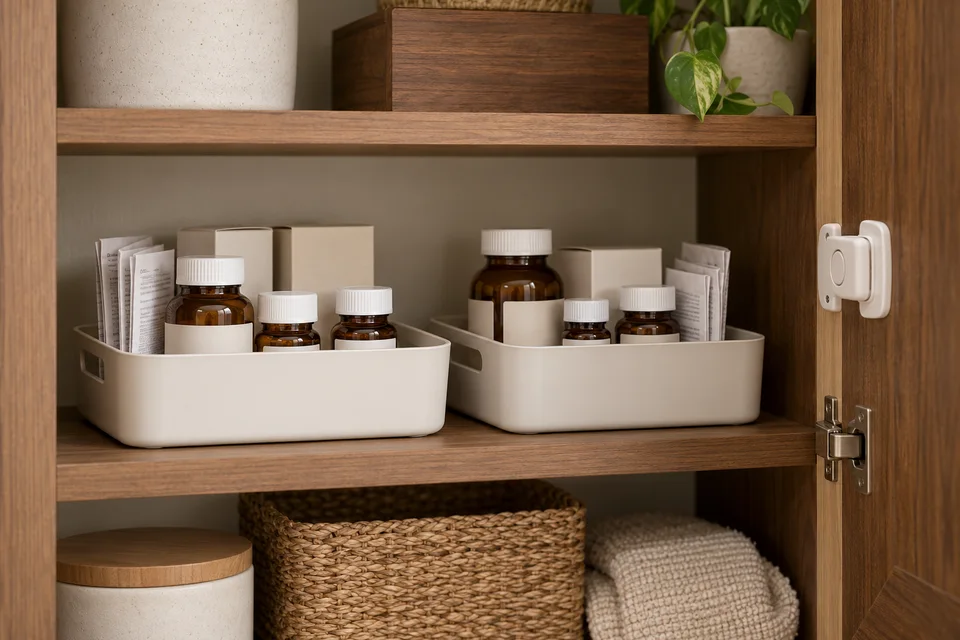
THE DIRECT ANSWER
Keep medicines identifiable in their original labeled containers, secure them from pets and children, and separate each pet’s supplies from human medicines. Follow the exact product’s storage instructions; some need refrigeration while others do not. If a label is missing, instructions conflict or storage conditions are uncertain, ask the dispensing clinic or pharmacist how to handle that product rather than guessing.
Sources: FDA: Properly Store Medications to Keep Your Pet Safe · FDA: Medications for Your Pet—Questions for Your Vet
Organization starts with identity, not matching containers
FDA advises retaining the original container and readable directions and pet name. It also warns that flavored medicines may attract pets and that child-resistant packaging is not necessarily resistant to chewing. A high shelf alone may not be secure.
A tidy row of identical unmarked jars loses the information you need. Make the storage system fit the labeled packages rather than decanting products to fit a visual scheme. The blank labels in our generated photographs deliberately contain no usable medicine information; real labels must remain readable.
PetCheck’s worksheet below records where the actual instructions are kept. It is not a substitute label. Complete it from the container and dispensing team’s directions; do not infer a product’s identity from tablet color or shape.
| Field | What to record | If unclear |
|---|---|---|
| Pet and product | Name on the actual dispensing label | Ask the dispenser to identify or replace the label |
| Container | Original labeled package and matching leaflet | Keep the uncertain item identifiable and separate while asking |
| Storage direction | Exact product-specific instruction | Do not choose room temperature or refrigeration by habit |
| Relevant date | Printed expiry and any supplied opening/use-by instruction | Ask which date applies; do not invent an extension |
| Location | Where this item is securely kept | Resolve access and storage requirements together |
| Contact / question | Dispensing clinic or pharmacy; unresolved issue | Record the answer and who provided it |
Sources: FDA: Properly Store Medications to Keep Your Pet Safe
Choose the location from the instructions
FDA explains that temperature extremes can affect medicines, that some require refrigeration and that some need protection from sunlight. There is no single storage temperature that this article can safely assign to every product.
Use a separate place for each household member’s supplies so a similar-looking bottle does not become the default choice. If different products for the same pet require different conditions, they may need different physical locations. Keep a simple index of those locations rather than forcing everything into one basket.
If a product has been left somewhere unsuitable, describe the known time and conditions to the dispensing team. ‘On the counter overnight; room temperature not measured’ is better than claiming the product stayed within a range you did not measure. Do not use smell or appearance to certify its effectiveness.
Sources: FDA: Medications for Your Pet—Questions for Your Vet · FDA: Properly Store Medications to Keep Your Pet Safe
A fictional two-pet cupboard audit
Fictional example: Rowan is organizing supplies for dog Pip and cat Fern. This example uses no real medicines, doses or treatment instructions. There is one clearly labeled current package for Pip, one product for Fern with a dispensing instruction to refrigerate, and an older bottle whose label is unreadable.
Rowan does not put every bottle in the refrigerator to make the system uniform. The current packages retain their own instructions and storage places. The unreadable bottle becomes a question for the dispenser, not an item that is silently relabeled from memory.
The household note records the unresolved item and whom Rowan contacted. If the question affects a medicine due now, Rowan contacts the clinic promptly for a plan instead of using the filing system to decide to give, skip or replace a dose.
| Item | Information available | Organizational next step |
|---|---|---|
| Pip’s current package | Readable pet and storage label | Retain package; assign a secure place matching its directions |
| Fern’s current package | Specific refrigeration direction from dispenser | Keep under those conditions; note its separate location |
| Older unidentified bottle | Label cannot be read | Keep secure and separate; ask dispenser about identification and disposal |
A storage note should not become a new prescription
The FDA’s questions-for-your-vet guidance makes missed, vomited or excess doses product-specific questions. This article therefore does not create a catch-up schedule, recommend repeating a dose or change an existing prescription.
Use two distinct kinds of note: a question awaiting an answer, and an instruction actually supplied by the clinical team. Include the date and source of the latter. A sentence beginning ‘Ask whether…’ should not be copied into a sitter handoff as if it were a direction.
My Pet Notes can keep these questions and help you preview selected notes before copying them. It does not check drug interactions, reconcile prescriptions, send information to the clinic or provide a medication reminder. Verify any handoff against the current label and veterinary instructions.
Keep an unresolved question in My Pet Notes →
Prepare current product information for a clinic conversation →
Sources: FDA: Medications for Your Pet—Questions for Your Vet
Give unused items a confirmed next step
FDA recommends appropriate disposal of expired or unwanted medicines, with take-back programs as the preferred option. US disposal instructions depend on the medicine and available services; used needles and other sharps need their own route. Follow current local and product guidance rather than flushing everything or putting loose medicines in an accessible bin.
Before your next review, write down what changed: a package received, a label clarified, an item returned through an appropriate service. ‘Disposal planned’ and ‘disposal completed’ are different entries.
End the audit by returning all packages to their correct secure locations. A temporary sorting surface is not the new storage place. Keep the original directions available to the person responsible for care.
- Each item belongs to an identified person or pet.
- Actual labels and storage directions are readable.
- Unresolved products have a specific question and contact.
- Packages are returned to secure, appropriate locations.
Sources: FDA: Disposal of Unused Medicines
FROM THE GUIDE · INTO THEIR EVERYDAY
A medicine-storage question
Copy facts from your real label and record unresolved questions. This does not choose a dose or check interactions.
Draft a storage questionChoose their notebook, add your own details, then save. Free, no account. Notes stay in this browser.
THE NEXT QUESTIONS
What else might you be wondering?
Should all pet medicines go in the refrigerator?
No. Use the exact product’s instructions and clarify any uncertainty with the dispenser. A storage choice that suits one product may not suit another.
Sources: FDA: Medications for Your Pet—Questions for Your Vet
Can I identify an unlabeled tablet by its appearance?
Do not rely on appearance or memory to relabel it. Contact the dispensing professional with the information you have and keep it secure while the question is resolved.
Does a note marked ‘given’ replace a prescribed schedule?
No. A note reports an event; the current prescription defines the plan. If there is uncertainty about what was given, ask the clinic how to proceed rather than assuming a blank or tick resolves it.
LOOK CLOSER AT THE EVIDENCE
Sources & what they establish
Official guidance, research findings and PetCheck’s practical interpretations have different roles. These notes explain how the sources were used.
Official medication-safety guidance
FDA: secure storage and product questions
Supports clear identification, secure separation and checking individual instructions.
Limit: These general pages cannot decide whether a specific mishandled medicine is usable or choose its dose.
Sources: FDA: Properly Store Medications to Keep Your Pet Safe · FDA: Medications for Your Pet—Questions for Your Vet
Original editorial organization
Inventory and unresolved-item workflow
Separates package facts, questions and completed actions.
Limit: Not a pharmacy assessment, interaction checker or medication administration protocol.
Sources checked 2026-10-20. Examples are fictional and illustrate reasoning, not patient outcomes. This is an editorial source review, not independent veterinary review. How we prepare these guides →
FOR ANOTHER VISIT
Keep this guide close.
Save it to read again, or copy a link to share.
ONE QUESTION CAN LEAD TO ANOTHER
A useful next read.
Choose the question that fits what you want to understand next.
 AI-generated editorial scene
What should I write down before my pet’s vet visit?
Bring clear product information and questions to the clinic.
Read the guide AI-generated editorial scene
What feeding instructions should I leave a pet sitter?
Give another caregiver a clear, separate feeding handoff without inventing medicine instructions.
Read the guide