HOME OBSERVATION · WATER
How can I measure my pet’s water intake for the veterinarian?
Define the observation window, account for shared bowls and refills, and bring a bounded record rather than a diagnosis.
THE DIRECT ANSWER
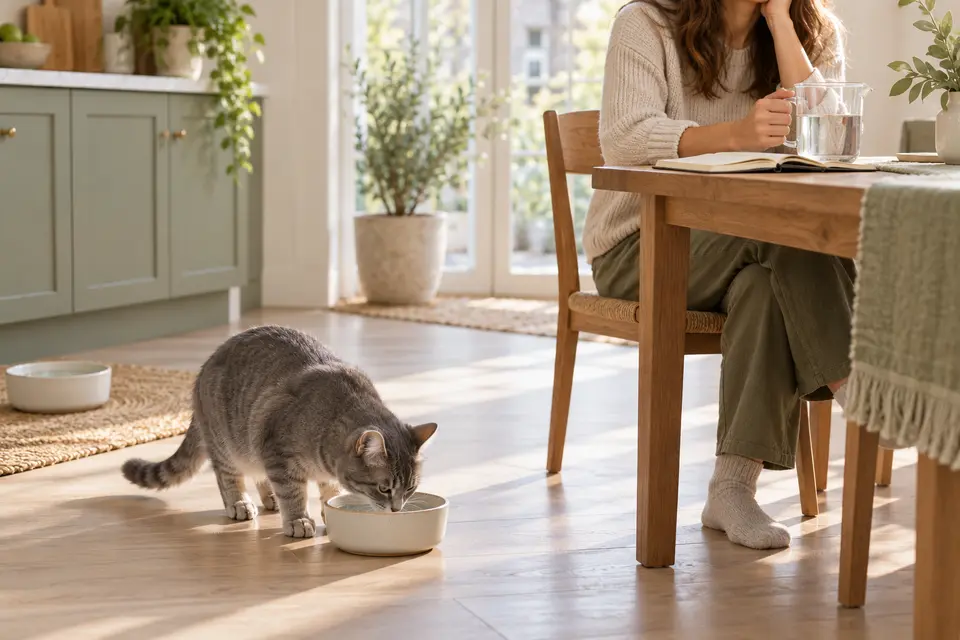
First ask the veterinary team whether and how long it wants water intake measured. For a defined window, record water added, measured water left, spills, cleaning changes and other known sources; do not restrict access to make the arithmetic easier. In a shared-bowl home, either follow a clinic-approved separation method or report the household total and the uncertainty. Bring the record promptly when drinking has changed—home measurements do not diagnose the cause.
Sources: Cornell Feline Health Center: Hydration · Cornell Riney Canine Health Center: Polyuria and polydipsia
Measure a window the clinic can interpret
Cornell explains that water enters through drinking and food and leaves through several routes. A bowl measurement is therefore one part of intake, not a complete hydration assessment. Wet food, outdoor sources and other animals can change what the bowl number means.
Ask the clinic for the observation period, unit and household arrangements it wants. Keep normal access unless the veterinarian says otherwise. Do not delay an appointment just to produce a longer log.
Start and end at named times. 'About two bowls' cannot be checked; '600 mL offered across two bowls between 7 a.m. and 7 p.m.' defines a household observation even when the pet-specific amount remains uncertain.
| Field | Record | Why it matters |
|---|---|---|
| Window | Start and end date/time | Separates a partial day from 24 hours |
| Water offered | Every measured fill or top-up | Prevents refills from disappearing from the total |
| Water left | Measured amount at the end | Supports subtraction without guessing |
| Known losses | Spill, cleaning discard, evaporation concern | Not all missing water was drunk |
| Other sources | Wet food, fountain, toilet, outdoor or unknown | Bowl difference is not total intake |
| Household access | Which animals could use each source | Defines whether the result is pet-specific |
Sources: Cornell Feline Health Center: Hydration · Cornell Riney Canine Health Center: Polyuria and polydipsia
Use a simple equation and an uncertainty column
For one controlled bowl, the observed difference is water added minus water left minus known discarded or spilled water. It is still an estimate: an unobserved spill, evaporation or another animal's drink can remain.
Use milliliters or another single unit throughout. If a pitcher has unclear markings, choose a more suitable measuring tool rather than inventing precision. Do not write decimal places the tool cannot support.
For fountains, reservoirs or automatic systems, ask the clinic whether a temporary measurable setup is appropriate. Device capacity and 'days remaining' indicators do not show what one animal drank.
A fictional shared-bowl example that stays uncertain
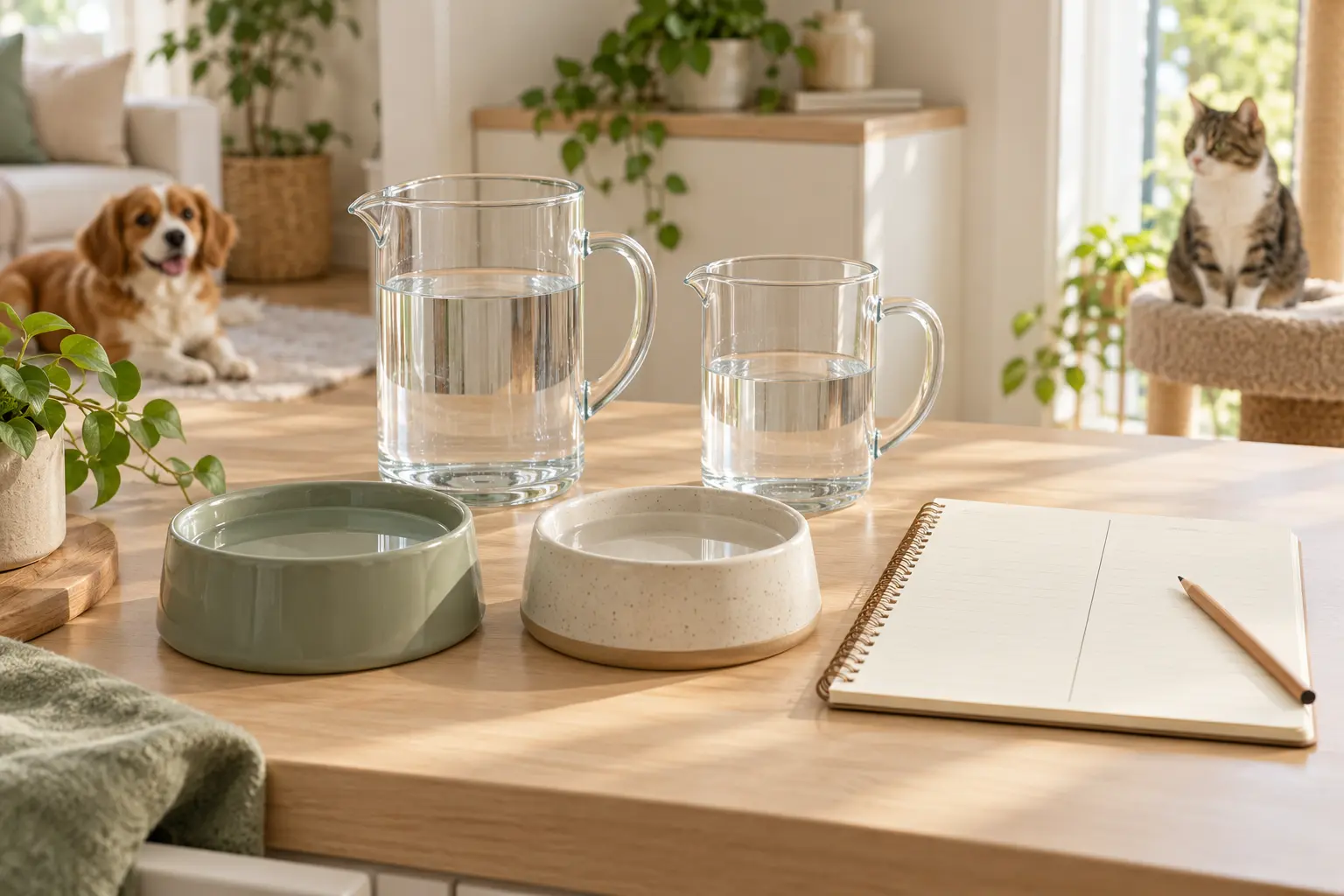
Fictional example: dog Milo and cat Bea share two indoor bowls. From 7 a.m. to 7 p.m., their household adds 800 mL total and measures 310 mL remaining. It discards 40 mL while washing after a food spill.
The observed household difference is 800 − 310 − 40 = 450 mL. That is not Milo's intake, Bea's intake or a daily requirement. Both animals had access, Bea ate wet food, and nobody observed every visit.
The useful note says '450 mL household bowl difference over 12 hours; two animals shared access; wet-food water not included.' The veterinarian can decide whether a different measurement is needed.
| Item | Amount | Meaning |
|---|---|---|
| Added | 800 mL | Two bowls and all refills |
| Remaining | 310 mL | Measured at 7 p.m. |
| Known cleaning discard | 40 mL | Not counted as drunk |
| Observed difference | 450 mL | 800 − 310 − 40 |
| Pet-specific result | Unknown | Milo and Bea shared access |
Bring the pattern around the number
Cornell notes that dogs may drink more with heat or activity and that increased drinking can accompany increased urination and many different conditions. Cornell's cat guidance also notes that food water content changes visible drinking.
Record temperature or activity context only if known, along with food form, vomiting or diarrhea, medication changes and urinary observations. Do not decide that one context caused the change.
A single total cannot establish dehydration, kidney disease, diabetes or another diagnosis. If the pet is unwell or the change is marked, contact the clinic rather than waiting for a complete spreadsheet.
Sources: Cornell Feline Health Center: Hydration · Cornell Riney Canine Health Center: Polyuria and polydipsia
FROM THE GUIDE · INTO THEIR EVERYDAY
A bounded water record
Keep the measurement window, bowl arithmetic and uncertainty visible. This does not diagnose hydration.
Draft my water recordChoose their notebook, add your own details, then save. Free, no account. Notes stay in this browser.
THE NEXT QUESTIONS
What else might you be wondering?
Can I measure one shared bowl and divide by the number of pets?
No. Equal access does not mean equal drinking. Report the household total and ask the clinic whether it wants a different arrangement.
Sources: Cornell Riney Canine Health Center: Polyuria and polydipsia
Should I remove other water sources for a cleaner result?
Do not restrict water on your own. Ask the veterinarian how to measure safely and record any sources you cannot quantify.
Does a normal-looking amount rule out illness?
No. A home estimate has measurement limits and cannot rule out disease. Discuss the change and other observations with the veterinarian.
Sources: Cornell Feline Health Center: Hydration · Cornell Riney Canine Health Center: Polyuria and polydipsia
LOOK CLOSER AT THE EVIDENCE
Sources & what they establish
Official guidance, research findings and PetCheck’s practical interpretations have different roles. These notes explain how the sources were used.
University veterinary guidance
Cornell hydration and PU/PD resources
Explains that intake varies with body, diet and context and that change in drinking/urination can matter.
Limit: General ranges and signs cannot diagnose an individual pet or validate a household measurement.
Sources: Cornell Feline Health Center: Hydration · Cornell Riney Canine Health Center: Polyuria and polydipsia
Original editorial method
Measured bowl-difference worksheet
Makes refills, remaining water, known losses and shared access visible.
Limit: Not a validated hydration test or a complete measure of water consumed.
Sources checked 2026-10-21. Examples are fictional and illustrate reasoning, not patient outcomes. This is an editorial source review, not independent veterinary review. How we prepare these guides →
FOR ANOTHER VISIT
Keep this guide close.
Save it to read again, or copy a link to share.
ONE QUESTION CAN LEAD TO ANOTHER
A useful next read.
Choose the question that fits what you want to understand next.
 AI-generated editorial scene
What should I write down before my pet’s vet visit?
Place the bounded measurement beside the wider timeline and questions.
Read the guide AI-generated editorial scene
How often should you clean pet bowls?
Return the water bowls to a practical cleaning routine after measurement.
Read the guide