HOME · SENIOR COMFORT
How can I make everyday routes at home easier for my senior dog?
Audit the path from bed to water and the toilet exit, then record what still makes movement difficult.
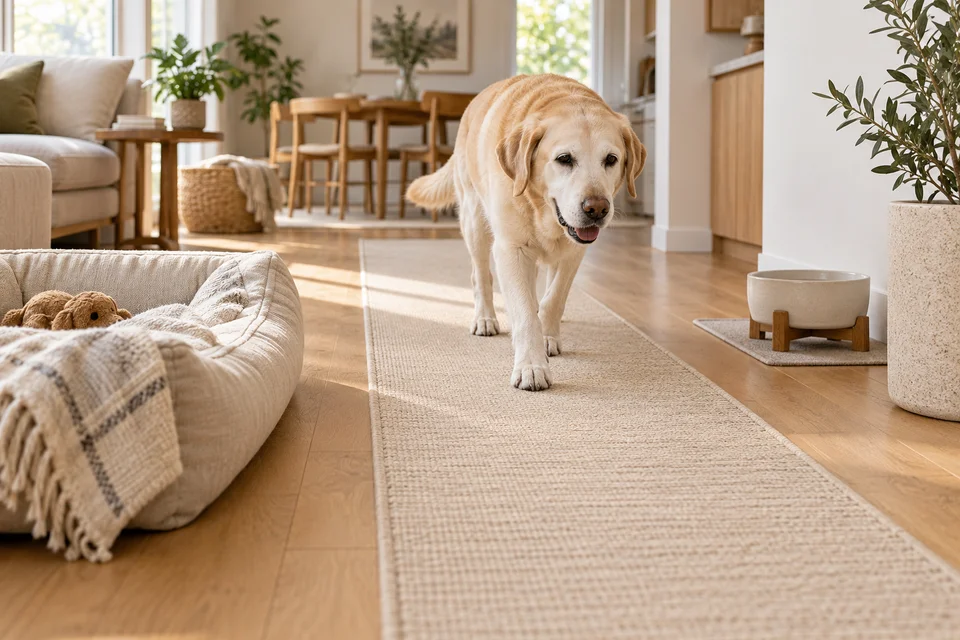
THE DIRECT ANSWER
Start with the routes your dog already needs: getting out of bed, reaching water and food, and reaching the usual toilet exit. Look for slippery gaps, shifting mats, tight turns, clutter and steps. AAHA recommends secure rugs or mats and adequately padded bedding for senior pets. Make practical changes without asking your dog to demonstrate a difficult movement. New hesitation, slipping or trouble rising also deserves a veterinary conversation; improving the floor is not a diagnosis or treatment for the reason movement changed.
Sources: AAHA: Communicating with families of senior pets—home tips · AAHA: Recognizing senior pet health problems
Map destinations before buying equipment
On a simple room sketch, draw three lines: bed to water, bed to food, and bed to the usual toilet exit. Mark the actual route, including the turn around a chair, rather than the straight line you wish the dog would take.
This route audit is PetCheck's practical planning method, not a validated mobility assessment. Its purpose is to identify a fixable environmental obstacle and a separate question for the veterinarian.
Inspect while your dog is resting. A destination may have a good mat while the approach still requires crossing a slippery strip. Check both directions: turning away from the bowl can be different from approaching it.
| Route segment | Look for | Record separately |
|---|---|---|
| Leaving the bed | Edge height, space, shifting bedding | Difficulty rising on any surface |
| Approaching water | Bare gaps and tight turns | Change in drinking or posture |
| Toilet exit | Clutter, doorway, steps | New accidents or reluctance |
| Return route | Turning space and displaced mats | Any observed slip, without retesting |
Treat traction as a continuous path
AAHA's home advice supports secure floor coverings and padded bedding. A rug that slides is not the same as a stable walking surface.
Our practical check is to inspect the edges, backing and transitions yourself, then keep the route clear. Include the space where the dog turns or pauses, not only the longest straight stretch.
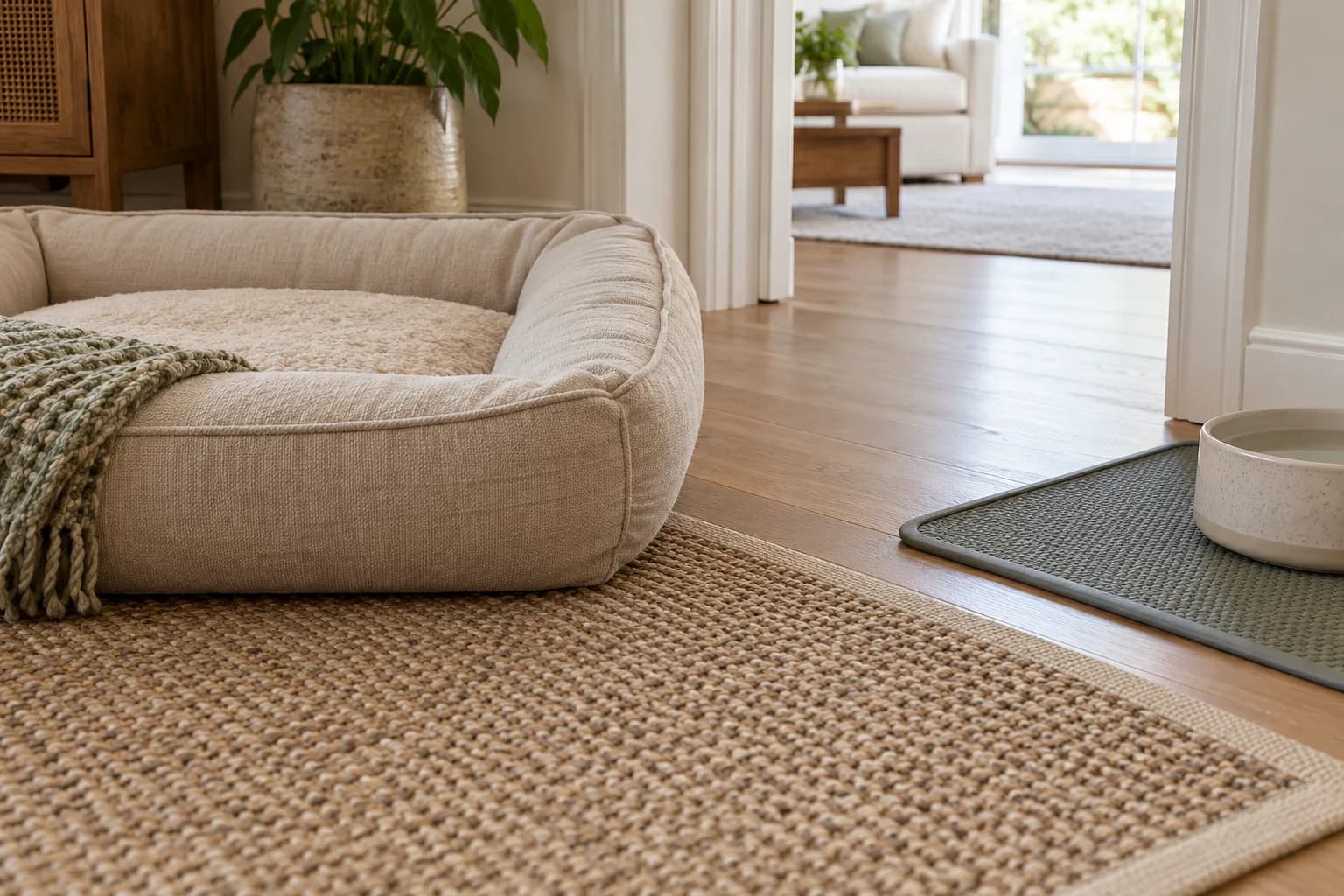
The body photograph shows separate bed and bowl surfaces with exposed floor between them. Use it as an audit prompt: where would the feet actually land? It is not an approved layout or a traction test. In your own home, resolve gaps and curled edges before inviting normal use.
Sources: AAHA: Communicating with families of senior pets—home tips
A fictional hallway repair
Fictional example: Mina notices that older dog Jasper pauses on the way to water. Her sketch shows a runner down the hall, but it ends before the ninety-degree turn into the kitchen. A shoe basket narrows that corner.
Mina clears the basket and secures an appropriate covering through the turn. She records the date of the change and tells the veterinary team about Jasper's new hesitation. She does not make him repeat the turn for a before-and-after video.
The next ordinary trip looked easier, but that is one observation, not proof the underlying problem is resolved. The veterinary question remains open.
| Before | Household change | What remains unknown |
|---|---|---|
| Runner ends before corner | Secure the turning area | Why hesitation began |
| Basket narrows the route | Move basket out of the path | Whether other routes are difficult |
| One easier trip afterward | Record date and context | Long-term effect and medical cause |
Keep the environment and the health history separate
AAHA advises seeking veterinary care for changes in standing or movement. Do not reduce a new change to 'just old age.'
Record what you saw in plain language: 'paused at kitchen turn after getting up,' rather than 'arthritis worsening.' Include whether the surface was wet, a mat moved, or the event was unwitnessed.
Ask which activities and assistance methods fit your individual dog. Keep that answer next to the household map so another caregiver does not improvise a ramp, lift or exercise challenge.
Make the repair survive ordinary housekeeping
A route can change after vacuuming, laundry, guests or furniture movement. Add a quick edge-and-gap check when mats return to the floor. Use the existing bedding guide for cleaning rather than treating washing as a mobility intervention.
Save the map and unanswered questions in My Pet Notes. The note is stored in this browser; it does not monitor movement, assess pain or alert a clinic.
A useful follow-up entry states the route, observed behavior and what changed. 'No difficulty observed during breakfast trip' is more precise than declaring the whole home safe.
- Bed, water, food and toilet routes are mapped.
- Edges and turning points are checked without making the dog perform.
- New movement changes have a veterinary follow-up.
- Caregivers know which assistance was actually advised.
FROM THE GUIDE · INTO THEIR EVERYDAY
My senior dog's everyday routes
Map bed, water and toilet access while keeping new movement changes separate.
Draft my route auditChoose their notebook, add your own details, then save. Free, no account. Notes stay in this browser.
THE NEXT QUESTIONS
What else might you be wondering?
Is one rug beside the bed enough?
Inspect the entire necessary route, including turns and gaps. One protected destination does not tell you how the dog reaches it.
Sources: AAHA: Communicating with families of senior pets—home tips
Does easier walking on a mat prove arthritis?
No. Record the observation and discuss the change with the veterinarian; a floor response cannot identify its cause.
Should I add a ramp immediately?
Ask about suitability and safe use for your dog first. This guide does not select a ramp, lifting method or rehabilitation plan.
LOOK CLOSER AT THE EVIDENCE
Sources & what they establish
Official guidance, research findings and PetCheck’s practical interpretations have different roles. These notes explain how the sources were used.
Veterinary practice guideline
AAHA senior home support
Recommends secure rugs and mats and adequately padded bedding.
Limit: It does not certify a floor product or evaluate a particular home. The route audit is original editorial synthesis.
Sources: AAHA: Communicating with families of senior pets—home tips
Veterinary organization owner guidance
AAHA movement-change awareness
Identifies changes in rising, walking and routine behavior as reasons for veterinary attention.
Limit: These observations do not diagnose arthritis or establish an individual's treatment.
Sources checked 2026-10-26. Examples are fictional and illustrate reasoning, not patient outcomes. This is an editorial source review, not independent veterinary review. How we prepare these guides →
FOR ANOTHER VISIT
Keep this guide close.
Save it to read again, or copy a link to share.
ONE QUESTION CAN LEAD TO ANOTHER
A useful next read.
Choose the question that fits what you want to understand next.
 AI-generated editorial scene
What should I write down before my pet’s vet visit?
Take a new movement change to the veterinarian as an observation, not an assumed diagnosis.
Read the guide AI-generated editorial scene
How should I wash pet bedding and soft toys?
Keep bedding and floor coverings clean without confusing cleaning with mobility treatment.
Read the guide