CAT LIFE · CARRIER PREPARATION
How can I help my cat get comfortable with a carrier?
Separate everyday familiarity from departure-day handling. Build a practical setup, record your cat’s responses and know when to ask the clinic for help.
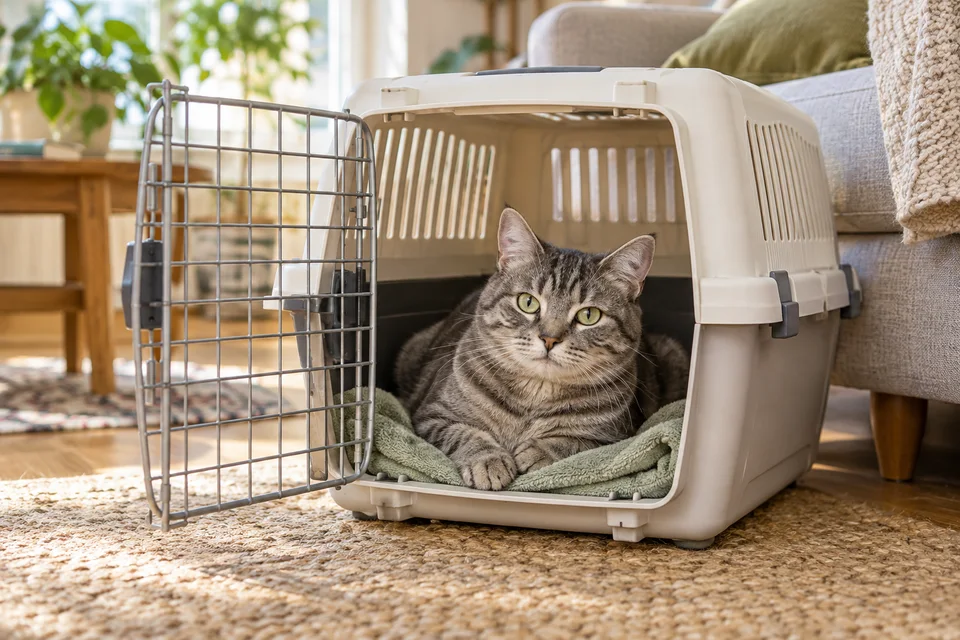
THE DIRECT ANSWER
Keep the carrier in a familiar living area with suitable bedding, and give your cat opportunities to investigate it without a trip immediately following. Work at the cat’s pace and ask the veterinary team for help if fear persists. Preparation can take time; it is not a reason to postpone necessary care. A familiar carrier also needs a separate hardware and transport check before departure.
Sources: FelineVMA / Cat Friendly Homes: Getting Your Cat to the Veterinarian · FelineVMA / Cat Friendly Homes: Five Cat Carrier Tips
Change what happens before the carrier appears
FelineVMA’s Cat Friendly Homes guidance explains that an unfamiliar carrier, car and clinic can contribute to distress. It recommends making the carrier part of the home environment, using familiar bedding and allowing time for positive associations. It explicitly advises against chasing a cat into the carrier.
For a planned visit, begin by looking at your current sequence. Does the carrier emerge from a cupboard only when everyone is rushing? Is the only available position beside a noisy appliance? Those are practical setup questions you can address without trying to assess the cat’s health from its behavior.
The aim is not to make the carrier invisible or to trap the cat during a moment of curiosity. It is to create an ordinary place that can be approached and left during familiarization. Keep necessary care on its own timetable, with advice from the clinic.
Sources: FelineVMA / Cat Friendly Homes: Getting Your Cat to the Veterinarian
Make the empty setup workable first
Cat Friendly Homes suggests leaving the carrier out and lining the bottom with a soft blanket. Its guidance emphasizes patience and careful handling rather than shoving or dropping a cat inside. Individual cats respond differently.
Before involving your cat, use the carrier’s own instructions to check assembly, doors and fasteners. If you remove parts for familiarization, keep them together and learn how to put them back correctly. The generated picture shows a preparation idea, not assembly instructions for a named model.
PetCheck’s setup table below is a planning aid. A calm-looking photo cannot certify fit, construction strength or crash protection, and none of the illustrated equipment has been tested by us.
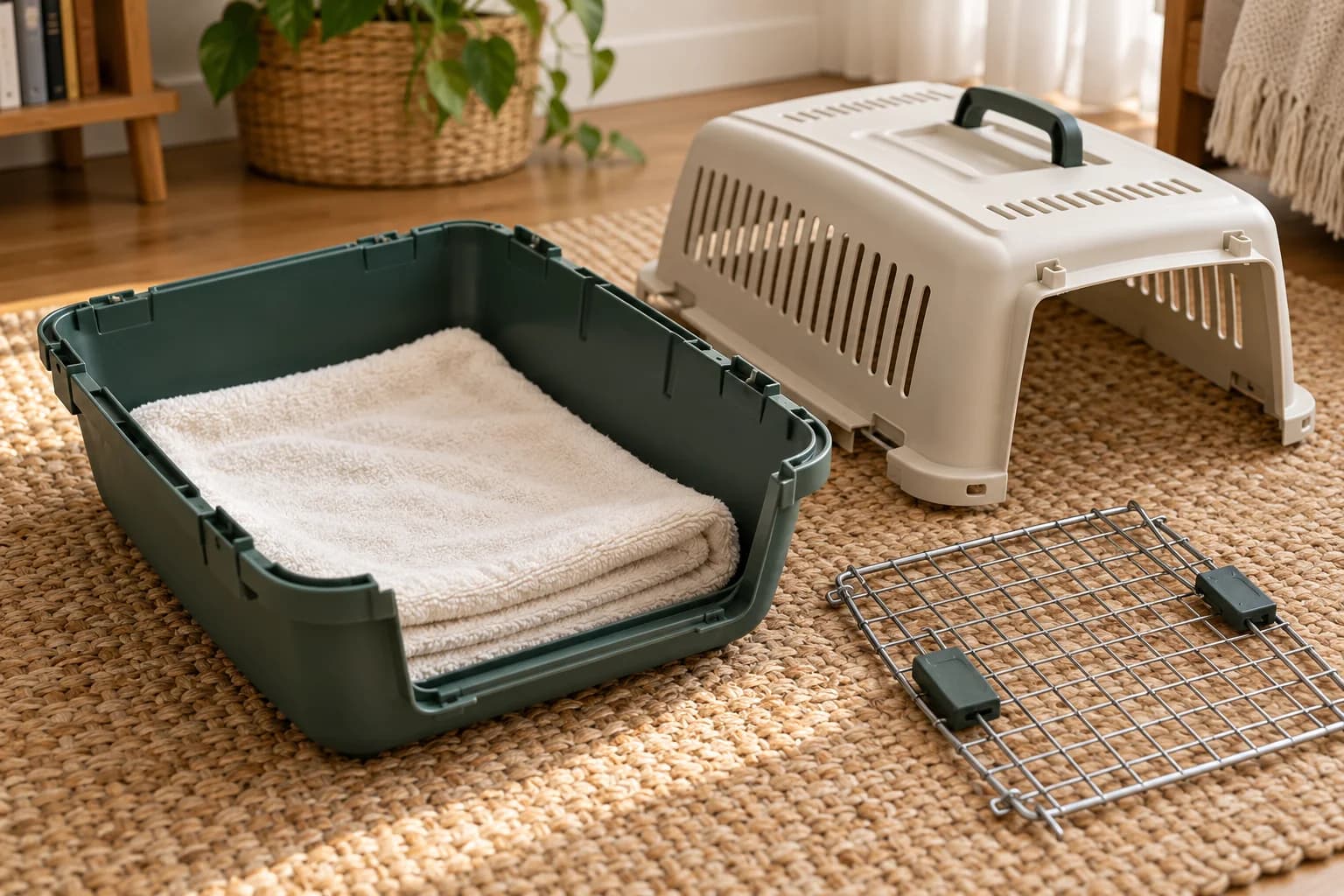
| Question | At-home preparation | Before carrying the cat |
|---|---|---|
| Where is it? | Stable place in a room the cat uses | A clear route to the exit without rushing |
| What is inside? | Suitable familiar bedding | Bedding arranged without blocking openings |
| Were parts removed? | Keep the door, top and fasteners together | Reassemble and check using the model instructions |
| How does the cat respond? | Record approach, entry or avoidance without forcing a test | Tell the clinic about unresolved difficulty |
| How will it travel? | Find the manufacturer’s transport directions | Follow model-specific securing instructions; do not infer them from a photo |
Sources: FelineVMA / Cat Friendly Homes: Five Cat Carrier Tips
Use the response to plan the next conversation
Do not turn a suggested preparation period into a deadline the cat must meet. The veterinary guidance describes adjustment over days or weeks, sometimes longer. ‘Day three’ is not evidence that the cat is ready for every later step.
Keep the observation small: approached the entrance, rested nearby, entered voluntarily, or moved away. These descriptions are more useful than a pass/fail label such as ‘trained.’ If closing the door or moving the carrier changes the response, record that distinction rather than assuming quiet behavior in an open carrier proves travel comfort.
Ask the veterinary team how to proceed if the cat freezes, tries to escape or remains highly fearful. Discuss food restrictions and any prescribed pre-visit medication with the clinic; this article does not set fasting times, choose a calming product or provide a dosing plan.
Sources: FelineVMA / Cat Friendly Homes: Your Role in Veterinary Visits
A fictional diary that does not promise a training timetable
Fictional example: Lee has a routine appointment booked for cat Nori. Lee leaves the carrier beside the sofa, then records three separate observations. These entries are illustrative, not a tested method, a prediction or a timetable to copy.
The useful change is in the description. Instead of saying ‘Nori loves the carrier now,’ Lee can tell the clinic that Nori has entered an open carrier, while the response to a closed door remains a concern. The appointment team can work with that specific information.
No extra handling is needed just to finish the log. One honest entry and a call can be more useful than a week of repeated attempts that make departure harder.
| Entry | What Lee saw | What it does not establish |
|---|---|---|
| First observation | Nori rested beside the open carrier | Not evidence of comfort inside it |
| Later observation | Nori entered and left while the door stayed open | Not evidence of comfort with a closed door or car ride |
| Separate attempt | Nori moved away when Lee approached the door | Reason unclear; describe this to the clinic rather than force a repeat |
| Follow-up | Lee called to discuss a departure plan | No medication or handling plan is invented by this example |
Keep departure day simple and specific
Cat Friendly Homes advises supporting the carrier from underneath and keeping cats contained during car travel. Securing arrangements depend on the carrier: a handle or strap alone is not evidence of a crash-tested attachment method. Consult the actual manufacturer’s instructions.
Before leaving, confirm the clinic’s arrival arrangements, any preparation instructions and whom to call if loading is difficult. Pack the requested records separately so you are not opening the carrier to retrieve papers.
Afterward, record one detail that helped and one question for next time. In My Pet Notes this is a manual, browser-local record, not a training program or an automatic reminder. A simple note can help you explain the last visit without promising that the next one will feel the same.
- The carrier is correctly reassembled and checked.
- I have the model’s transport instructions.
- The clinic knows about unresolved loading difficulties.
- Records and arrival instructions are ready separately.
Sources: FelineVMA / Cat Friendly Homes: Getting Your Cat to the Veterinarian
FROM THE GUIDE · INTO THEIR EVERYDAY
A carrier observation
Describe what your cat did without forcing another attempt. This is not a training timetable.
Draft my carrier noteChoose their notebook, add your own details, then save. Free, no account. Notes stay in this browser.
THE NEXT QUESTIONS
What else might you be wondering?
What if the appointment is today?
Call the clinic for a practical plan. Familiarization is advance preparation, not a requirement you must complete before seeking care. Avoid a last-minute chase or repeated forced attempts.
Sources: FelineVMA / Cat Friendly Homes: Getting Your Cat to the Veterinarian
Does sleeping in the open carrier mean car travel will be easy?
No. An open resting place, a closed carrier, being carried and travelling are different situations. Describe what your cat has actually experienced.
Can I use a calming medicine left from another pet?
Do not choose a medicine or dose from this guide or another pet’s prescription. Ask the veterinarian for an individual plan if additional support is needed.
Sources: FelineVMA / Cat Friendly Homes: Your Role in Veterinary Visits
LOOK CLOSER AT THE EVIDENCE
Sources & what they establish
Official guidance, research findings and PetCheck’s practical interpretations have different roles. These notes explain how the sources were used.
Feline veterinary caregiver guidance
FelineVMA: familiarity, handling and visits
Supports a familiar carrier environment, patient preparation and a discussion with the clinic when difficulties remain.
Limit: General guidance does not predict a particular cat’s response or certify a carrier’s transport safety.
Sources: FelineVMA / Cat Friendly Homes: Getting Your Cat to the Veterinarian · FelineVMA / Cat Friendly Homes: Five Cat Carrier Tips · FelineVMA / Cat Friendly Homes: Your Role in Veterinary Visits
Original editorial planning aid
Setup table and Nori’s diary
Separates equipment checks from observed behavior and a departure plan.
Limit: Not a tested training protocol, validated stress scale or patient case.
Sources checked 2026-10-20. Examples are fictional and illustrate reasoning, not patient outcomes. This is an editorial source review, not independent veterinary review. How we prepare these guides →
FOR ANOTHER VISIT
Keep this guide close.
Save it to read again, or copy a link to share.
ONE QUESTION CAN LEAD TO ANOTHER
A useful next read.
Choose the question that fits what you want to understand next.
 AI-generated editorial scene
What should I write down before my pet’s vet visit?
Prepare the visit’s observation notes separately from the carrier.
Read the guide AI-generated editorial scene
How should I wash pet bedding and soft toys?
Check the care instructions for the familiar bedding used at home.
Read the guide