DAILY LIFE · ENRICHMENT
How should I introduce a food puzzle to my dog?
Make the first session a supervised choice, with an accessible task and food drawn from the existing plan.
THE DIRECT ANSWER
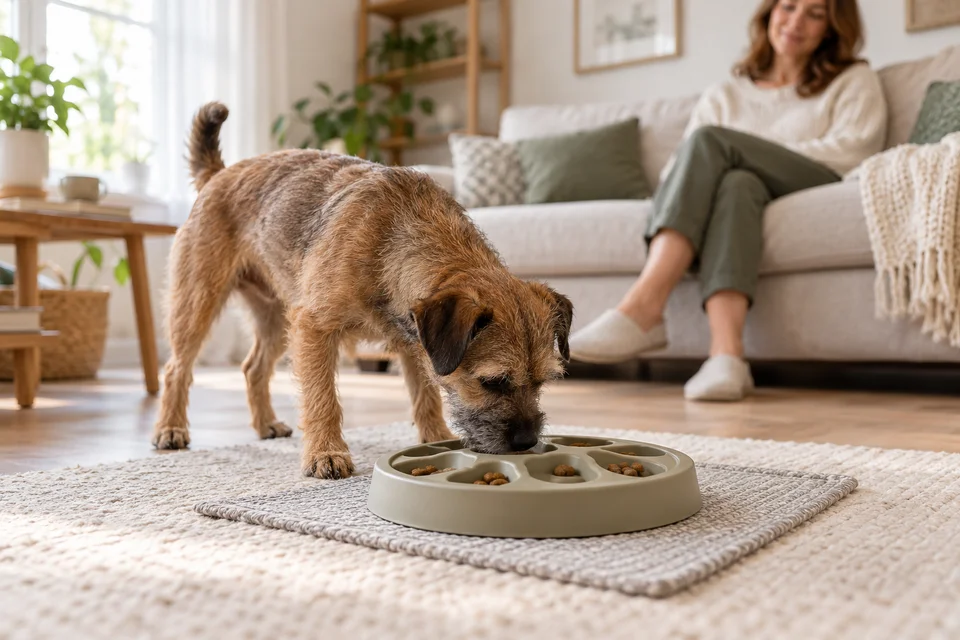
Choose an intact, appropriately sized puzzle your dog can use comfortably, check the manufacturer's instructions, and begin with food that is easy to reach while you supervise. Use suitable food already allowed in your dog's existing feeding plan and account for it rather than adding an uncounted extra meal. Let the dog approach or leave. If the task causes frustration, guarding, chewing of parts or difficulty reaching food, stop and simplify or choose another activity. A harder puzzle or a longer session is not automatically better enrichment.
Sources: Ohio State Veterinary Medical Center: Toys and puzzles for your pet (2024 PDF) · RSPCA Australia: The importance of enrichment for dogs
Match the task to this dog, not a difficulty badge
Ohio State's veterinary behavior handout distinguishes foraging mats, fillable toys, slow feeders and more complex puzzles. It warns that a toy may frustrate or excite a pet rather than soothe it.
Check the individual task: must the nose fit a recess, must a part be lifted, or does the toy roll across a floor? A puzzle that is simple for one dog may be inaccessible to another.
For the first introduction, choose the easiest available configuration and keep the ordinary feeding method available. Do not withhold the normal meal to force participation. Seek advice if pain, dental problems, a restricted diet or mobility limits affect suitability.
| Check | Useful question | Reason to change the plan |
|---|---|---|
| Fit and access | Can this dog reach the food comfortably? | Awkward reach or physical difficulty |
| Integrity | Any loose parts, sharp edges or damage? | Damaged or swallowable components |
| Difficulty | Is food easy to discover at first? | Repeated unsuccessful effort |
| Household | Can other pets approach the food? | Competition or guarding concern |
| Food | Does it fit the existing plan? | Unknown ingredient or uncounted extra food |
Sources: Ohio State Veterinary Medical Center: Toys and puzzles for your pet (2024 PDF)
Allocate food before filling the puzzle
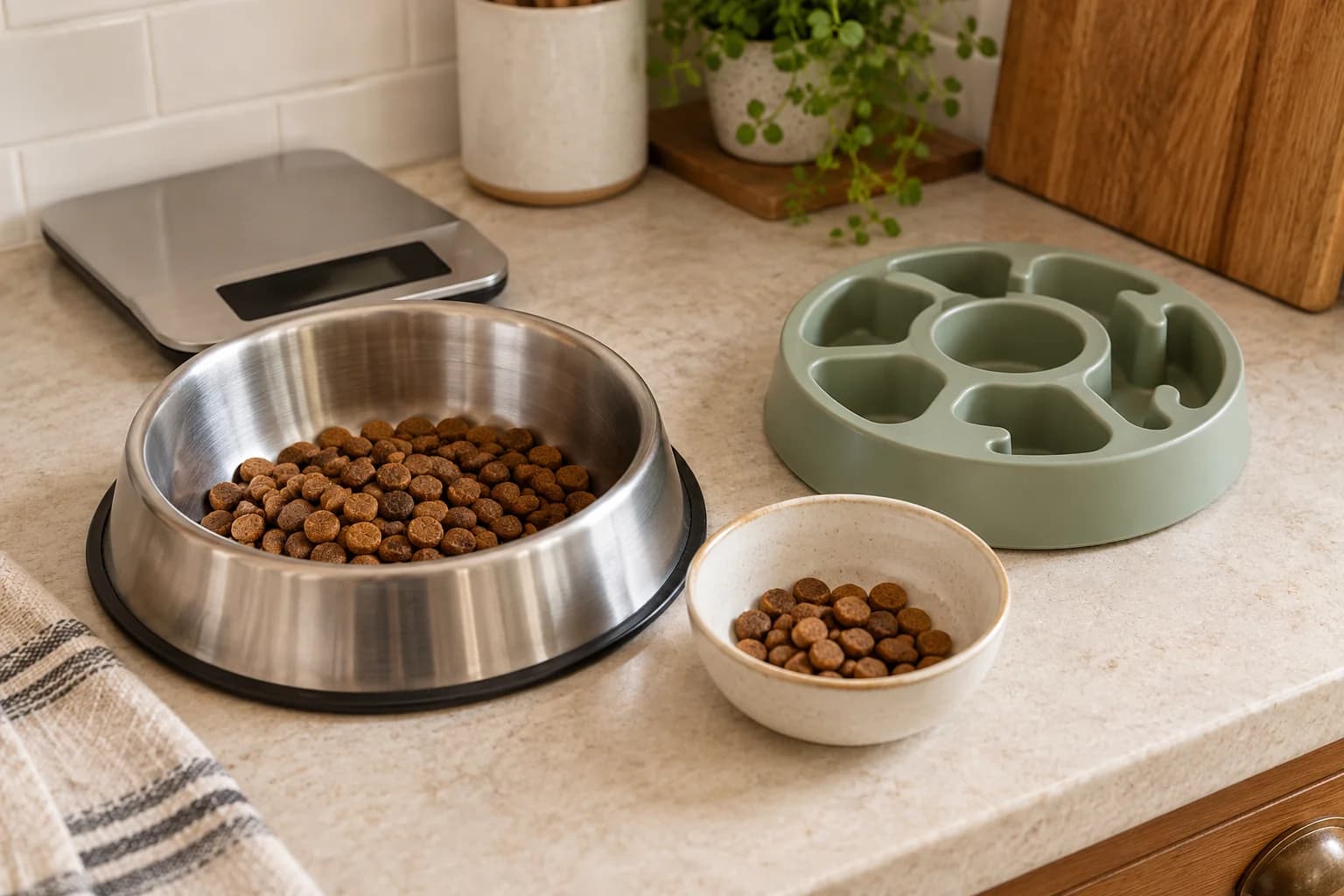
RSPCA cautions that feeding enrichment can lead to overfeeding when food is simply added. Set aside the puzzle allocation from the already established daily amount, with any restrictions from the veterinary plan preserved.
Our practical method is to label the prepared amount by destination: bowl, puzzle and other planned uses. Moving the same food into a toy changes its presentation, not its recipe or energy content.
Do not assume a spoonful of a new filling equals the energy of the kibble it replaces. If you want a new ingredient, ask how it fits the plan. The kitchen-scale buying guide concerns measuring food, not testing toys or weighing animals.
Sources: RSPCA Australia: The importance of enrichment for dogs
A fictional first session with the same daily total
Fictional bookkeeping: Ada's existing plan for dog Moss uses 180 g of one dry recipe per day. She allocates 20 g of that same food to an easy puzzle and 160 g to ordinary meals: 20 + 160 = 180 g. These quantities are invented, not feeding advice.
Moss investigates and eats 12 g, then walks away. Ada records 8 g remaining, removes and handles leftovers according to the food and puzzle directions, and does not automatically refill the toy. The rest of the day remains tied to the existing feeding plan.
The observation is 'approached, ate some, left,' not 'failed the puzzle.' If reduced intake is unexpected or Moss seems unwell, the next step is veterinary advice rather than a more tempting recipe.
| Item | Amount | Interpretation |
|---|---|---|
| Existing daily amount | 180 g | Already decided outside this guide |
| Ordinary meals allocated | 160 g | Same recipe |
| Puzzle allocated | 20 g | Included, not extra |
| Puzzle eaten / remaining | 12 g / 8 g | Offered is not the same as eaten |
Watch engagement instead of timing a performance
Ohio State advises close observation when introducing a new toy, including frustration, stress and attempts to ingest components. RSPCA emphasizes individual preference and choice.
Record observable actions: sniffed, nudged, obtained food, left, chewed an edge. Avoid converting speed into an intelligence score. A dog choosing a different activity is information about suitability today.
If an item is guarded, give space and obtain professional advice about safe management. A second pet should not be used to test whether the first dog will share. This guide is not a resource-guarding training protocol.
Sources: Ohio State Veterinary Medical Center: Toys and puzzles for your pet (2024 PDF) · RSPCA Australia: The importance of enrichment for dogs
Close the session with an equipment and food check
Account for leftovers, clean according to the exact product and food directions, and inspect before the next session. Use the bowl-cleaning guide for the cleaning-versus-disinfection distinction; not every toy can go in a dishwasher.
Save the configuration, food allocation and response in a local My Pet Notes entry. It is not an automated food tracker or a guarantee that an item is safe unattended.
At the next opportunity, repeat a comfortable easy setup or choose a different suitable activity. Advancement is optional. No product ranking, hands-on toy test or promised behavior outcome is implied here.
- Existing food allowance is preserved.
- First use is easy, voluntary and supervised.
- Damage, frustration or guarding changes the plan.
- Leftovers and cleaning are handled before storage.
FROM THE GUIDE · INTO THEIR EVERYDAY
My dog's first food-puzzle session
Record an easy supervised setup, existing food allocation and the dog's choices.
Draft my puzzle sessionChoose their notebook, add your own details, then save. Free, no account. Notes stay in this browser.
THE NEXT QUESTIONS
What else might you be wondering?
Is the hardest puzzle best?
No. Suitability depends on access, preference and the dog's response. A challenging toy can frustrate or excite rather than calm.
Sources: Ohio State Veterinary Medical Center: Toys and puzzles for your pet (2024 PDF)
Can puzzle food be extra?
Account for it in the existing feeding plan. Do not silently add food or substitute different ingredients gram-for-gram.
Sources: RSPCA Australia: The importance of enrichment for dogs
Can I leave a new toy with my dog while I go out?
Do not use an unobserved first trial. Supervise introduction, check the actual instructions and discuss individual risks. One uneventful session does not certify unattended safety.
Sources: Ohio State Veterinary Medical Center: Toys and puzzles for your pet (2024 PDF)
LOOK CLOSER AT THE EVIDENCE
Sources & what they establish
Official guidance, research findings and PetCheck’s practical interpretations have different roles. These notes explain how the sources were used.
University veterinary behavior handout
Ohio State toy-selection cautions
Supports supervision, appropriate difficulty, integrity checks and attention to guarding.
Limit: The handout is not PetCheck product testing; its named products are not endorsed or ranked here.
Sources: Ohio State Veterinary Medical Center: Toys and puzzles for your pet (2024 PDF)
Animal welfare organization guidance
RSPCA individualized enrichment
Supports observing choice and avoiding overfeeding or ingestion hazards.
Limit: It does not promise a specific behavioral result or prescribe an individual's diet. The worked food ledger is fictional.
Sources: RSPCA Australia: The importance of enrichment for dogs
Sources checked 2026-10-26. Examples are fictional and illustrate reasoning, not patient outcomes. This is an editorial source review, not independent veterinary review. How we prepare these guides →
FOR ANOTHER VISIT
Keep this guide close.
Save it to read again, or copy a link to share.
ONE QUESTION CAN LEAD TO ANOTHER
A useful next read.
Choose the question that fits what you want to understand next.
 Worked arithmetic example
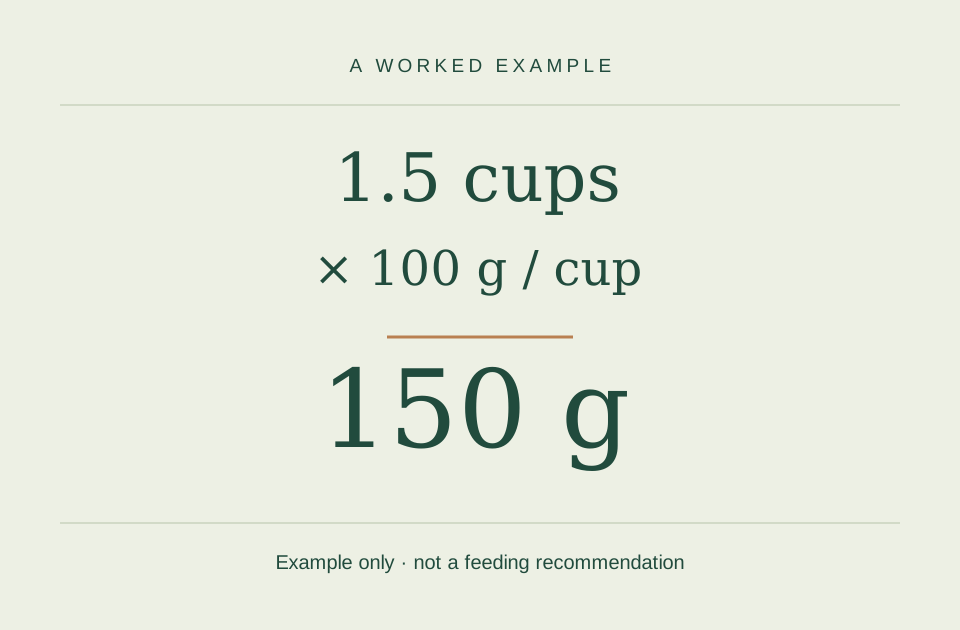
Should you measure dog food in cups or grams?
Allocate food from the existing daily amount before filling the puzzle.
Read the guide AI-generated editorial scene
How often should you clean pet bowls?
Separate cleaning from disinfection and check the actual puzzle's care instructions.
Read the guide