COOPERATIVE CARE · PAWS
How can I help my pet get comfortable with paw handling and nail trims?
Break paw care into small voluntary steps, stop before restraint, and keep an honest record of what your pet accepts.
THE DIRECT ANSWER
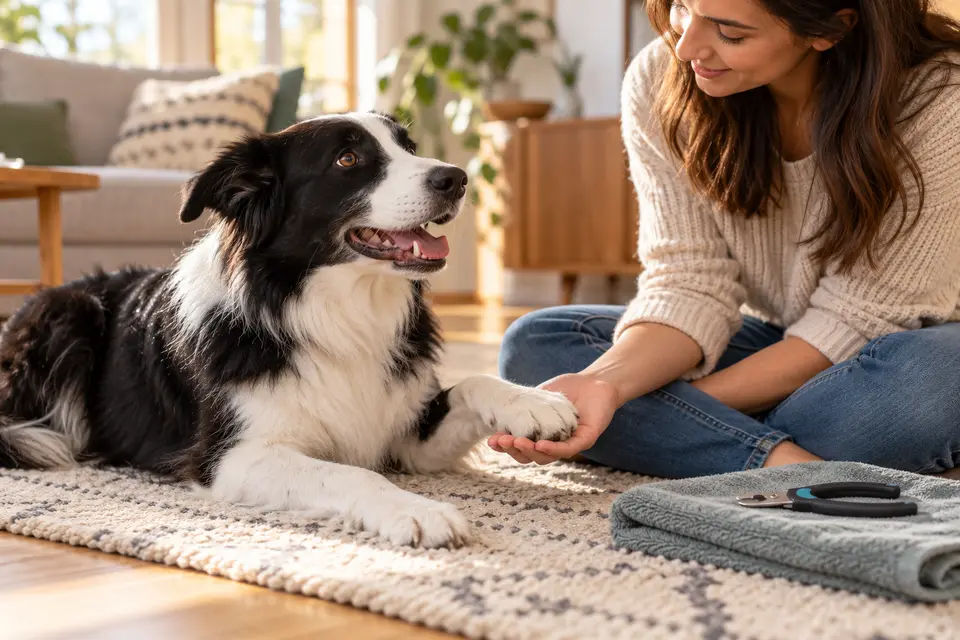
Practice when no nail urgently needs cutting: pair one brief, low-pressure step—approaching the paw, touching the leg, resting the paw in a hand, or seeing the tool—with something your pet values. Let the pet move away and stop at hesitation, struggle or distress. Progress only when the current step is comfortably repeated. Ask a veterinarian or qualified groomer to demonstrate anatomy and tools before trimming, especially for dark nails, painful paws or a pet with previous fear.
Sources: Cornell Riney Canine Health Center: Grooming and cooperative care · AAHA: Humane restraint of animals
Paw contact and nail cutting are different steps
Cornell describes cooperative care as voluntary participation built through gradual exposure at the animal's pace, choice, predictability and reinforcement. A pet can be comfortable near clippers yet not ready for toe handling—or accept touch while worrying about the tool.
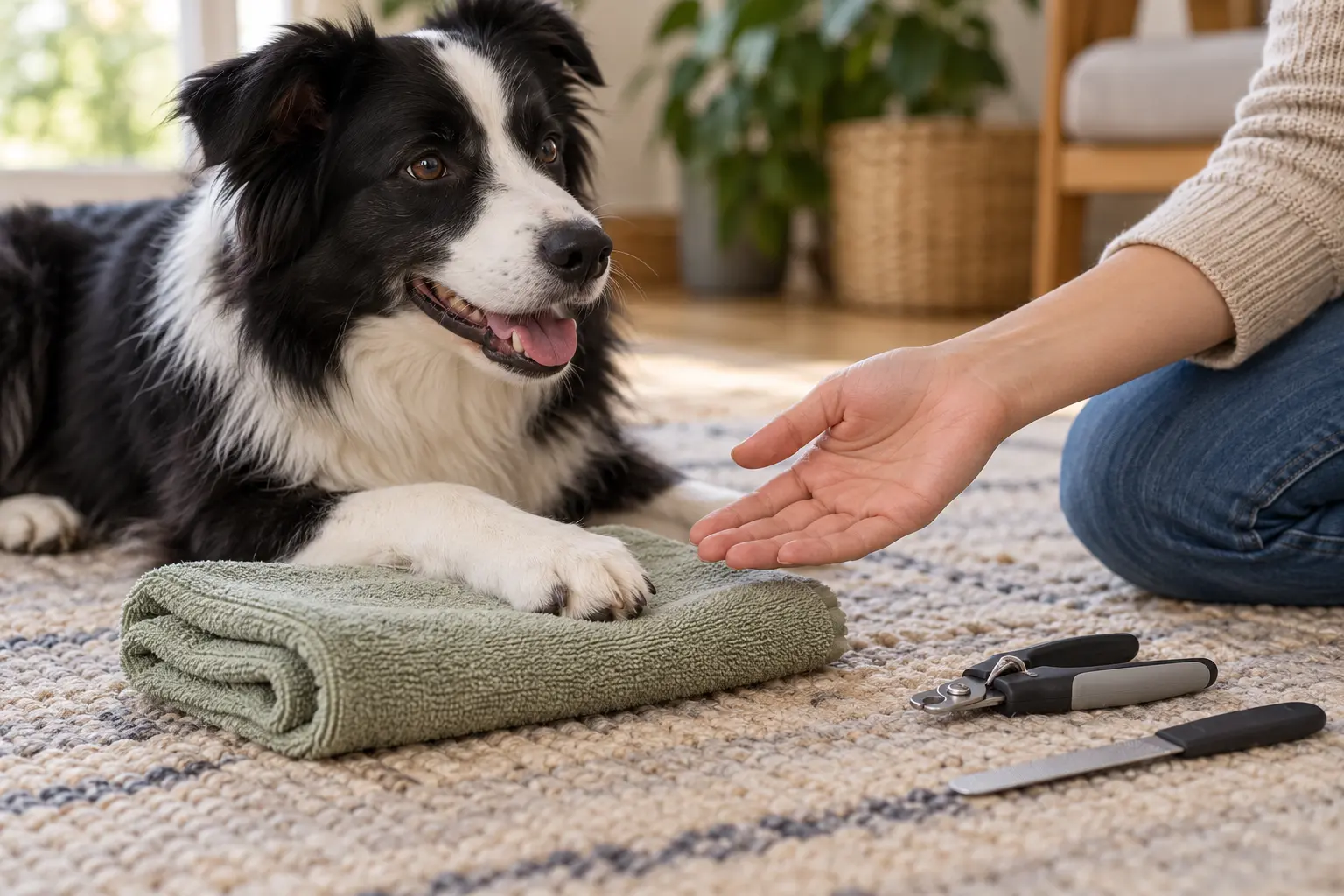
List the smallest current step without a deadline. 'One front paw rested in my palm for one second' is clearer than 'almost ready.' Keep the clippers closed during tool familiarization.
Do not hold the animal down to finish. AAHA identifies multiple people restraining an animal for a nail trim as inappropriate physical restraint.
| Step | Possible observation | Reason to pause |
|---|---|---|
| Approach | Pet remains in the chosen station | Moves away or stops taking usual reward |
| Leg touch | Brief touch accepted without tension | Pulls back, freezes, mouths or vocalizes |
| Paw support | Paw rests loosely in an open hand | Grip is needed to keep it there |
| Tool present | Closed tool can rest nearby | Pet watches rigidly or avoids the area |
| Professional trim | Technique and anatomy were demonstrated | Pain, uncertainty or unsafe movement |
Sources: Cornell Riney Canine Health Center: Grooming and cooperative care · AAHA: Humane restraint of animals
Make stopping part of the setup
Choose a stable, non-slip surface and a position the pet can leave. Work away from stairs and other hazards. The goal is not immobility; it is a predictable brief interaction.
Use a consistent start cue and an equally clear finish. A lifted head, withdrawn paw or departure should end the attempt rather than trigger tighter holding.
Food can support learning, but do not use it to hide fear or create risk around dietary restrictions. Ask the veterinary team about suitable reinforcement for the individual pet.
Sources: Cornell Riney Canine Health Center: Grooming and cooperative care · AAHA: Humane restraint of animals
A fictional practice log without a trim deadline
Fictional example: Lee's veterinarian has checked cat Miso's paws and shown Lee a handling position. On day one Miso stays on the mat while Lee touches one foreleg. On day three Miso places one paw in Lee's open hand, then withdraws it.
Lee stops immediately and records 'paw support for one second; withdrew before tool appeared.' No nail is cut, and the record does not call the session a failure.
On day five the closed clippers are placed on the towel at a distance; Miso leaves. Lee ends the session and asks the clinic how to adjust.
| Day | Observed step | Boundary kept |
|---|---|---|
| 1 | Brief foreleg touch accepted | No paw hold |
| 3 | Paw rested in open hand for about one second | Stopped on withdrawal |
| 5 | Closed tool placed at a distance; Miso left | No pursuit or trim |
| Follow-up | Clinic question prepared | No timeline guessed |
Do not learn nail anatomy by trial and error
Nail color, species, anatomy, medical history and movement affect what can be done safely. Ask a veterinarian or qualified professional to show the tool, position and where to stop for this pet.
A grinder and clippers create different sound, vibration and handling demands. Familiarity with one does not transfer automatically to the other, and this guide does not rank products.
If care is overdue but home handling is unsafe, contact the veterinary or grooming team. The answer is not to compress weeks of practice into one forced session.
Sources: AAHA: Humane restraint of animals
Record one accepted step and one stop signal
A reusable note needs the surface, body position, step attempted, response and reason for stopping. Avoid labels such as stubborn or dramatic.
My Pet Notes stores the text in this browser. It cannot evaluate gait, pain, nail length or trim technique, and it does not schedule care.
Share the record before the next professional visit so the team knows what handling has and has not been practiced.
- The paw is not painful or injured.
- The pet can leave the setup.
- The current step is smaller than a trim if needed.
- The stop signal ends the session.
FROM THE GUIDE · INTO THEIR EVERYDAY
A paw-practice note
Record one voluntary step and the stop signal. This does not assess pain or teach nail anatomy.
Draft my paw-practice noteChoose their notebook, add your own details, then save. Free, no account. Notes stay in this browser.
THE NEXT QUESTIONS
What else might you be wondering?
Should I hold my pet still until the trim is finished?
No. Avoid force and stop when the animal withdraws or becomes distressed. Ask the veterinary team about safer handling and professional options.
Sources: AAHA: Humane restraint of animals
How many days should paw training take?
There is no universal timetable. Progress from the animal's observed comfort, prior experience and professional guidance rather than a calendar.
Sources: Cornell Riney Canine Health Center: Grooming and cooperative care
Can I practice if the paw seems sore?
Do not practice on a painful, swollen, bleeding or injured paw. Contact a veterinarian for assessment.
LOOK CLOSER AT THE EVIDENCE
Sources & what they establish
Official guidance, research findings and PetCheck’s practical interpretations have different roles. These notes explain how the sources were used.
University veterinary guidance
Cornell cooperative grooming
Supports voluntary participation, gradual exposure, predictability and positive reinforcement.
Limit: Does not supply a universal training duration or replace examination of a painful paw.
Sources: Cornell Riney Canine Health Center: Grooming and cooperative care
Veterinary association policy
AAHA humane restraint
Supports patient-friendly handling and rejects forceful multi-person restraint for routine nail trims.
Limit: Clinical teams still decide what safe handling or medication is needed for an individual procedure.
Sources: AAHA: Humane restraint of animals
Original editorial workflow
Miso's fictional practice log
Separates paw contact, tool exposure and a stop signal.
Limit: Not a tested protocol, real animal or promise of trim success.
Sources checked 2026-10-22. Examples are fictional and illustrate reasoning, not patient outcomes. This is an editorial source review, not independent veterinary review. How we prepare these guides →
FOR ANOTHER VISIT
Keep this guide close.
Save it to read again, or copy a link to share.
ONE QUESTION CAN LEAD TO ANOTHER
A useful next read.
Choose the question that fits what you want to understand next.
 AI-generated editorial scene
How do I start brushing my dog or cat’s teeth at home?
Apply the same principle of small, voluntary steps to a different home-care routine.
Read the guide AI-generated editorial scene
What should I write down before my pet’s vet visit?
Bring pain, fear or handling questions to the veterinary team in a bounded note.
Read the guide