HOME HYGIENE · ACCIDENT CLEANUP
How should I clean up pet vomit or diarrhea at home?
Protect people and pets, remove the visible material first, and use surface-appropriate products exactly as labeled.
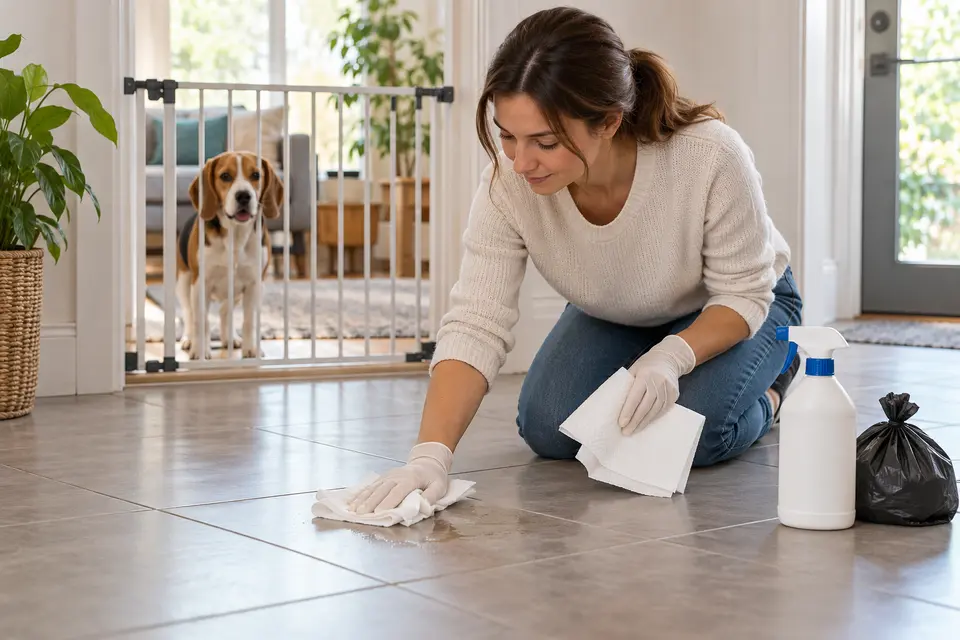
THE DIRECT ANSWER
Keep children and pets away, ventilate when product directions require it, use disposable gloves, and remove the visible material with absorbent supplies. Clean the surface with soap or detergent appropriate for that material before any needed disinfection. Follow the disinfectant label for surface compatibility, dilution, contact time, rinsing and safe pet re-entry; never mix cleaners. Bag waste, wash hands, and contact the veterinarian about the illness separately—cleaning cannot explain or treat the cause.
Sources: CDC: When and How to Clean and Disinfect Your Home · CDC: Cleaning and Disinfecting Pet Supplies
Assign the pet and the spill to different tasks
Move the pet to a safe, comfortable area without punishment. One person can contact the veterinary team while another protects the cleanup zone. Do not delay care to finish the floor.
Use barriers so another pet cannot lick the area or cleaning product. Keep food-preparation tools and pet bowls away from cleanup supplies.
Record where the material occurred and whether a toy, bed or bowl was contaminated. A photo of the mess is not needed for routine cleanup and should not be treated as a diagnosis.
| Stage | Action | Common mistake |
|---|---|---|
| Contain | Keep people and pets out; gather gloves and absorbent material | Letting a second pet inspect the area |
| Remove | Lift visible material without spreading it | Starting with disinfectant over organic matter |
| Clean | Use surface-appropriate soap or detergent | Using one method on tile, carpet and fabric |
| Disinfect if needed | Use a labeled product and full contact time | Mixing products or guessing dilution |
| Finish | Dispose, wash hands, dry and verify safe re-entry | Returning a pet before residue is handled |
Visible soil changes what disinfectant can do
CDC says cleaning with soap or detergent removes dirt and many germs, and surfaces should be cleaned before sanitizing or disinfecting because soil can interfere with chemical action.
Use a product compatible with the floor, upholstery or fabric. Blot soft surfaces and follow their care instructions; do not saturate materials or use a vacuum on wet material unless the appliance and cleaning guidance explicitly permit it.
Disinfection may be appropriate when a pet is sick or a specific pathogen is involved. The receiving veterinarian or public-health guidance may require a particular product or routine.
Sources: CDC: When and How to Clean and Disinfect Your Home · CDC: Cleaning and Disinfecting Pet Supplies · CDC: Giardia Infection Prevention and Control
A fictional accident across two surfaces
Fictional example: Dog Otis vomits once on a washable mat and adjacent sealed tile. Casey keeps Otis and a child in another room and contacts the veterinary clinic because Otis may have swallowed part of a toy.
Casey removes visible material, places the mat aside for its own care-label route, and cleans the tile with a suitable detergent. Any disinfectant is used only after checking its label and the clinic's advice.
The mat and tile are not treated as the same material. The example does not recommend a chemical, claim disinfection or say a single vomiting event is safe to monitor.
| Item | Separate route | Limit retained |
|---|---|---|
| Pet | Kept away; clinic contacted about possible toy | Cleanup does not assess the pet |
| Visible material | Removed and bagged | No germ claim |
| Sealed tile | Cleaned with compatible detergent | Disinfectant label still governs |
| Washable mat | Care label checked separately | No universal heat or bleach rule |
| Room | Kept closed until dry and safe | Re-entry time depends on products and surface |
The label is part of the safety equipment
CDC recommends EPA-registered disinfecting products when disinfection is used and says to follow label contact time and drying directions. Pet items may need rinsing before reuse; the exact label and item instructions govern.
Never mix bleach with ammonia, acids or other cleaners. Do not combine products to make them 'stronger,' and do not use a stronger concentration than directed.
Keep containers closed and labeled. If exposure to a cleaning product occurs, contact the product's emergency line and medical or veterinary help as appropriate.
Sources: CDC: When and How to Clean and Disinfect Your Home · CDC: Cleaning and Disinfecting Pet Supplies
Close the zone only after the last check
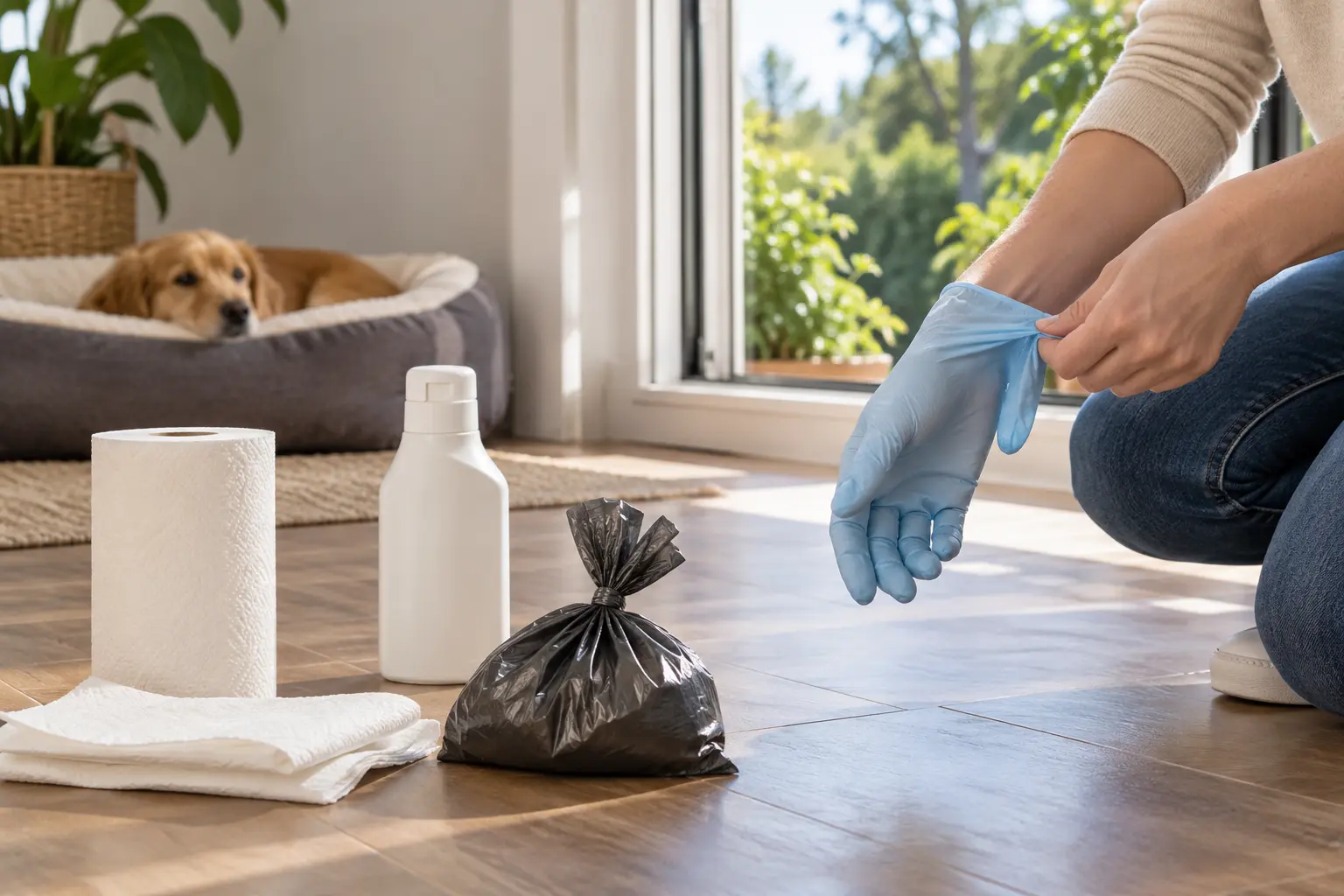
Remove gloves without touching the contaminated outer surface, bag disposable waste according to local rules, and wash hands with soap and water. Clean reusable tools separately.
Check that the surface is dry, any required rinse is complete, and no residue or small item is accessible before reopening the area.
My Pet Notes can hold a local list of surfaces and unfinished tasks. It cannot certify disinfection, identify an infection or alert the veterinarian.
- The pet and household members are protected first.
- Visible material was removed before disinfection.
- Each surface followed its own care and product labels.
- Drying, rinsing and safe re-entry were checked.
FROM THE GUIDE · INTO THEIR EVERYDAY
A household cleanup handoff
Separate pet care, surfaces and unfinished cleaning tasks. This does not certify disinfection.
Draft my cleanup handoffChoose their notebook, add your own details, then save. Free, no account. Notes stay in this browser.
THE NEXT QUESTIONS
What else might you be wondering?
Can I spray disinfectant directly over the mess?
Remove visible material and clean first. Soil can reduce disinfectant contact with the surface; then follow the exact product label if disinfection is needed.
Should I use the same method on carpet and tile?
No. Follow the material's care guidance and a product labeled for that surface. Avoid saturating or damaging soft materials.
Does disinfecting mean the cause is no longer a concern?
No. Surface cleaning does not diagnose or treat the pet. Contact the veterinarian about repeated illness, urgent signs or a suspected exposure.
LOOK CLOSER AT THE EVIDENCE
Sources & what they establish
Official guidance, research findings and PetCheck’s practical interpretations have different roles. These notes explain how the sources were used.
Public-health guidance
CDC home and pet-item cleaning
Supports cleaning before disinfection, surface compatibility, label contact time, drying and rinsing precautions.
Limit: Does not identify the cause of a pet's vomiting or diarrhea or prescribe one product for every material.
Sources: CDC: When and How to Clean and Disinfect Your Home · CDC: Cleaning and Disinfecting Pet Supplies
Pathogen-specific public-health guidance
CDC Giardia prevention
Shows that diagnosed infections can require more focused cleaning and disinfection.
Limit: It does not imply that an undiagnosed household accident is Giardia.
Original editorial workflow
Otis's fictional two-surface cleanup
Separates pet care, tile and fabric tasks.
Limit: Not a disinfection test, real illness or chemical recommendation.
Sources checked 2026-10-22. Examples are fictional and illustrate reasoning, not patient outcomes. This is an editorial source review, not independent veterinary review. How we prepare these guides →
FOR ANOTHER VISIT
Keep this guide close.
Save it to read again, or copy a link to share.
ONE QUESTION CAN LEAD TO ANOTHER
A useful next read.
Choose the question that fits what you want to understand next.
 AI-generated editorial scene
How should I wash pet bedding and soft toys?
Route contaminated fabric through its own component-specific care instructions.
Read the guide AI-generated editorial scene
What should I write down before my pet’s vet visit?
Keep the pet's illness timeline separate from the household cleanup record.
Read the guide