HOME PREPARATION · LOUD EVENTS
How can I prepare my pet for fireworks or loud noises?
Build a secure, familiar plan before a loud event, record the response you actually see, and involve your veterinarian early when fear is intense.
THE DIRECT ANSWER
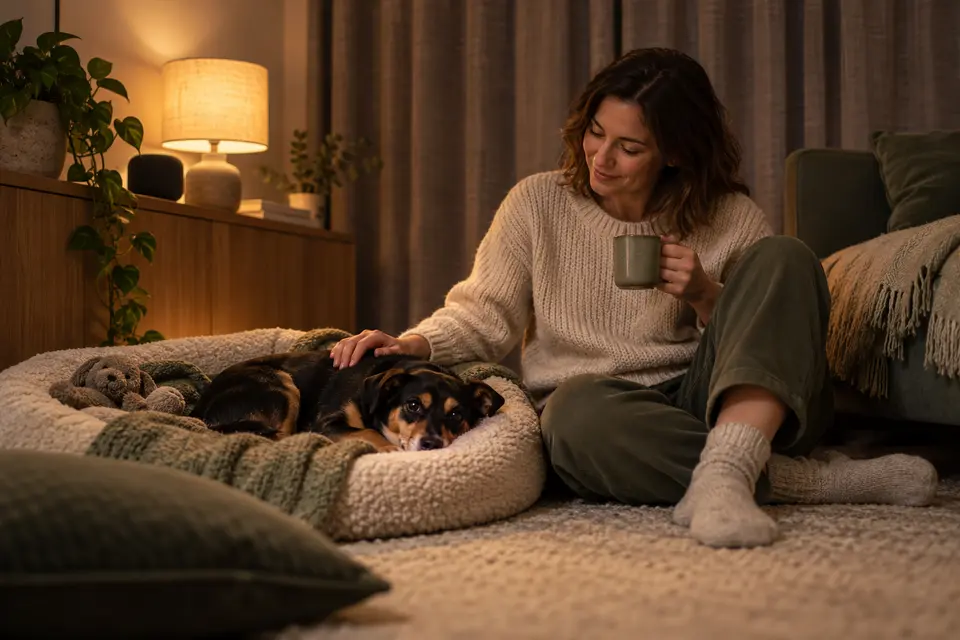
Prepare before the noise: confirm identification details, choose a secure familiar indoor area, close escape routes, keep normal essentials accessible, and decide who will stay with the pet. Let the pet use its preferred safe place without punishment or forced interaction. If your pet has intense fear, escape attempts, self-injury risk or a history of severe reactions, contact your veterinarian in advance for an individual plan; do not choose or dose a calming medication from this guide.
Sources: AVMA: July 4 Safety · AAHA: Noise Aversion in Pets · RSPCA: Keeping pets safe during fireworks
Do the household work while the home is still quiet
AAHA emphasizes preparation for noise aversion and a familiar safe space. AVMA advises keeping pets indoors during fireworks and checking identification. These are prevention steps; they do not guarantee that an animal will feel calm.
Walk through doors, windows, gates, cat flaps and visitor traffic before the event. Decide which person is responsible for each boundary. A sign reading 'keep door closed' is useful only if everyone understands which door and when.
Set up water, bedding and toileting access appropriate to the species and household. Introduce the room in ordinary conditions rather than moving a frightened animal into an unfamiliar setup for the first time.
| Part | Confirm before the event | Avoid assuming |
|---|---|---|
| Access | Pet can choose a familiar resting or hiding area | A crate or room is calming merely because it is enclosed |
| Boundaries | Doors, windows, gates and visitor plan are assigned | Someone else will notice an escape route |
| Essentials | Water, suitable toileting and familiar bedding are available | The pet will leave hiding to find them |
| Sound and light | Curtains and ordinary background sound are tested gently | Louder masking sound is automatically better |
| Contacts | Veterinarian and emergency contact are ready | A severe response can wait until the event ends |
Sources: AAHA: Noise Aversion in Pets · AVMA: July 4 Safety
Observe the response without turning comfort into a test
RSPCA advises against punishment and says pets should be allowed to hide, pace or decline play. Offer presence and familiar options; do not pull an animal from a hiding place to prove that a setup works.
Notice location, posture, movement, vocalization, appetite and attempts to escape. Record the time and the noise context, while acknowledging what you did not see. A quiet animal may still be fearful; behavior must be interpreted by a professional in context.
Do not play increasingly loud recordings during an active event or improvise desensitization. Planned behavior work takes time and should follow qualified guidance.
Sources: RSPCA: Keeping pets safe during fireworks · AAHA: Noise Aversion in Pets
A fictional evening plan with a real uncertainty
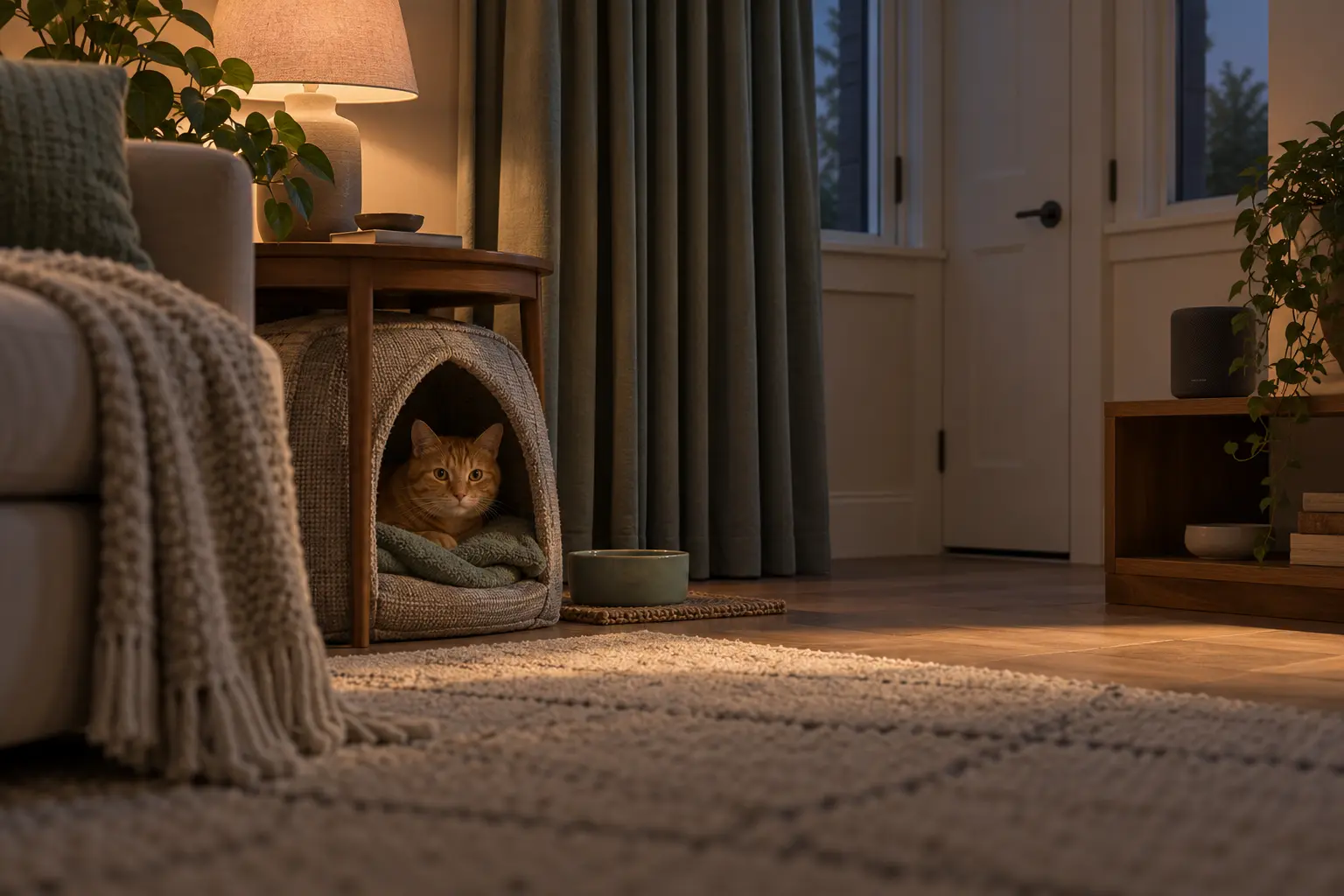
Fictional example: A neighborhood notice says fireworks may begin at 8 p.m. Taylor prepares an interior room for cat Fern in the afternoon, confirms the registry contact, and assigns the front door to one adult during arrivals.
At 8:12 Fern enters the covered bed. At 8:20 Taylor sees Fern remain there while eating is unobserved. The note says exactly that; it does not convert hiding into a diagnosis or write 'would not eat.'
Fern later emerges after the noise decreases. Taylor records the time and one question for the veterinarian because an earlier event involved frantic door scratching. The example does not show that this room prevented fear or injury.
| Time | What happened | Limit |
|---|---|---|
| Afternoon | Room, water, litter and door plan checked | Preparation does not predict response |
| 8:12 p.m. | Fern entered covered bed after loud bangs began | Reason and internal state are not known |
| 8:20 p.m. | Still in bed; no eating observed | Eating outside the observation window is unknown |
| After event | Emerged when sound decreased; veterinary question saved | No medication or behavior plan invented |
Bring severe or repeated fear to the veterinarian early
AAHA lists behaviors such as hiding, trembling, panting, vocalizing and escape attempts among possible noise-aversion signs. Similar-looking behavior can have different causes, so a home note should not assign a disorder.
Contact the clinic well before a predictable event when the pet has a history of intense fear. Give the dates, triggers, duration, recovery and safety risks. Ask what to do if the planned support is insufficient.
Do not give a leftover prescription, human product, supplement or another pet's medicine. This guide does not compare calming products or set a dose.
Sources: AAHA: Noise Aversion in Pets
Keep one useful detail for next time
After the home is quiet, record one feature the pet used, one feature it avoided and one unresolved risk. Check doors and the animal before reopening outdoor access.
My Pet Notes can keep the observation in this browser. It does not monitor noise, notify a registry, alert a veterinarian or predict a future response.
If the pet escaped, follow local lost-pet procedures and update the microchip registry as missing where applicable. The separate identification guide explains how registry records differ from household notes.
- Identification and contact records were checked separately.
- Every escape route has a responsible person.
- The pet can reach familiar essentials without being forced out.
- Severe-history questions reached the veterinarian before the event.
FROM THE GUIDE · INTO THEIR EVERYDAY
A quiet-event plan
Prepare the room, boundaries and contacts before the noise. This is not a behavior treatment plan.
Draft my quiet-event planChoose their notebook, add your own details, then save. Free, no account. Notes stay in this browser.
THE NEXT QUESTIONS
What else might you be wondering?
Should I make my pet stay in a crate during fireworks?
Do not assume confinement is calming for every pet. Use a familiar, secure setup and individual veterinary or behavior guidance, especially if the pet has panicked in confinement.
Sources: AAHA: Noise Aversion in Pets
Can I give a calming medicine from a previous event?
Only use a medicine under current veterinary instructions for this pet. Contact the clinic in advance rather than selecting or reusing a dose from this article.
Does hiding mean the plan failed?
Not by itself. Let the pet use a safe hiding place and record the broader response. Ask a professional about severe, prolonged or risky behavior.
LOOK CLOSER AT THE EVIDENCE
Sources & what they establish
Official guidance, research findings and PetCheck’s practical interpretations have different roles. These notes explain how the sources were used.
Veterinary and welfare guidance
AAHA, AVMA and RSPCA loud-event preparation
Supports advance preparation, secure indoor spaces, identification and non-punitive observation.
Limit: Does not guarantee calm or select an individual treatment.
Sources: AAHA: Noise Aversion in Pets · AVMA: July 4 Safety · RSPCA: Keeping pets safe during fireworks
Original editorial workflow
Fern's fictional event log
Separates a prepared environment, witnessed behavior and observation gaps.
Limit: Not a validated fear scale, patient case or behavior-treatment trial.
Sources checked 2026-10-21. Examples are fictional and illustrate reasoning, not patient outcomes. This is an editorial source review, not independent veterinary review. How we prepare these guides →
FOR ANOTHER VISIT
Keep this guide close.
Save it to read again, or copy a link to share.
ONE QUESTION CAN LEAD TO ANOTHER
A useful next read.
Choose the question that fits what you want to understand next.
 AI-generated editorial scene
How do I update my pet’s microchip contact details?
Verify the separate registry and contact records before a higher escape-risk event.
Read the guide AI-generated editorial scene
What should I write down before my pet’s vet visit?
Keep a bounded account of the response for a veterinary conversation.
Read the guide