SEASONAL HOME · VISITORS
How should I plan Halloween door duty when I have pets?
Give visitors, pets and returning candy bags separate routes—from the first knock to the final cleanup.
THE DIRECT ANSWER
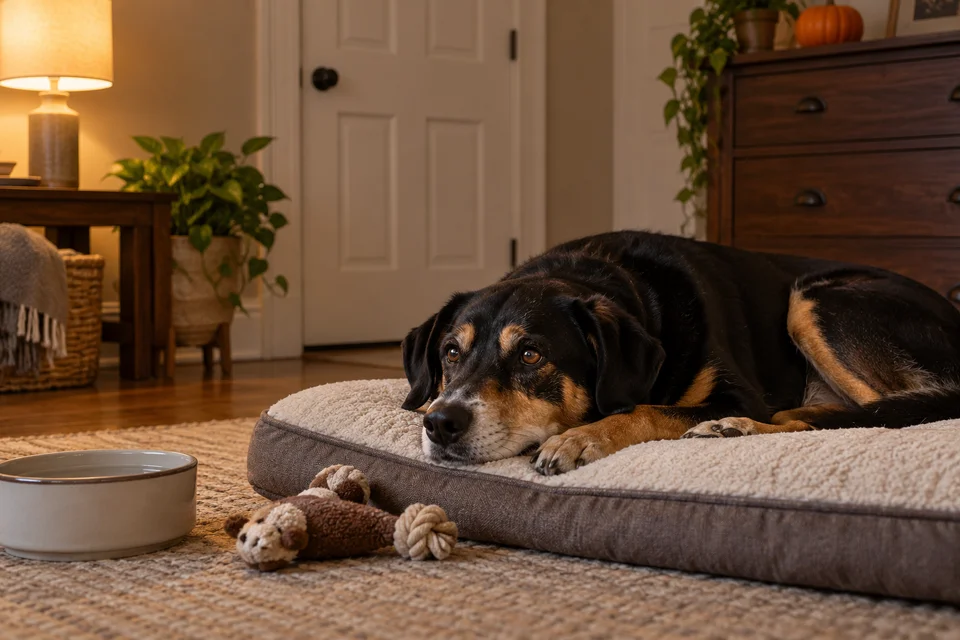
Before visitors arrive, choose a secure comfortable pet space away from the entrance and decide who answers the door and who checks the pets. Keep sweets, returning trick-or-treat bags and wrappers inaccessible, and make sure every household member knows not to open the pet room for a greeting. If the pet cannot settle or the layout cannot keep the routes separate, simplify or skip door duty. Costumes are optional; a pet does not need to meet visitors or dress up to be included in the evening.
Sources: ASPCA: Halloween safety tips · AAHA: Halloween safety for pets
Separate three routes before the first knock
AAHA describes the escape opportunity created by repeated door opening. ASPCA recommends a separate comfortable room for pets who may find the activity stressful.
Our household planning method separates three routes: visitors to the entrance, the caregiver to the pet space, and candy bags to secure storage. Walk these routes without the pet and look for crossings that would open an escape path.
A gate alone is not necessarily adequate for an animal that climbs or jumps it. Choose a separation method the individual pet tolerates and cannot readily defeat, while preserving safe human access and emergency exits.
| Job | Before visitors | During the evening |
|---|---|---|
| Door person | Choose greeting location | Do not invite pets to greet |
| Pet caregiver | Settle familiar retreat and supplies | Check comfort without opening an escape route |
| Returning household | Agree candy-storage location | Store bags before pet greetings |
| Everyone | Know which door stays closed | Communicate before changing the plan |
Sources: AAHA: Halloween safety for pets · ASPCA: Halloween safety tips
Prepare a retreat the pet can actually use
Set up familiar resting space and water, with the cat's necessary resources if a cat will stay there. Check that decorations, wires and small accessories are not within reach. A room used only as a crowded storage area may not be a comfortable retreat.
Try the arrangement during a calm ordinary period, not for the first time amid repeated knocking. Observe how the pet responds; do not repeatedly ring the bell to provoke a test.
If separation causes distress or household access cannot be managed, change the human plan. AAHA suggests alternatives such as not participating or greeting away from the entrance; choose only an arrangement that still leaves appropriate pet supervision.
Sources: AAHA: Halloween safety for pets
A fictional evening that exposes a missing handoff
Fictional example: Jo answers visitors while Sam checks dog Fern in a familiar back room. At 7:10 pm, the children return with candy bags and head toward Fern. The original plan covered outgoing visitors but not returning family.
Jo pauses door duty. Sam confirms Fern's room stays closed while bags go into inaccessible storage. Only after the entrance is secured does the household resume ordinary pet contact.
This invented sequence illustrates a process gap, not a tested escape-prevention system. A useful plan includes how to stop greeting visitors when there are too few adults to keep roles separate.
| Moment | Risk in the original plan | Revised action |
|---|---|---|
| Visitors arrive | Repeated exterior opening | Pet space remains separate |
| Children return | Bags and pet greeting cross routes | Pause; secure entrance and bags first |
| One adult steps away | Roles no longer covered | Pause door duty |
| Last visitor leaves | Wrappers remain accessible | Complete sweep before reopening rooms |
The job continues after the door closes
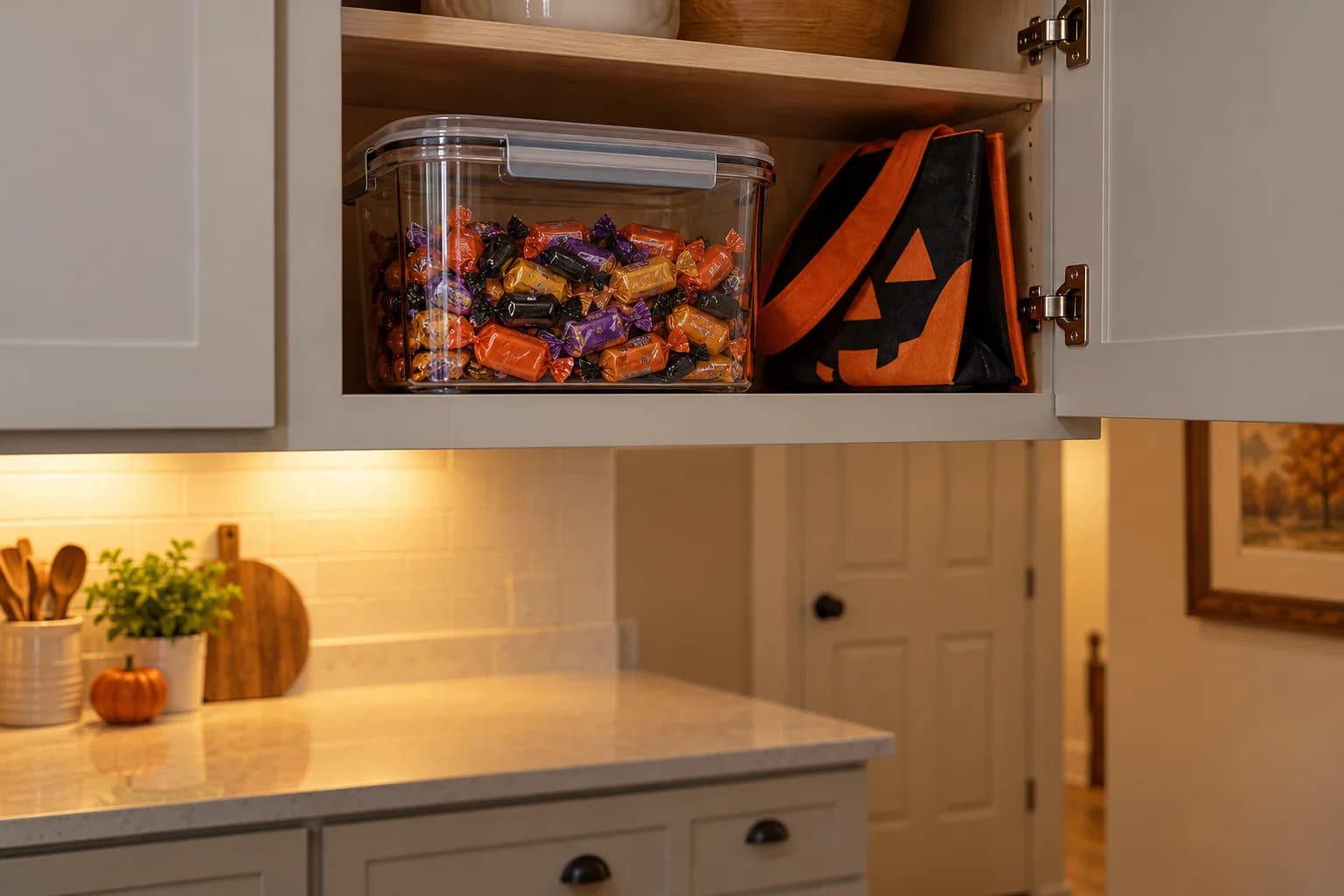
ASPCA identifies chocolate and xylitol-containing sweets as hazards, and AAHA also warns about wrappers. Keep the whole collection inaccessible, including bags in bedrooms and waste containers—not only the serving bowl.
The cupboard photograph is a storage illustration with its door open for visibility. Close and secure the real cupboard; a high shelf alone is not a guarantee, especially around climbing cats.
Skip costumes if the pet is uncomfortable. Any outfit must not impede movement, vision or breathing or have accessible small parts. Neither a costume nor a posed photograph is required for a happy shared evening.
Sources: ASPCA: Halloween safety tips · AAHA: Halloween safety for pets
Save roles and a closing check, not private details in a public link
Use My Pet Notes for the household roles, pet-space location, storage plan and stop condition. It remains local to this browser and does not send reminders or tell another caregiver what to do.
Check current identification beforehand using the microchip guide. If an exposure happens, use the separate poisoning-call guide and professional help rather than completing this evening checklist.
Finish by checking bags, floor, waste and decorations, securing the entrance and confirming every pet's location. Then record what to change next time. Keep phone numbers and private household access information out of public social posts.
- Door and pet-care roles do not conflict.
- Returning bags have an inaccessible storage destination.
- The plan can pause when supervision is insufficient.
- Cleanup and pet location are checked before normal access resumes.
FROM THE GUIDE · INTO THEIR EVERYDAY
Our visitor-evening pet plan
Separate the entrance, comfortable pet space and returning candy bags.
Draft my visitor planChoose their notebook, add your own details, then save. Free, no account. Notes stay in this browser.
THE NEXT QUESTIONS
What else might you be wondering?
Does my sociable dog have to greet visitors?
No. The plan may keep all pets away from the doorway. Familiar sociability does not guarantee comfort with costumes, repeated knocking or crowded entrances.
Sources: ASPCA: Halloween safety tips
Is the candy bowl the only storage problem?
No. Include returning bags, bedroom stashes, wrappers and waste. The household plan should cover where these go after the last visitor.
Sources: ASPCA: Halloween safety tips · AAHA: Halloween safety for pets
Should I wait for symptoms after suspected candy ingestion?
No. Contact a veterinarian or animal poison service promptly and keep the package and known facts for the call.
Sources: ASPCA: Halloween safety tips
LOOK CLOSER AT THE EVIDENCE
Sources & what they establish
Official guidance, research findings and PetCheck’s practical interpretations have different roles. These notes explain how the sources were used.
Animal welfare and poison-prevention guidance
ASPCA Halloween precautions
Supports inaccessible sweets, a comfortable separate space, identification and costume limitations.
Limit: The household role table is original planning synthesis, not a guarantee of safety or a toxic-dose calculation.
Sources: ASPCA: Halloween safety tips
Veterinary organization seasonal guidance
AAHA door, decoration and wrapper risks
Addresses repeated door opening, alternative greeting arrangements and accessible hazards.
Limit: No advertised product on the source page is adopted as a tested or necessary purchase.
Sources: AAHA: Halloween safety for pets
Sources checked 2026-10-26. Examples are fictional and illustrate reasoning, not patient outcomes. This is an editorial source review, not independent veterinary review. How we prepare these guides →
FOR ANOTHER VISIT
Keep this guide close.
Save it to read again, or copy a link to share.
ONE QUESTION CAN LEAD TO ANOTHER
A useful next read.
Choose the question that fits what you want to understand next.
 AI-generated editorial scene
How do I update my pet’s microchip contact details?
Check identification details before a busy visitor evening.
Read the guide AI-generated editorial scene
What information should I collect after a possible pet poisoning?
If exposure occurs, prioritize professional help and an exact information handoff.
Read the guide