FOOD SAFETY · PACKAGE CHECK
How do I check whether my pet food matches a recall?
Compare an official notice with the food actually in your home: exact product, size, UPC, lot and date. Learn what a match, a mismatch and a missing code mean.
THE DIRECT ANSWER
Open the complete official recall notice and compare every identifying condition it specifies with your actual package—not just the brand or a retailer photo. Record product and recipe, package size, UPC when provided, lot code and the relevant date. A missing or unreadable code is unresolved, not a ‘no match’. This guide explains a checking method; it does not certify any food as currently recalled or safe.
Sources: FDA: Save Your Pet Food Lot Number · FDA: Animal and Veterinary Recalls & Withdrawals
Use the notice behind the headline
A headline may identify a brand but omit affected sizes, batches, markets or an expansion issued later. For US products, begin with FDA’s animal-food recall listing, open the relevant announcement and check the manufacturer’s linked instructions. In another country, use the relevant regulator and manufacturer for that market.
Write down the notice URL and when you checked it. Read any updates, all product rows and the consumer action instructions. A search snippet, old screenshot or social post is a pointer to investigate, not the complete matching rule.
FDA explains that ‘terminated’ describes completion of recall efforts. It is not a statement that an affected old package has become suitable to feed. Follow the notice’s product-specific instructions rather than converting a status label into a safety clearance.
Compare the real package, field by field
Use two columns: what the notice says and what you can read on the package. Preserve letters, leading zeroes and any meaningful prefixes. If the notice covers several rows or ranges, check all of them. Some recalls cover all lots; a lot-specific assumption would be wrong in that case.
FDA distinguishes a product’s UPC from its batch identifier. Code locations vary, and a date may form part of a lot code. If a character is uncertain, keep a clear photograph and tell the manufacturer what is unclear instead of silently changing it.
| Field | Official notice | Your actual package |
|---|---|---|
| Product and recipe | Copy the full affected name and format | Copy the full name, not just the brand |
| Package size | Weight, can size or multipack details specified | Read the quantity on this package |
| UPC, if specified | Copy all digits | Do not substitute an order number or lot code |
| Lot or batch | Exact code, range, prefix or all-lots wording | Copy the complete code and flag uncertainty |
| Date | Best-by, production or another specified date | Keep the date label with the value |
| Other scope | Market, distribution or other conditions stated | Check those conditions too |
Sources: FDA: Save Your Pet Food Lot Number · FDA: How to Report a Pet Food Complaint
Three packages, three different conclusions
This is a completely invented notice and product. ‘Example Food A, dry recipe, 2 kg, product code EXAMPLE-UPC, lot TEST-A, best-by 2030-06-30’ is a teaching row, not a real recall or a valid barcode. Assume this fictional notice contains only that row and no broader conditions.
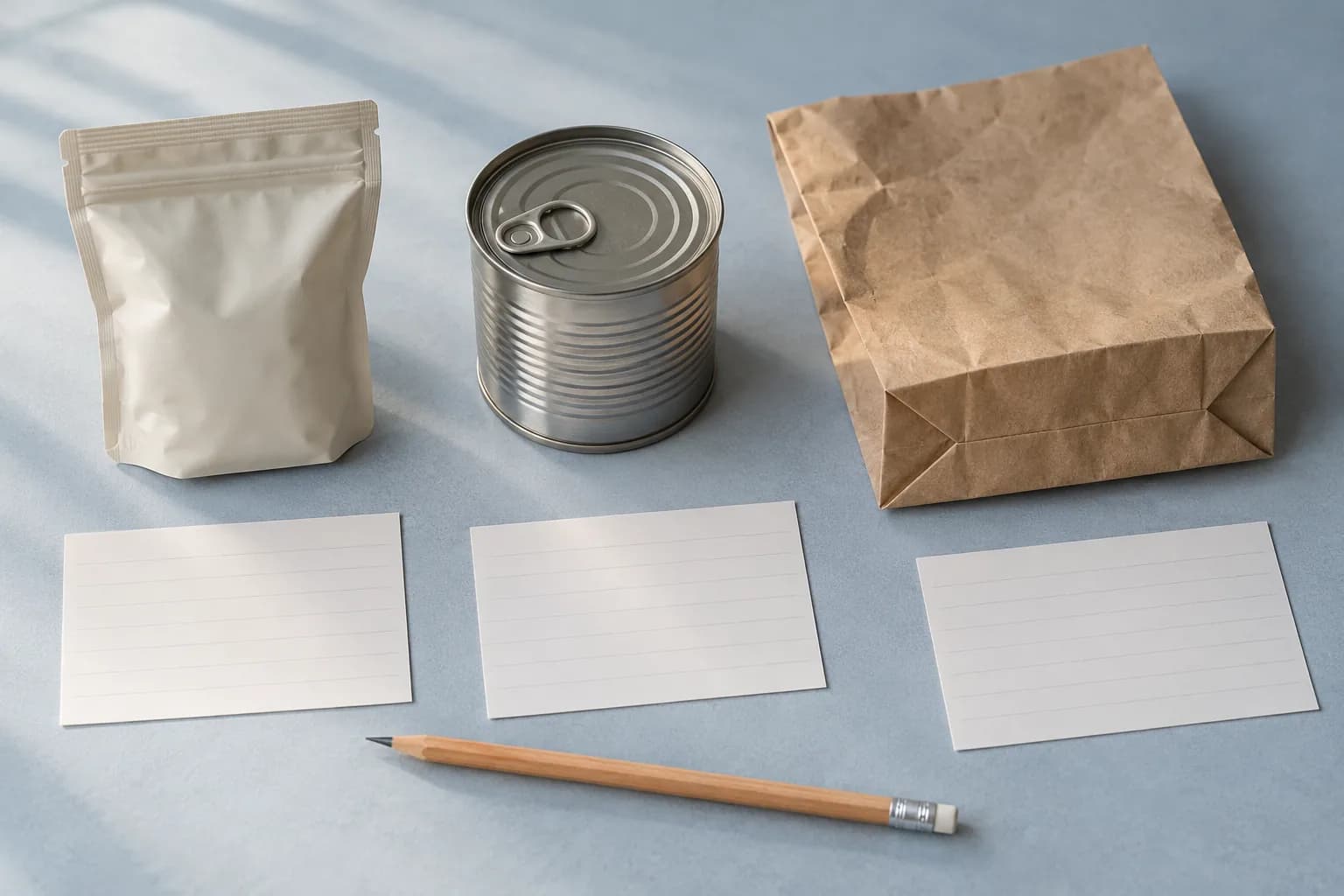
Package 1 matches every stated field. Package 2 has the same recipe and size but clearly reads TEST-B. Package 3 has a torn lot area. The third package must not be grouped with the second: one has a legible difference, while the other has missing evidence.
For a real notice, a mismatch with one row only means that row does not match. It does not rule out other rows, later expansions or another problem with the food. Keep the conclusion as narrow as the comparison you performed.
| Package | Comparison | Narrow conclusion |
|---|---|---|
| 1 | All fields equal the invented notice row | Matches that fictional row; follow its action instructions |
| 2 | Lot TEST-B differs from the sole specified lot TEST-A | Does not match that row; no broader safety verdict |
| 3 | Lot cannot be read | Unresolved; contact the manufacturer with package photos |
Check each package before treating a cupboard as one batch
Two bags bought together may carry different codes. A can and its outer case may also carry different useful identifiers. Make a separate record for each package you need to check. Do not assume a delivery date identifies the manufacturing batch.
If food from several bags has been mixed, tell the manufacturer which original lots could be present. The code from the newest bag cannot identify every piece of food left in the container. Keeping original packaging and batches traceable makes a later comparison much easier.
The photographs here are generated editorial scenes. They show packaging as a subject, not readable recall evidence. Use photographs of your own actual codes when asking the manufacturer to identify your food.
Let the notice determine the next action
When a package matches, follow the notice’s instructions about stopping use, keeping it away from animals, contacting the company, returning or disposing of it, and cleaning if specified. Do not invent one disposal or cleaning method for every recall. Keep identifying details and proof of purchase if the notice requests them.
If your pet is unwell or you suspect a food-related problem, contact your veterinarian; do not wait to finish a perfect worksheet. FDA encourages reporting food problems and asks for product identity, purchase and handling history, and relevant information about the animal. A report is information for investigation, not proof that the food caused the illness.
If a possible match is unresolved, keep the package separate while promptly seeking manufacturer guidance; ask the clinic about the pet’s feeding needs if a usual food cannot be used. This article does not select a replacement diet and contains no shopping recommendation.
- I opened the complete notice and checked for updates.
- I compared every stated condition for each package.
- Missing codes remain marked uncertain.
- I can find the notice’s consumer contact and action instructions.
Sources: FDA: How to Report a Pet Food Complaint · FDA: storing pet food and treats
THE NEXT QUESTIONS
What else might you be wondering?
Does a matching brand mean every product is affected?
Read the scope. A notice may be limited to particular products or batches, or may be broader. Neither ‘same brand’ nor ‘different lot’ is enough without the full conditions.
Does no result on the recall page prove the food is safe?
No. A search result is not a test of the food in your home. Damaged packaging, handling concerns or illness still deserve their own response.
Sources: FDA: storing pet food and treats
Can I use the barcode from an online product listing?
Use the package you actually have. A listing may describe another size or version, and a UPC does not identify a specific manufacturing batch.
Sources: FDA: Save Your Pet Food Lot Number
LOOK CLOSER AT THE EVIDENCE
Sources & what they establish
Official guidance, research findings and PetCheck’s practical interpretations have different roles. These notes explain how the sources were used.
Official identification guidance
FDA: codes and reporting fields
Supports distinguishing product identity, lot and dates, and retaining package evidence.
Limit: The generic guidance cannot resolve an unreadable code or establish causation in a particular animal.
Sources: FDA: Save Your Pet Food Lot Number · FDA: How to Report a Pet Food Complaint
Official notice directory
FDA: recall scope and status
Provides a US starting point for opening notices and understanding recall status.
Limit: This is not continuous monitoring. No live product-status verdict is made by this guide.
Editorial comparison exercise
Match, mismatch and missing evidence
The invented three-package example separates different conclusions.
Limit: All example identifiers are fictional and must not be used to check an actual food.
Sources checked 2026-10-19. Examples are fictional and illustrate reasoning, not patient outcomes. This is an editorial source review, not independent veterinary review. How we prepare these guides →
FOR ANOTHER VISIT
Keep this guide close.
Save it to read again, or copy a link to share.
ONE QUESTION CAN LEAD TO ANOTHER
A useful next read.
Choose the question that fits what you want to understand next.
 AI-generated editorial scene
Should dog food stay in its original bag?
Keep the packaging that identifies the food and batch you may need to check.
Read the guide AI-generated editorial scene
How should you store dry pet food?
Maintain a separate everyday storage routine without treating a recall search as a safety test.
Read the guide