01 / NOTICE THE CHANGE. KEEP THE QUESTION OPEN.
“It happened after”
is not the same as “it happened because.”
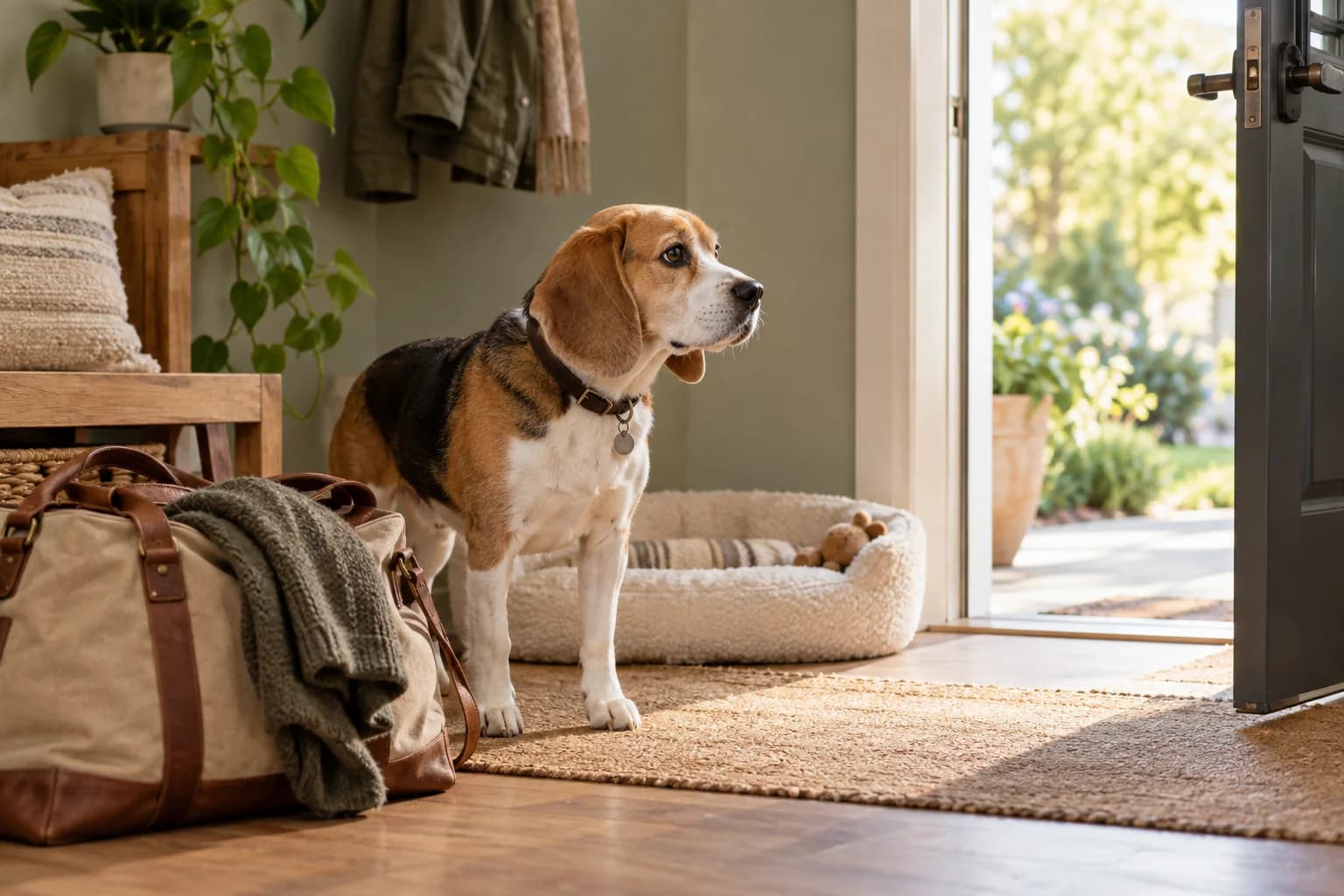
Imagine coming home after a weekend away. Your dog stayed somewhere different, ate a different meal, and now the stool looks looser. The food packet is right in front of you. It is an easy explanation to reach for: “It must be that.”
But the meal was not the only thing that changed. The routine changed too. And there may be relevant details you did not see. A sequence tells you what came first. By itself, it does not separate the possible explanations. That is a reasoning limit, not a reason to ignore the sequence.
A neat story can leave things out.
Switch the view. The facts stay the same; what we claim about them changes.
Illustrative sequence, not a patient history, diagnostic test or recommended observation period. Other causes are still possible.
The point is not to replace one confident guess with a longer list of frightening diseases. It is to keep a useful clue from becoming a conclusion too early. Food-related changes and stress are possibilities; infections and other disorders can also produce loose stool. A veterinarian may use the history, an examination and, when appropriate, tests to investigate. [1][6]
Bring the order of events.
Do not make the cause up for them.
“Sudden” is a description of how the change appeared to you. It is not a diagnosis or a reassuring severity category. When you first noticed it is worth recording, but a dog’s condition matters more than how tidy the story sounds.
02 / THE WHOLE HISTORY, NOT JUST THE NEW BAG
The useful question is wider
than “Did we switch foods?”
It is possible to give a perfectly accurate answer—“the usual food”—and still leave out an important part of the account. A new treat, something picked up outdoors, a recent stay away, or a medicine change is not necessarily captured by the name of the regular meal. Veterinary history-taking looks beyond that one label. [2]
PUT THE OBSERVATION IN CONTEXT
Put the change beside the observation.
Travel, a different meal and a changed routine belong on a timeline. None becomes a proven cause simply by appearing first.
Before
Describe the familiar food and routine.
What changed
Record the actual change and when it occurred. Keep the packaging if relevant.
What followed
Write down the observed stool and other signs without turning the sequence into a diagnosis.
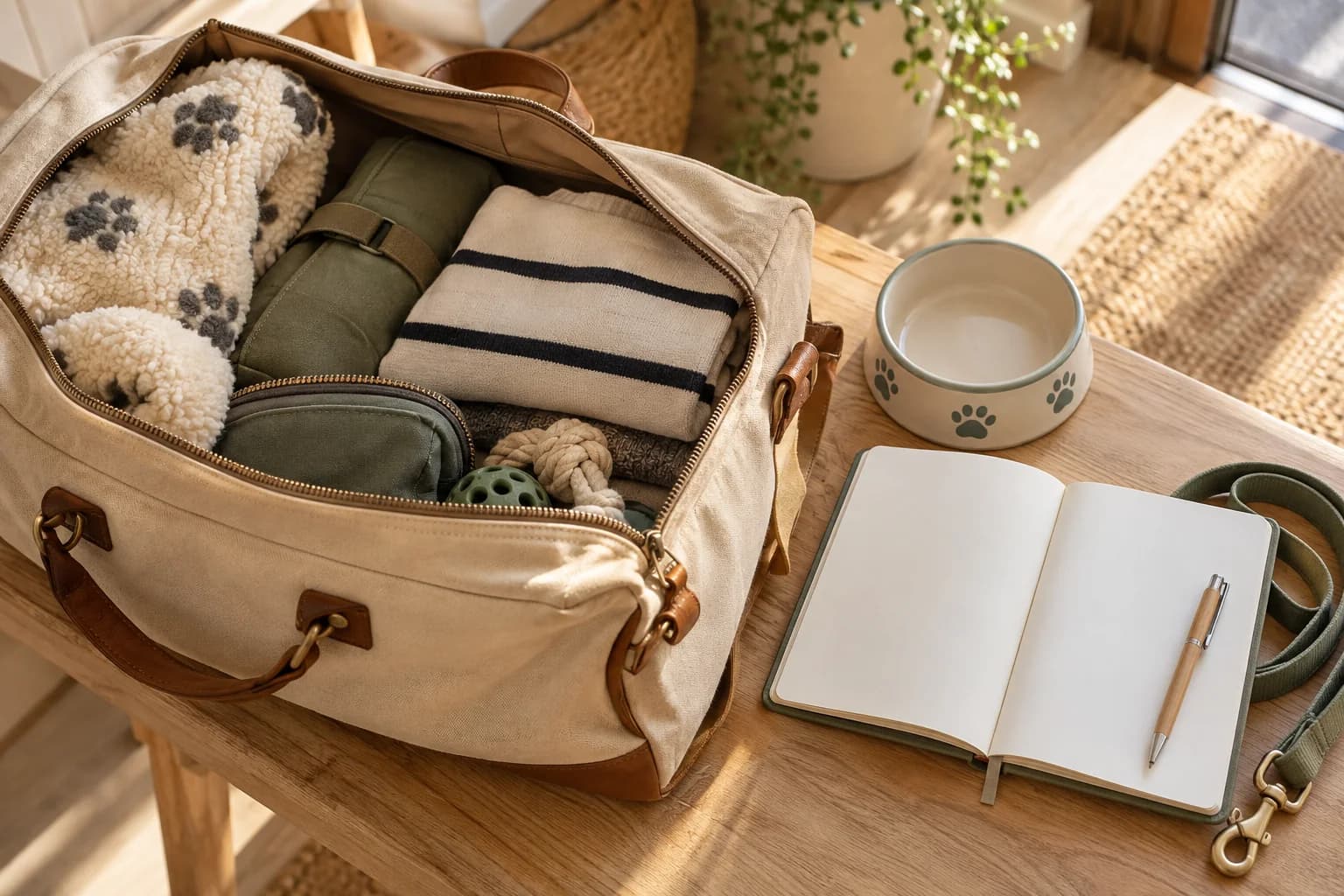
A fictional everyday scene illustrates record keeping; it does not demonstrate a cause.
This does not mean every detail in the account is responsible. It means they are different pieces of information. Write what you know happened and identify what you do not know. “May have eaten something on the walk” should not silently become “ate spoiled food.” “Started a medicine” should not become “the medicine caused it.”
Keep the package, not a verdict about the package.
When a food product is a concern, its exact identity can be more useful than the phrase “the new kibble.” The FDA explains that the lot number helps identify the particular product involved in a complaint. Keeping the packaging details or a clear picture of them can preserve that information. [5]
Product name · lot code · date label
Keep these separately for your veterinarian or a product report. Do not upload a food label to PetCheck’s stool-photo checker.
And do not turn record-keeping into an unsupervised experiment. Do not deliberately re-expose your dog to a suspected harmful item, stop prescribed treatment, or keep changing foods simply to see which story wins. Ask your veterinarian what should change and what should stay consistent.
03 / AN OUTCOME IS NOT A CAUSAL TEST
Getting better does not automatically
tell you what was wrong.
Now imagine that the next stool is firmer. You changed the food back, returned to the usual routine and time has passed. Which of those changes explains the difference? From this sequence alone, you cannot tell. More than one thing moved at once.
VCA notes that some acute diarrhea improves without the original cause ever being established. “It improved” and “we proved the cause” are different claims. Keeping that distinction prevents a useful observation from becoming an unsupported permanent food label. [1]
Three observations. Not one “better.”
The stool description improved. The whole account did not simply become “all clear.” The new appetite change needs veterinary advice.
This is not a waiting plan. Signs requiring care should not wait for a clearer photo or a completed comparison.
In the example, the firmer stool is real information. So is the refusal to eat. Do not erase one by averaging the story into “better.” Cornell’s advice includes reduced appetite and other accompanying signs as reasons to seek veterinary care. [3]
Why switching brands is not the same as a food-allergy test.
A diagnostic diet trial is a controlled veterinary investigation. The University of Illinois explains why the selected diet and other exposures—including treats and flavored products—need to be managed carefully. Simply swapping one bag for another does not reproduce those conditions. [4]
This guide deliberately does not give a diet-trial schedule or tell you to challenge a suspected food. Those decisions belong with the veterinarian looking after the dog. A one-off stool change does not establish food allergy.
Uncertainty here is not failure. “The stool changed after several recent events; the cause is not established” may be a more useful starting point than a confident explanation that hides those events. The goal is a clearer account, not certainty on demand.
04 / MAKE THE NEXT CONVERSATION EASIER
A useful account can be short
without jumping to conclusions.
Start with the change you actually saw. Then put the surrounding events beside it, rather than inside an explanation. Keep “what changed in the dog” separate from “what changed in the routine.” Appetite, activity and vomiting are part of the clinical history, not footnotes to the photograph. [2]
A short account that keeps the question open.
“The new food upset him. He is better now.”
- First noticed
- Loose stool the morning after returning home.
- Recent changes
- Different food and a stay away from home.
- Since then
- The later stool looked more formed.
- The whole dog
- Now refusing food; contacting the veterinarian.
- Still unknown
- Whether either recent change explains the signs.
The example shows how to report a concern—not how to manage this dog at home. It has not been produced by PetCheck’s analyzer.
Four prompts for your own note—not another form to finish.
What looked different? Describe the change without assigning a diagnosis.
What else changed around that time? Include known food, routine or treatment changes; mark uncertain details as uncertain.
What is happening to the dog now? Report new or ongoing concerns, even if one stool looks more typical.
What is the next real action? Contact the veterinarian when needed. Neither this note nor a photo check is a prerequisite for care.
A stool photo is a starting point.
Recent changes belong beside it.
Describe the photo.
Keep the explanation open.
With PetCheck, review visible features in your photo and add context. It does not prove that a food or recent event caused a change. This article’s examples are not carried into your record.
Start with your own stool photo Educational workflow illustration. No photo selected. No check has run. This page does not save or send a clinical note.SOURCES, SCOPE & LIMITS
The sources support the explanation.
They do not certify the product.
These are named clinical-education and product-identification references. The fictional weekend, comparison lanes and handoff are original teaching examples—not validated clinical tools. Links checked September 7, 2026; no independent veterinarian review of this article is claimed.
- 01VCA Animal HospitalsDiarrhea in Dogs ↗
Diet, stress, infections and other possible causes; history and examination; improvement can occur without a confirmed cause.
- 02VCA Animal HospitalsDiarrhea Questionnaire and Checklist for Dogs ↗
Questions about timing, foods, medication, the dog’s condition and information the owner does not know. Our examples are not the questionnaire.
- 03Cornell University College of Veterinary MedicineDiarrhea ↗
Concerning accompanying signs, veterinary advice and the limits of owner-directed medication. Not a validation of this guide or an app.
- 04University of Illinois College of Veterinary MedicineCooking Up a Food Allergy: Conducting a Diagnostic Food Trial ↗
A diagnostic food trial is a structured veterinary investigation, not simply changing brands. This guide does not prescribe a trial.
- 05U.S. Food and Drug AdministrationSave Your Pet Food Lot Number! ↗
Keeping package and lot information can help identify a product involved in a complaint. It does not establish that food caused an illness.
- 06MSD Veterinary ManualDisorders of the Stomach and Intestines in Dogs ↗
Different gastrointestinal disorders can share outward signs; clinical context and veterinary investigation matter.
This guide is not a diagnosis, treatment plan, food-allergy test or recommendation to delay care. It cannot establish what happened during an unobserved interval or what caused a change.
FOR ANOTHER VISIT
Keep this guide close.
Save it to read again, or copy a link to share.
ONE QUESTION CAN LEAD TO ANOTHER
A useful next read.
Choose the question that fits what you want to understand next.
 AI-generated editorial scene
Can changing dog food cause diarrhea?
If food changed too, explore that question without treating timing as proof of a cause.
Read the guide AI-generated editorial scene
Loose or watery stool
Describe texture, amount and frequency when one changed stool becomes a pattern question.
Read the guide