DOG OBSERVATION · EXPLAINED
Greasy-looking dog poop: what does the shine tell you?
Separate a visible sheen from a diagnosis. Learn why repeated changes, appetite and weight tell a more useful story than a close-up alone.
AI-assisted educational writing. Not independently veterinarian-reviewed. Editorial method
THE DIRECT ANSWER
The direct answer
A shiny surface does not tell you how much fat is in the stool or whether nutrients are being absorbed normally. Start with the visible description and whether it recurs. Persistent changes with weight loss or altered appetite deserve veterinary assessment; a photo cannot diagnose a digestion problem.
Sources: [1] Merck Veterinary Manual
All sections, questions & sources
Dotted terms open a short explanation. Stay on the page as you read.
01 · UNDERSTAND THE QUESTION
“Greasy” is an impression. Describe what produced it.
Did the surface reflect light, show a separate coating or leave a visible mark during ordinary cleanup? Those descriptions preserve the observation. “Greasy” jumps ahead to what the material might be. You do not need to touch, smear or test it to make a better record.
PUT THE OBSERVATION IN CONTEXT
A reflection is not an ingredient.
Light changes what a surface looks like. Keep that visual impression separate from food history and other changes.
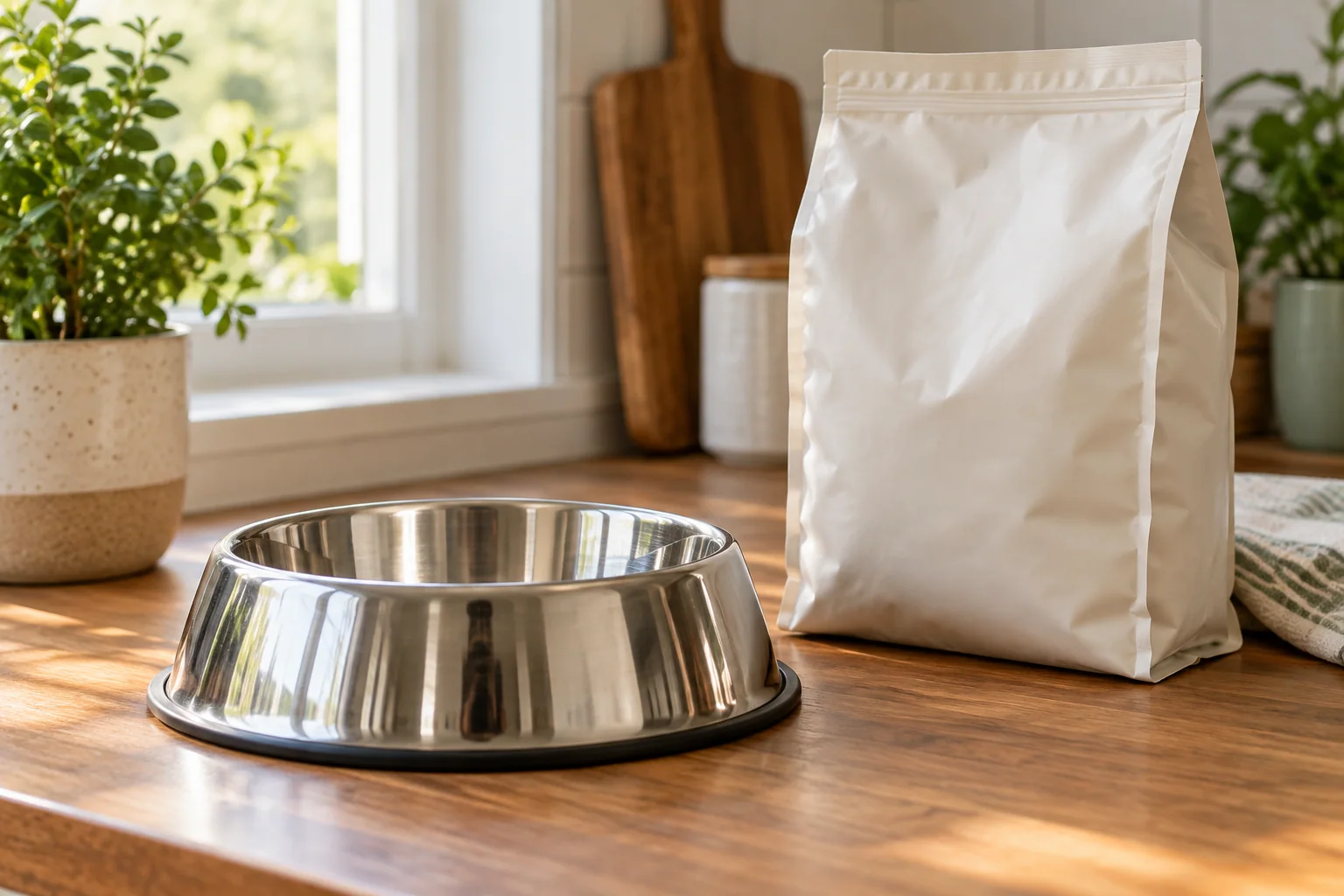
The viewing conditions
Note the light and whether the description came from a photo or direct observation.
A repeated appearance
Keep separate events separate rather than counting several photos of the same event.
The longer pattern
Bring relevant food and weight history to the conversation without naming a cause.
The bowl illustrates ordinary reflection only. It is not a stool model or a test for fat.
Lighting is part of the image. A bright reflection can be prominent in one camera angle and less obvious in another. Keep a wider original photo if available, and state whether you saw the appearance directly or noticed it only on the screen.
A photograph cannot chemically identify a coating. Calling it fat, oil or IN PLAIN ENGLISHMucusA slippery secretion made by the bowel lining. Mucus-producing cells help protect and lubricate that surface.Describe a coating you noticed separately from the stool underneath it.MSD Veterinary Manual Source checked from the picture alone is more certain than the evidence allows. If a film or coating is the main feature, use those words and describe whether the stool beneath it was formed or loose.
02 · UNDERSTAND THE QUESTION
Digestion and absorption are different jobs
Digestion breaks food down; IN PLAIN ENGLISHAbsorptionThe transfer of nutrients and fluid from the digestive tract into the body.An empty food bowl shows intake; it does not measure how much was absorbed.Merck Veterinary Manual Source checked takes nutrients into the body. Merck describes disorders affecting pancreatic digestion or intestinal absorption that can produce overlapping patterns such as diarrhea, appetite changes and weight loss. A visible sheen does not locate a problem in either process.
IN PLAIN ENGLISHExocrine pancreatic insufficiency (EPI)A condition in which the pancreas supplies too few digestive enzymes for food to be digested properly.Veterinary assessment and testing are needed. Pale or shiny-looking stool alone does not establish EPI.Merck Veterinary Manual Source checked , or EPI, means too few pancreatic IN PLAIN ENGLISHDigestive enzymesSubstances that help break food into smaller components that can be absorbed. The pancreas supplies important digestive enzymes.Understanding their role does not establish that a pet needs an enzyme supplement.Merck Veterinary Manual Source checked are available. Merck describes a pattern that can include weight loss despite eating well and bulky, loose stools; veterinary testing is used to assess it. EPI is an example of why the whole history matters, not a diagnosis attached to a shiny photograph.
This distinction also explains why “add enzymes” is not a conclusion to draw at home. The useful question for the clinic is whether the overall history suggests a problem that needs investigation, and which assessment addresses it.
Sources: [1] Merck Veterinary Manual[3] Merck Veterinary Manual
Separate the surface from the wider pattern
Use the right-hand column to improve the history you give, rather than assign a diagnosis.
| Observation | What remains uncertain | What to bring into the account |
|---|---|---|
| Shine in one photo | Lighting versus the material itself | Whether it was visible in person; the original image. |
| A visible coating | What the coating consists of | Coating, underlying form and when it was seen. |
| Similar appearance on several occasions | Whether the circumstances were comparable | Dates, fresh versus old stool and recent changes. |
| A change in stools and weight or appetite | The cause and significance of the combined pattern | Actual records and a request for veterinary assessment. |
Sources: [1] Merck Veterinary Manual
03 · UNDERSTAND THE QUESTION
Look for a pattern you can document honestly
Write down when the appearance was first noticed and whether later passages looked similar under comparable conditions. Avoid turning one uncertain observation into “always.” If different people saw different stools, keep their descriptions attached to the time.
Bring actual weight records if you have them, including the date and scale used. “Last clinic weight was…” is clearer than estimating a percentage from photographs. Changes in how a harness fits can be worth mentioning, but they are not a measured weight change.
Record what was offered and what was eaten, including extras, oils or supplements already in use. A dog offered a full bowl did not necessarily finish it. That distinction makes the appetite history easier to interpret without prescribing a new feeding plan.
04 · UNDERSTAND THE QUESTION
Ask what the assessment is trying to answer
A productive appointment starts with the change, its duration and how the dog is doing. You can ask: “Does this pattern need a digestion or absorption assessment?” The clinician can explain which examination or tests fit the history.
Keep previous results and medication names available, and ask whether a fresh sample is wanted before collecting one. The clinic’s collection instructions matter more than a generic internet container or storage rule.
Write the agreed next step in plain language: what to keep track of, whether a follow-up is planned and what should bring the call forward. A saved checklist can help prepare that conversation; it does not monitor the dog or replace it.
MAKE THE CONVERSATION EASIER
Prepare the pattern, not a label
Keep these details in your own note; the checklist below saves preparation progress only.
- Visible feature
- Shine, coating or a cleanup observation; direct view versus photo.
- Recurrence
- Dates and which passages somebody actually saw.
- Appetite and weight
- Food eaten and dated measurements, with uncertainty left intact.
- Food and products
- Current food, extras, medicines and supplements already being given.
TAKE SOMETHING USEFUL WITH YOU
Prepare the wider picture
Tick the preparation steps you have done. Save this guide to keep the checklist for your next visit.
0 of 3 preparation steps checked · Not a health or safety score
Saved only on this browser. No account or reminder is created. Clearing browser data removes the saved list.
THE NEXT QUESTIONS
What else might you be wondering?
Can a photo confirm fat in the stool?
No. A photo records visible appearance, not stool composition or nutrient uptake. Describe the feature and the pattern; your veterinarian can decide whether the history warrants testing. A confident visual label adds no laboratory evidence.
Sources: [1] Merck Veterinary Manual
Does greasy-looking stool mean EPI?
The appearance alone cannot establish EPI. The pancreatic reference explains a disorder assessed through the broader history and testing. Tell the clinic about recurrence and any appetite or weight change instead of starting with a presumed pancreatic diagnosis.
Sources: [3] Merck Veterinary Manual
Should I buy digestive enzymes now?
A sheen is not a basis for selecting a treatment. Ask the veterinarian about the cause of the overall pattern and whether a product is appropriate. Include anything already being used so that the feeding and medication history is complete.
What if it is really a mucus coating?
You do not need to settle the material’s identity before asking for advice. Say where the coating appeared, whether the stool underneath held its shape and whether it was present on more than one passage. The mucus guide can help with the wording, but it cannot identify the coating from a photo either.
FOLLOW THE EVIDENCE
Sources & what they establish
These are veterinary references and public-health guidance. PetCheck’s comparisons, note prompts and fictional examples explain how to organize observations; they are not clinical studies or tested diagnostic tools.
Merck Veterinary Manual
Malabsorption Syndromes in Small Animals ↗
Digestion, nutrient uptake and the significance of weight and appetite changes.
Limit: Clinical patterns overlap and require assessment; appearance cannot measure nutrient absorption.
Cornell University Hospital for Animals
Emergency and Critical Care ↗
Emergency signs including collapse, severe pain and difficulty urinating.
Limit: Examples of urgent signs, not an individual triage assessment.
Merck Veterinary Manual
Pancreatitis and Other Disorders of the Pancreas in Dogs ↗
Pancreatic digestion, exocrine pancreatic insufficiency and the role of veterinary testing.
Limit: A shiny stool or recognizable piece does not establish a pancreatic disorder.
Source review: . Independent veterinary review has not been completed.
FOR ANOTHER VISIT
Keep this guide close.
Save it to read again, or copy a link to share.
ONE QUESTION CAN LEAD TO ANOTHER
A useful next read.
Choose the question that fits what you want to understand next.
 AI-generated editorial scene
Yellow stool
When color is also part of your question, describe it separately from a shiny-looking surface.
Read the guide AI-generated editorial scene
Food-like pieces in dog poop: what can you tell?
Compare how to record visible pieces while keeping digestive explanations unconfirmed.
Read the guideHave a photo to organize?
Use the photo flow to describe visible features. Bring the timing, behavior and other observations into the conversation too. Veterinary care comes first when your pet needs help.
Choose a photo →